The photographs displayed on this page were meticulously identified to correspond to the exact date and the name of the source the time they were captured. However, errors may occasionally occur. If you notice any discrepancies or inaccuracies in the dates or other details, please let us know by sending an email here.
Your feedback is invaluable to me, and we will acknowledge your contribution by citing you as a contributor.
- 0entries indexed on -
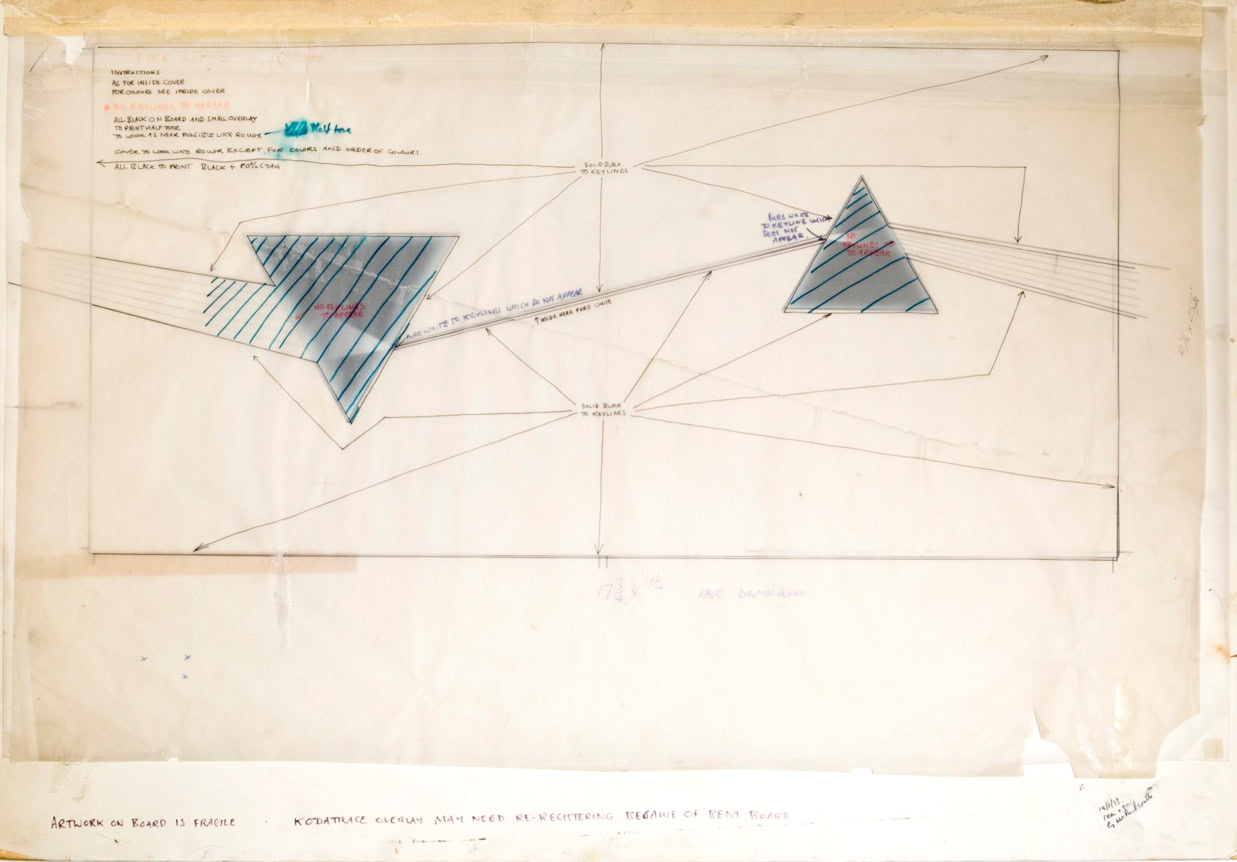
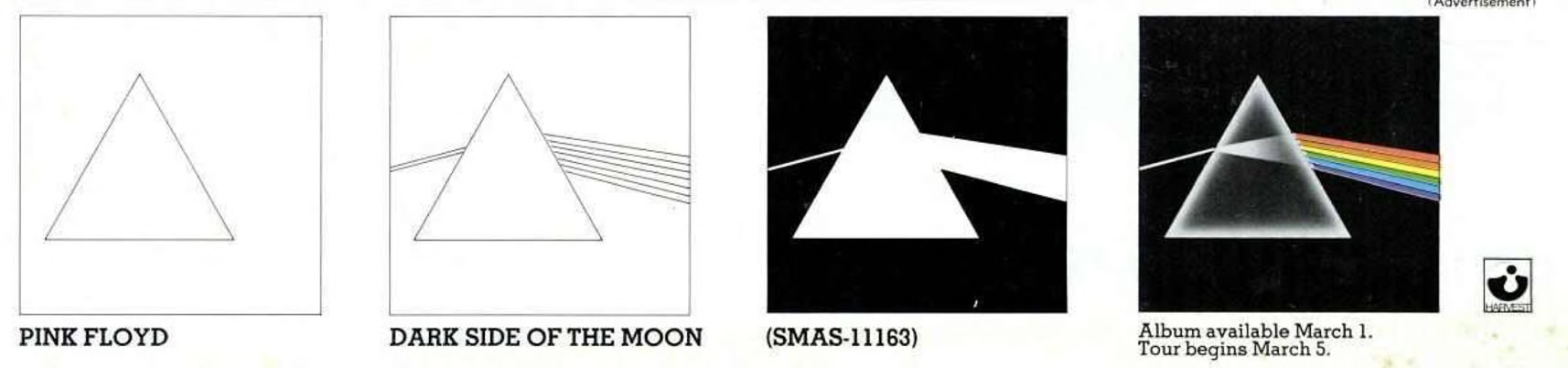
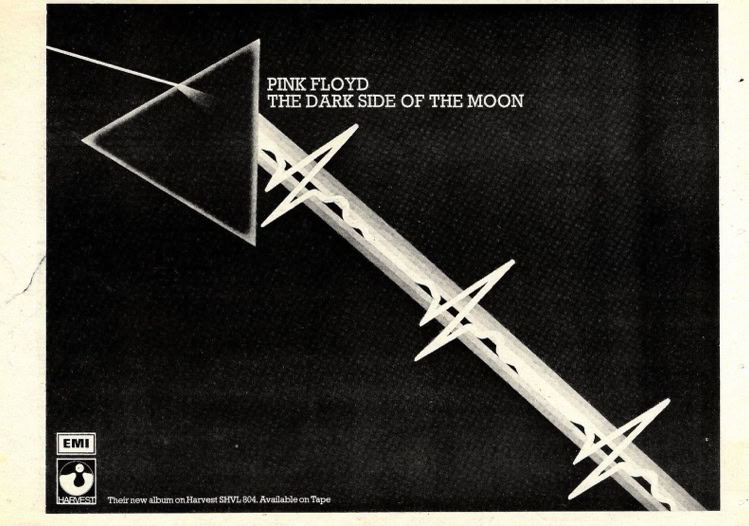
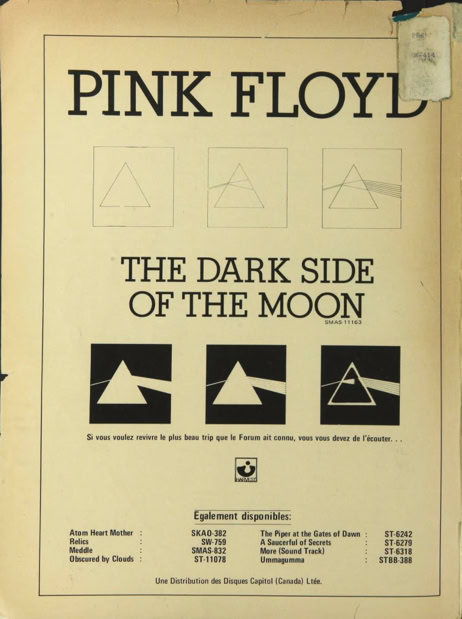
« Dark Side of the Moon » cover; original sketch
Interviewer: «At what point were you introduced to the Dark Side material? Did you go to the shows where they played it or did you hear some of the demos ? »
Storm Thorgeson: «I heard a bit in the studio. I don’t have much to say about music. Usually I like it, and I just absorb it. I don’t have much to say, and they ain’t let me say anything anyway. They say “For God’s sake, Storm, do not harm our song. Do not murder our tune.” So I never say anything, really, about the music. I just let it go over, really, I suppose. It’s my job to reinterpret it, really. So it doesn’t really matter what I think, it matters what comes out the other end. And with Dark Side it was very much about the madness of the lyrics and about something that Rick said to me. He said “Could we not have one of your funny pictures, Storm?” and I said “What do you mean? That’s what I do. Pictures. How about a change?” I said “But I don’t do graphics.” He said “Well, why is it a challenge?” »
Interviewer: « Did the idea of the prism in some way relate to what you were hearing on the record directly? »
Storm Thorgeson:« No, it related mostly to a light show. They hadn’t really celebrated their light show. That was one thing. The other thing was the triangle. I think the triangle, which is a symbol of thought and ambition, was very much a subject of Roger’s lyrics. So the triangle was a very a useful – as we know, obviously – was a very useful icon to deploy and making it into the prism – you know, the prism belonged to the Floyd. »
Interviewer: «According to legend, was there one version of the cover that had the Silver Surfer, the Marvel Comics character? »
Storm Thorgeson: « Yeah, a photographic version, but they turned it down.»
Interviewer: «What do you mean a photographic version ? You actually painted someone silver and put them on a surfboard ? »
Storm Thorgeson: «Probably. I don’t know, I never got to do it, did I? I did a drawing. Unfortunately we lost them, otherwise they’d be straight to your inbox. We can’t find them. »
Interviewer: «Marvel Comics might have stopped you from doing that anyway, right? »
Storm Thorgeson: «Well, I think because it was photographic, they couldn’t really do much.
I mean. think about it, it wouldn’t be the Silver Surfer, it would be a man on a surfboard. I was more interested in the wave, actually. I was interested in a tiered wave, because I thought it was a very good representation of the Floyd and the fans. I don’t think you can copyright a wave. Or can you? »
Interviewer: «Well, no, not a wave. He surfed in space, anyway. »
Storm Thorgeson:«Exactly. So I think that I probably would have gotten away with it, but they didn’t like it anyway, so it was thrown out. »
«Storm Thorgerson: How I Designed the Cover of 'Dark Side of the Moon'», Rolling Stones, 28 September 2011
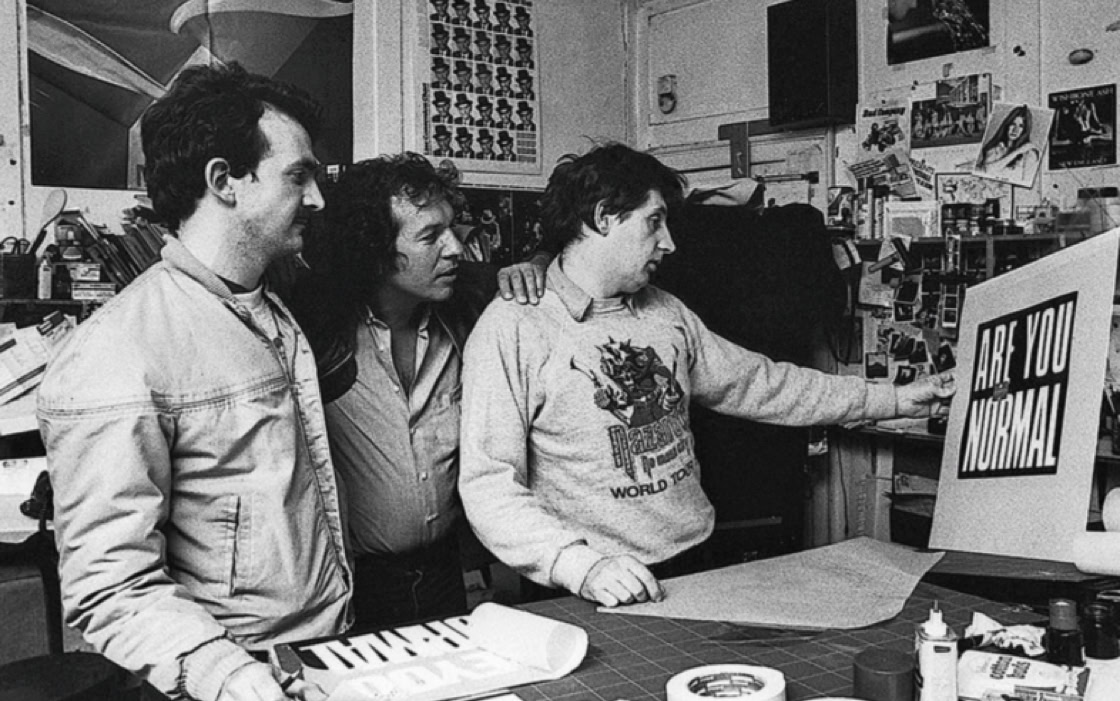
The Hipgnosis team: Chris Christorffeson, Aubrey Powell and Storm Thorgerson photographed on 1980.
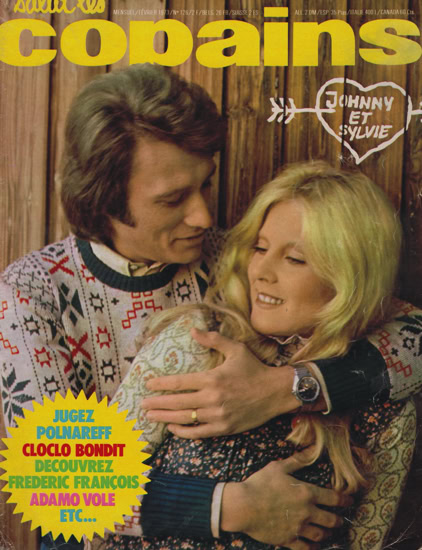
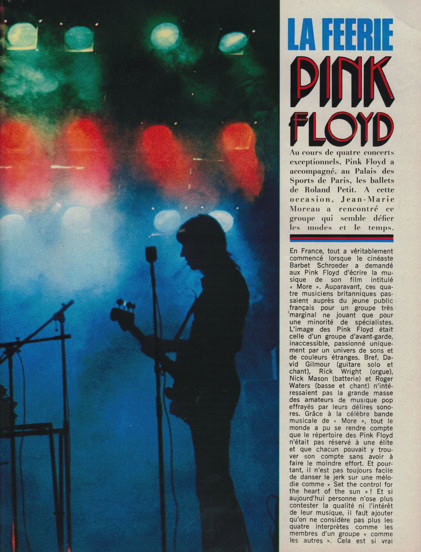
PRESS MENTION| January 1973 The famous French music magazine «Salut les copains» dedicates a long article on the Parisian’s shows.
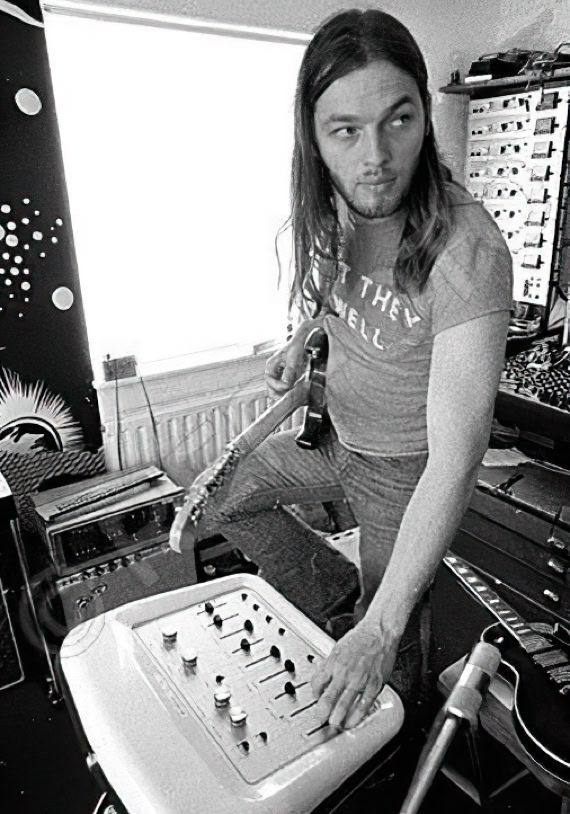
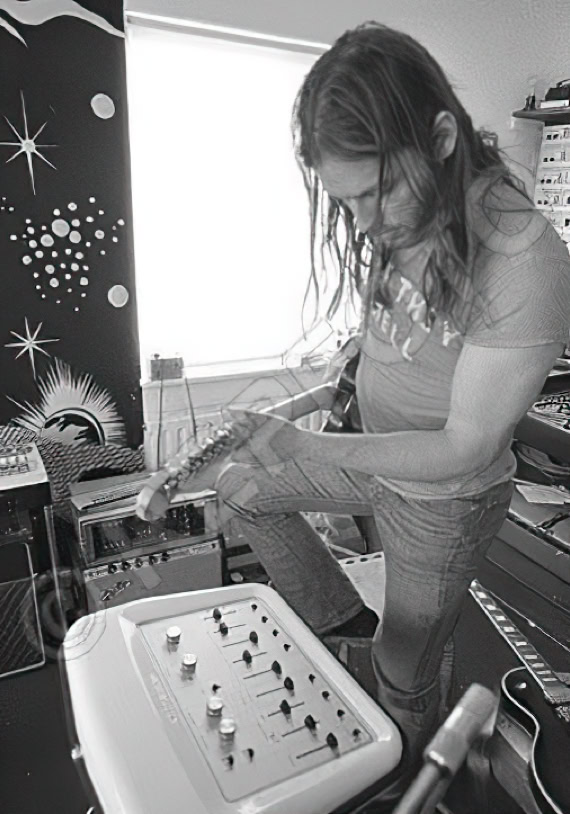
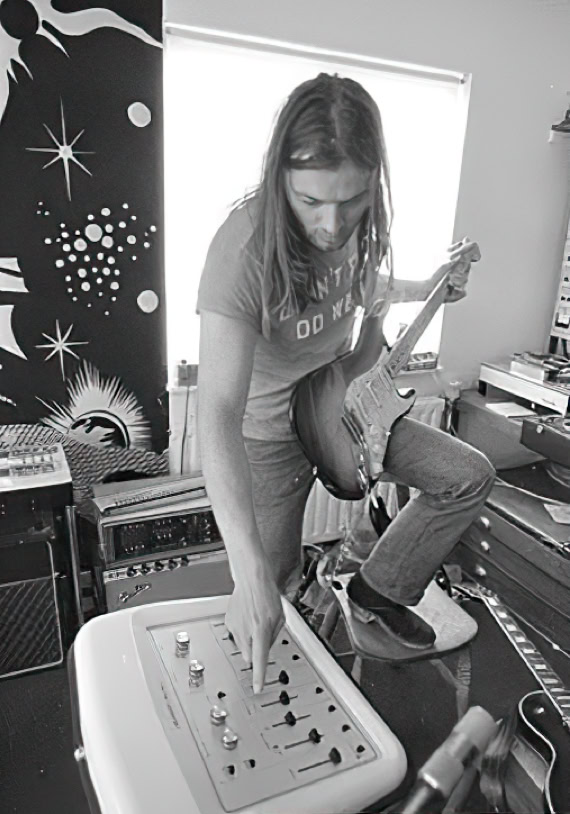
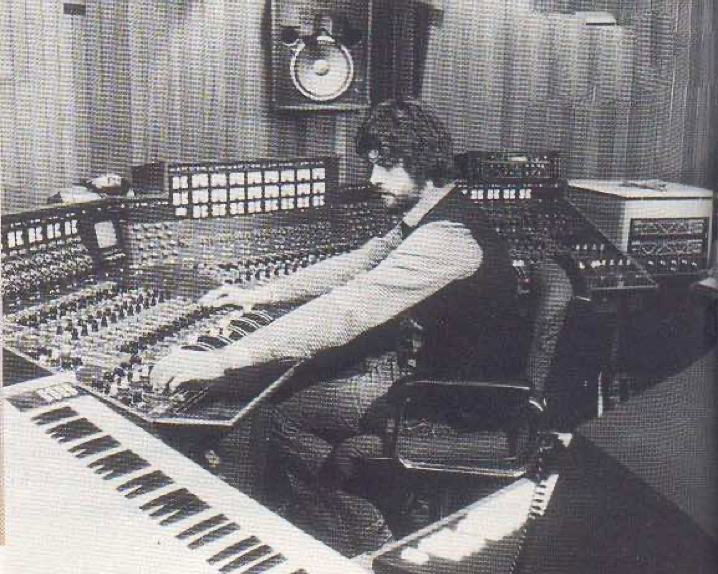
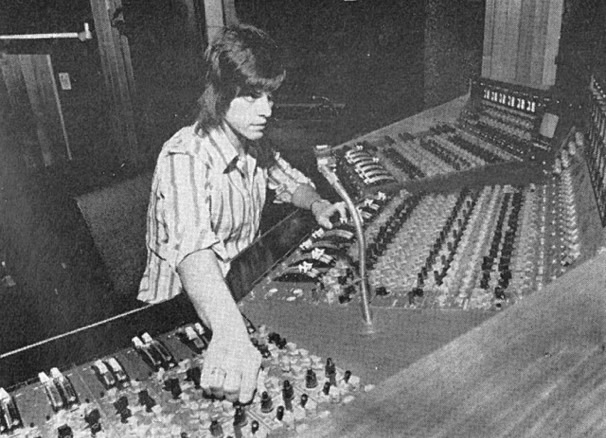
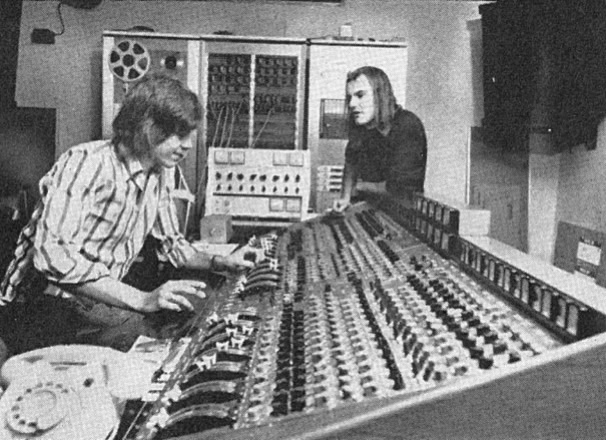
MISCELLANOUS| Early January 1973 David Gilmour finished to build his home studio in his country home.
David photographied in his home studio by Robert ELLIS. March 1973.
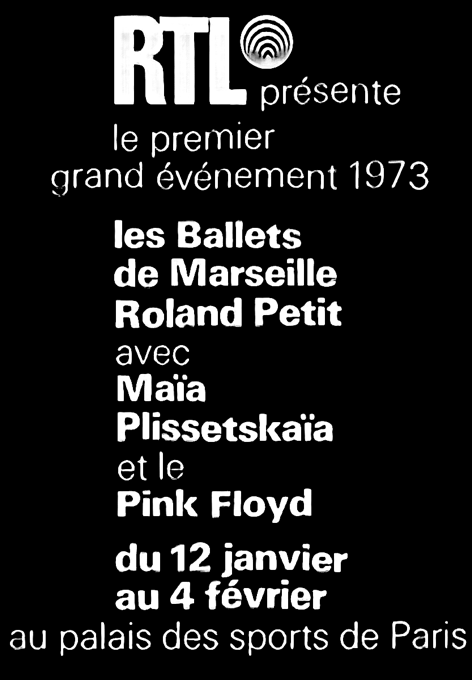
RECORDING SESSIONS| 8 january 1973, the band mix the re-recording a new version of Careful with that Axe, Eugène for the playback of the ballet’s shows.
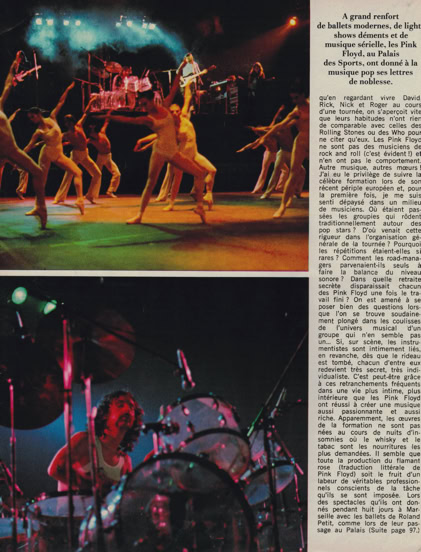
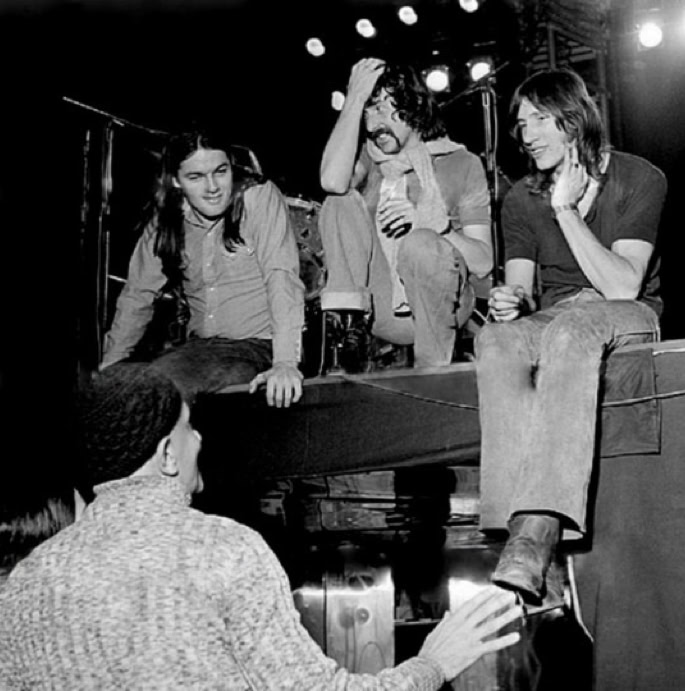
MISCELLANOUS| From 11 and 12 January 1974 rehearsals for the Ballet at Paris
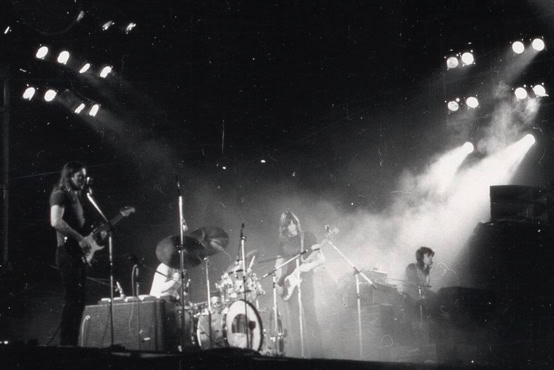
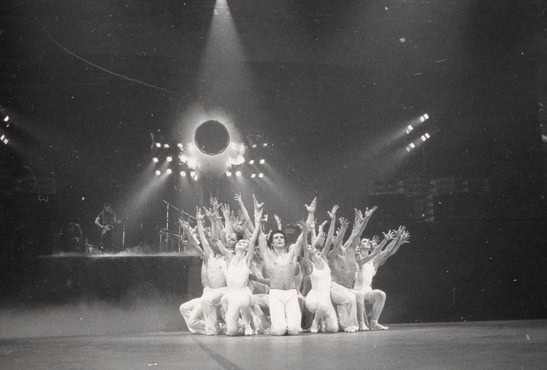
Pictures of the rehearsals by Marc ENGUERAND
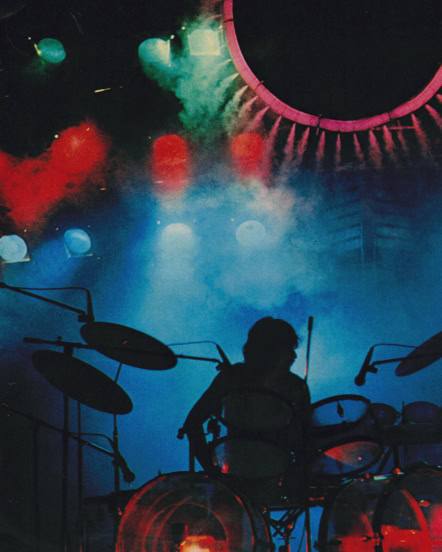
CONCERT DATE| 13 January 1973 «Ballet Pink Floyd», Palais des Sports de la Porte de Versailles, Paris, France
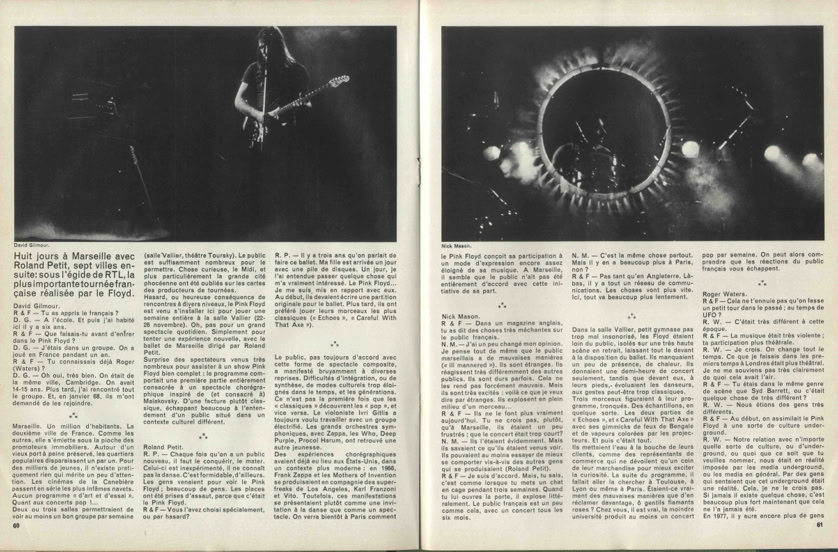
«Paris accueillait le Pink Floyd dans l'énorme vase renversé de l'Ile des Vannes. Paris « où tout se passe ». Enfin, c'est ce qu'on en dit quand on n'y habite pas. Les concerts y sont plus abondants qu’ailleurs, on s’y perd plus facilement. Ici, on peut être seul. En province, jamais ; il y a toujours cent paires d'yeux, des oreilles, et des langues pour essayer de maintenir les gens dans la «tradition ».
A Paris, on se perd plus facilement dans l'immensité, et la diversité. Chose facile pendant les deux concerts de Saint-Ouen (1er et 2 décembre). Il y avait 5 000 personnes à chaque fois, réservant au groupe un triomphe largement disproportionné avec ce qu’il présentait sur scène. Une première partie très longue — près d’une heure — était entièrement consacrée à sa nouvelle composition, « Dark Side Of The Moon ». Un poème symphonique à la structure délicate, et pourtant infiniment plus terne à terre que l'ensemble habituel des œuvres du groupe. Celui-ci veut, dans sa démarche actuelle, prendre une certaine distance avec l'image « science fiction » que les années passées en compagnie de Syd Barrett avaient contribué à former.
Atmosphère : ça y est, le mot est lâché. Tout l’art du Pink Floyd semble consister à créer une ambiance, un climat propice à certains songes intérieurs. A condition, bien sûr, de s'y laisser prendre, d'oublier les effets, la mécanique de haute précision qui règle la moindre note, le professionnalisme sans réserves sur lequel repose tout l’ensemble. C'est peut-être beaucoup demander, et le sentiment doit avoir du mal à se détacher de la technique.
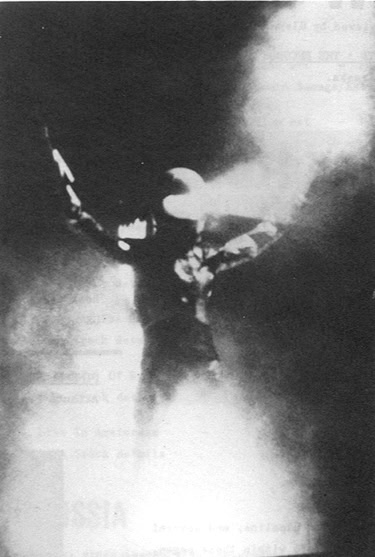
Ces qualités et ces défauts coexistent plus que jamais dans le nouveau grand morceau, « Dark Side Of The Moon ». La musique a évolué vers une sophistication qui ne la rend pas immédiatement perceptible à première écoute. Le Pink Floyd suit en cela une voie parallèle à celle de son éminent confrère, le Soft Machine : épuration des formes, recherche esthétisante, volonté marquée d’éviter toute violence, non sans la suggérer par de fréquentes allusions dans les changements de tempos ou la mise en scène. C’est ici que le Floyd affirme une ambition nouvelle : théâtralisation, multiplications des supports visuels, trucages viennent renforcer les idées exprimées à travers la musique, accentuant chacun de ses moments par un gimmick approprié (explosion de feux colorés, jaillissements de fumées, gong qui s'enflamme dans l'obscurité).
La question peut se poser de savoir si le groupe n’est pas plus ou moins conscient de son peu d'impact visuel (les musiciens bougent rarement), et cherche à pallier ces insuffisances par un délire technico-baroque. Ce peut être aussi une étape vers le light show en trois dimensions. Il fut un temps où le Floyd innovait en matière de spectacle, avec les stroboscopes, les couleurs-cris. Cela, c'était le monde de Barrett. Un univers difficile à supporter (et lui-même ne tint pas longtemps à ce régime). Mais avec l'arrivée d'Alice Cooper, et des groupes à caractère visuel très accentué, la nécessité de produire un show complet s’imposait d’elle-même. Le développement des media, la fascination exercée quotidiennement sur la rétine par des milliers d’images/informations, oblige les gens concernés par le spectacle, ou directement impliqués dans celui-ci, à s'adapter à de nouvelles formes d’expression. Cela entraîne, pour le Pink Floyd, une certaine obligation de travailler très professionnellement. Au détriment de l’invention, de la spontanéité. Reste la rigueur d'un travail bien fait. Éléments importants dans la mise en scène, les différents appareils purement techniques ajoutent leur fascination à l'ensemble. Ils font partie d’un décor aujourd’hui familier, celui des amplis, ces piles de boîtes sombres d’où s’échappent les vagues de notes. Chez le Pink Floyd, ce matériel est imposant. Il a un rôle à tenir, indépendamment de sa fonction technique de reproduction. Multiplicateur de puissance, il éloigne encore plus le groupe de son public. Isolés sur un piédestal, à plusieurs mètres au-dessus du sol, ils semblent rechercher l'adulation, s'enfermer davantage dans leur légende, héros intouchables assumant un rôle pour le moins discutable. Le Pink Floyd semble plus prêt à revendiquer un statut de super star qu’à chercher le contact direct avec son public, comme pouvait le faire le MC5, qui attire littéralement les gens vers lui. Pink Floyd, c’est l’anti-Living Theatre. Ils produisent un spectacle brillant, flattant l'imagination des intellectuels, mais réfrénant les mouvements d'enthousiasme, la spontanéité. Et pourtant, ils tiennent leur auditoire. Dans un thème comme « Careful With That Axe », ils mettent l'accent sur le paroxysme, en cris, en lumières. Ce moment — qui devrait durer tout au long du morceau — est amené progressivement, selon un code bien défini, déterminé à produire l'émotion au moment voulu.
Après la seconde partie, il y eut trois rappels. Chaque fois, les musiciens sont revenus sur la scène, reprendre tranquillement leur place et leur instrument. Comme si pareille éventualité avait été préparée de longue date. Et le public était ravi. There's no business like show business …»
«La vie en rose», Rock&Folk, January 1973.
Pink Floyd with the dancer and Petit’s wife Zizi Jeanmaire
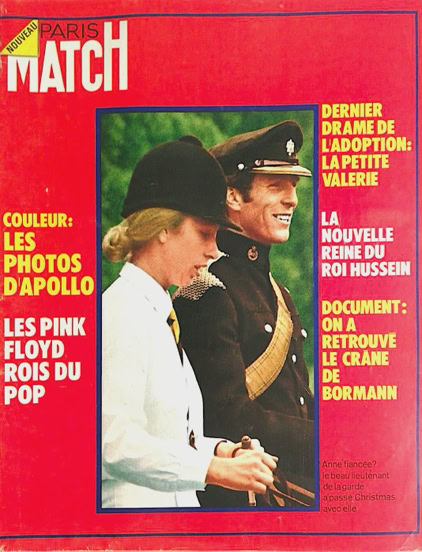
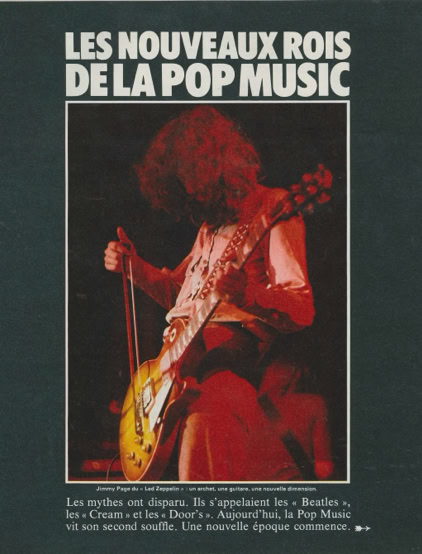
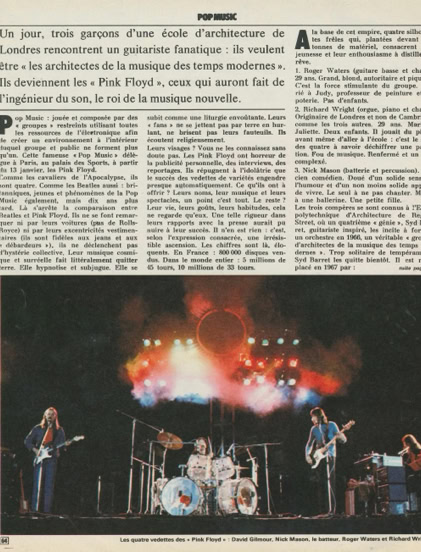
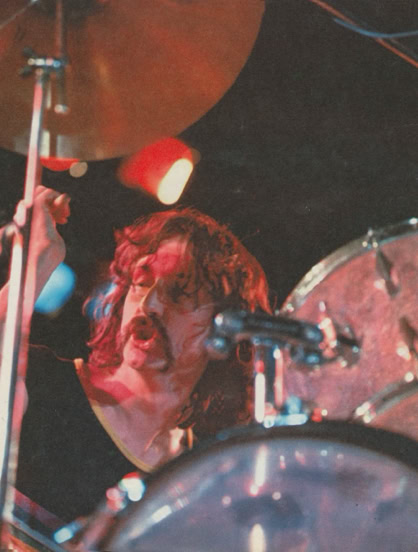
PRESS MENTION| February 1973. «Paris Match» dedicates a long article about «The new kings of the Pop Music» with a long focus on Pink Floyd
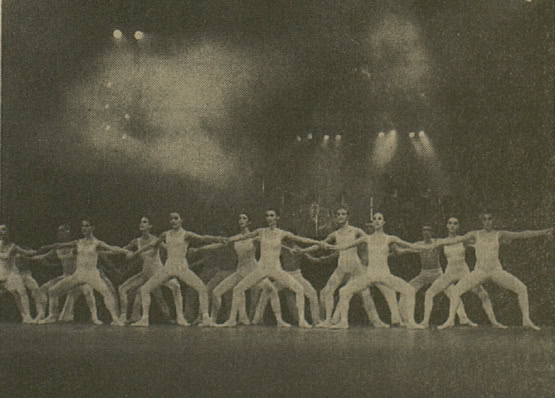
CONCERT DATE| 14 January 1973 «Ballet Pink Floyd», Palais des Sports de la Porte de Versailles, Paris, France
Pictures by Fernand MICHAUX
«Le Pink Floyd a toujours été à la recherche de nouvelles formes d'expression. Il était donc évident qu'un jour ou l'autre, il rencontrerait la danse, le ballet. Mais ce que l'on ne comprend pas, c'est le choix sur lequel se sont portés Rick Wright, Nick Mason, Roger Waters et David Gilmour.Aérienne, structurée, élaborée, la musique du Pink Floyd est délire de sons, de cris, de lumières. De facture trop classique, la compagnie dirigée par Roland Petit est à l'opposé de l'univers sonore du groupe pop', les danseurs (exception faite de Rudy Bryons et Denys Ganio) sont médiocres. Le chorégraphe - Roland Petit - est trop éloigné, par l'esprit et la démarche, du Pink Floyd, si bien que le ballet en soi manque singulièrement d'inspiration, de souffle. La mésalliance est flagrante. Chacun reste de son côté, les Pink Floyd, les danseurs, les spectateurs. C'est ainsi que l'on voit le Pink Floyd isolé au fond du plateau, sur une scène surélevée, coupé du public par les danseurs qui font barrage à l'univers de sensations du groupe anglais, à la communion entre les quatre musiciens et les spectateurs - ce qui est tout de même le comble pour la musique pop'. Dans l'hypothèse d'une nouvelle expérience de ce genre, espérons que le Pink Floyd sera plus inspiré et choisira un contexte plus moderne, où la musique, leur musique, sera bien utilisée, bien mise en situation»
«Pink Floyd chez Roland Petit», Le Monde, 16 Janvier 1973
«Les 13 et 14 janvier, Pink Floyd revenait chez nous, pour présenter au public parisien un spectacle où en fait ils n'étaient que des musiciens sous les ordres de Roland Petit. Tentative ou plutôt collaboration assez inattendue, mais ne sommes-nous pas en droit de tout attendre chez le groupe qui ne cesse de changer sur tous les plans. Revenons au spectacle, le public présent au ballet n'a rien de com-parable avec le public habituel du Pink Floyd, les smokings et les visons côtoient les freaks, un peu étonnés de voir ces " étrangers venus écouter leur musique. Mais l'on sent, dès le début du premier ballet, qu'il y a dans la salle, deux publics bien distincts : celui de Roland Petit et celui du Pink Floyd. Donc le spectacle dé-bute avec " Allumez les étoiles ª. Si le public du petit Roland semble apprécier (ou fait semblant) ce n'est pas le cas des " autres ª qui s'ennuient tellement qu'ils attendent la moindre occasion pour rigoler en troublant le déroulement du ballet. Cela va des «à poils» aux chuchotements généraux qui donne au ballet, une allure de numéro de clowns. le ne critiquerai pas ces " jeunes au mauvais es-prit ª car, je l'avoue, ils m'ont dis-trait pendant cette partie fort ennuyeuse qui dura plus d'une heure. Quand vint la fin, le petit Roland se fit copieusement siffler. A ce moment, je préférais être à ma place qu'à la sienne, mais le chauve, lui, très suffisant se fit applaudir par ses danseurs. Après un quart d'heure d'entracte, le public attendait le plat du jour, j'ai nommé Pink Floyd. Les lumières s'éteignent, on entend du vent, le Pink Floyd est éclairé, Roger Waters fait retentir une note de basse qui se répercute au loin avec l'écho : " One Of These Days ª, c'est parti. Dans la salle, c'est le délire, tout le monde tape des pieds, les visons sont scandalisés, tant pis pour eux, si le ballet devait être la traduction dansée de la musique, et bien c'était complètement foiré. Le riff de basse qui nous prenait aux tripes était traduit chorégraphiquement par 40 danseurs qui tournaient la tête de gauche à droite.
Après, enchaîne-ment sur Obscured By Clouds et When You Are In à nouveau du vent, puis Careful With That Axe Eugène un peu raboté, avec ces gémissements diaboliques de Waters, précédant le cri accompagné des fumigènes. Pour finir Echoes un peu tronqué aussi, pendant lequel Gilmour se prendra un chorus, mignon plein. A ce même moment, sur le devant de la scène, deux danseurs jouent à saute-mouton, n'importe quoi. Le ballet est fini, le Pink Floyd descend saluer avec les danseurs et le petit Roland. Le pauvre croit que c'est lui que l'on acclame, laissons-lui ses Illusions. Pendant que le Pink Floyd salue derrière, les rideaux se sont fermés pour éviter tout rappel, ils sont malins ces Anglais. Le public quitte la salle en-core sous le coup du choc de la petite heure qu'il vient de passer, et, il est temps, je crois, de tirer des conclusions sur cette expérience. Jamais, depuis les Beatles, la grande presse, écrite et parlée, ne fit autant de bruit autour d'un groupe de rock musique. Pensez-vous que ce succès du groupe, au-près de ce nouveau public, ce se-rait fait sans la présence à l'affiche de Roland Petit ? Je ne le pense pas, et c’est dommage. La musique que joua le Pink Floyd était trop trop découpée, le côté planant de morceaux comme Echoes ou Careful était sérieusement compromis à cause du raccourcissement. Vouloir présenter dans un même spectacle Pink Floyd et un ballet était pour le moins prétentieux de la part du chorégraphe. Quand l'on pense que Mick Mason attire, à lui seul, plus l'attention que 40 danseurs. Il y a des moments dans ce ballet, où l'on a envie de dire aux danseurs : «Partez, vous m’empêchez de voir» Mais, hélas I nous ne sommes pas à Saint-Ouen, et pour les fans du groupe c'est certainement le côté sadique de ce spectacle. Le manque de chaleur de l'ensemble, c'est d'abord la chorégraphie et ensuite les smokings dans le public. le me suis mis à regretter Saint-Ouen, tous assis par terre, à la bonne franquette, Waters nous chantait de sa voix intime : «Nous et vous, et après tout, nous sommes seulement des gens ordinaires. Nous étions près du groupe, il jouait pour nous et pas pour 40 danseurs, on pouvait même en redemander et nous étions exaucés. Nous étions entre nous... Peut-être le Pink Floyd veut-il toucher un nouveau public ? Comme avec la musique de «La Vallée» leur musique s'est mise à la portée de tout le monde, pour preuve, j'ai même vu la police applaudir. C'est ça le plus grave que le Pink Floyd tombe dans la facilité. Pink Floyd-Ballet, une petite heure de plaisir à la portée de tous. Après Saint-Ouen, un peu faiblard, mais comme le Flamand Rose c'est toujours extraordinaire, on ne regrette pas d'être venus. Ils reviendront les 3 et 4 février pour quatre représentations, à vous de décider, c'est avant tout un ballet avec un peu de Pink Floyd tout de même... On attend «Dark Side Of The Moon» avec impatience.»
«Ballet rose», MaxiPop, 23 January 1973
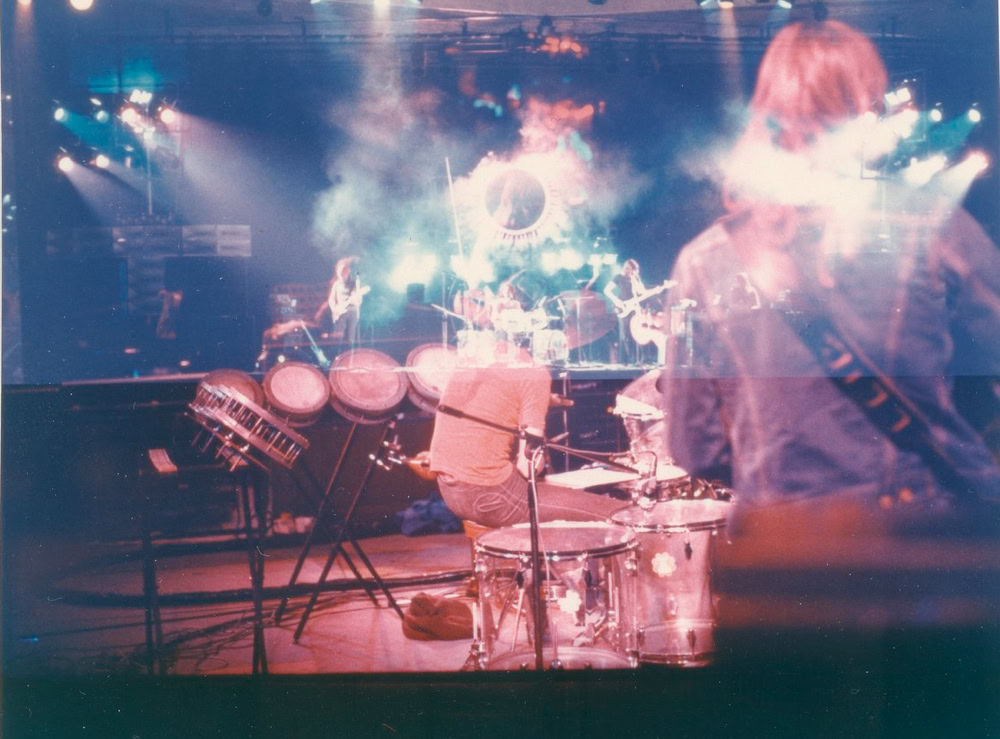
Double-exposure picture by Fernand MICHAUX
RECORDING SESSION| 21 January 1973 Clare Torry is recording the Great gig in the sky.
Clare Torry was originally invited to done his vocal track on 19 the session is delayed for two days to let the singer attend the Chuck Berry gig.
Clare Torry:
«I received a phone call to come in and do a session for Pink Floyd. It didn’t mean much to me at the time, but I accepted and was booked: 7-10pm, Sunday, January 21, Studio 3. When I arrived they explained the concept of the album to me and played me Rick Wright’s chord sequence.
They said, ‘We want some singing on it.’ But didn’t know what they wanted, so I suggested going out into the studio and trying a few things. I started off using words but they said, ‘Oh no, we don’t want any words.’
So the only thing I could think of was to make myself sound like an instrument, a guitar or whatever, and not to think like a vocalist. I did that and they loved it. I did three or four takes very quickly, it was left totally up to me, and they said, ‘Thank you very much.’ In fact, other than Dave Gilmour, I had the idea they were infinitely bored with the whole thing, and when I left I remember thinking to myself, That will never see the light of day.
If I’d known then what I know now I would have done something about organising copyright or publishing. I would be a wealthy woman now. The session fee in 1973 was £15, but as it was a Sunday I charged a double fee of £30... which I invested wisely, of course».
«The Dark Side of the Moon», Mojo, March 1998
« La vie en rose », a report on the 1972 French show in the « Rock & Folk » January 1973.
MISCELLANOUS| Early February 1973, Pink Floyd is awarded by a gold Record for the German sales of «Obscured by Clouds».
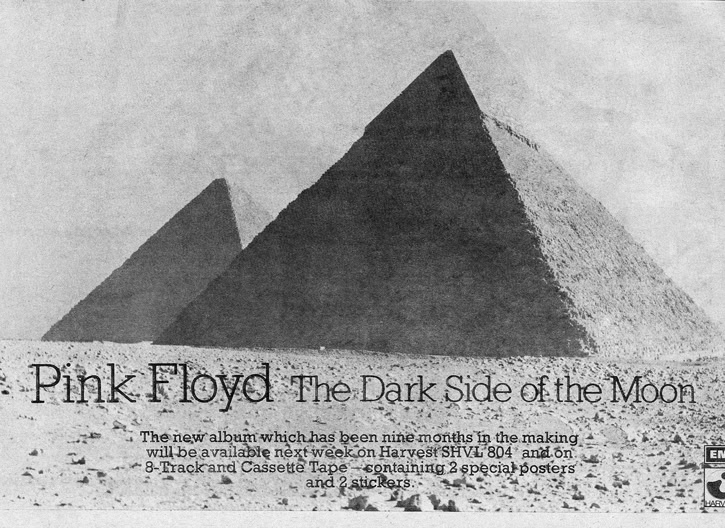
Teaser for the forthcoming « Dark Side of the Moon » (February 1973, USA)
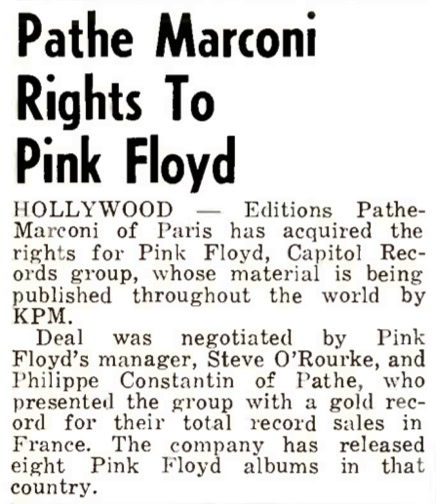
MISCELLANOUS| Early February 1973. Philippe Constantin awards the band for the first million of sales in France.
«Pink Floyd (...) a reçu un disque d’or pour la vente, en France, de leur millionième 30 cm. C’est le PDG de leur maison de disque qui leur a remis le disque, au cours d’une cérémonie tres intime»
«Un million de disques pour Pink Floyd», Hit, March 1973
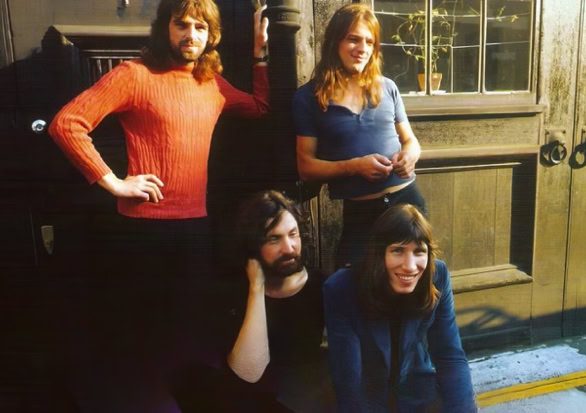
MISCELLANOUS|From 18 February to 21 February 1973 Rehearsals at the Rainbow Theatre Around this time, Storm held a photo session at Hay's Mews in London to support the public release of the new Floyd’s album.
Photographies by Storm THORGERSON
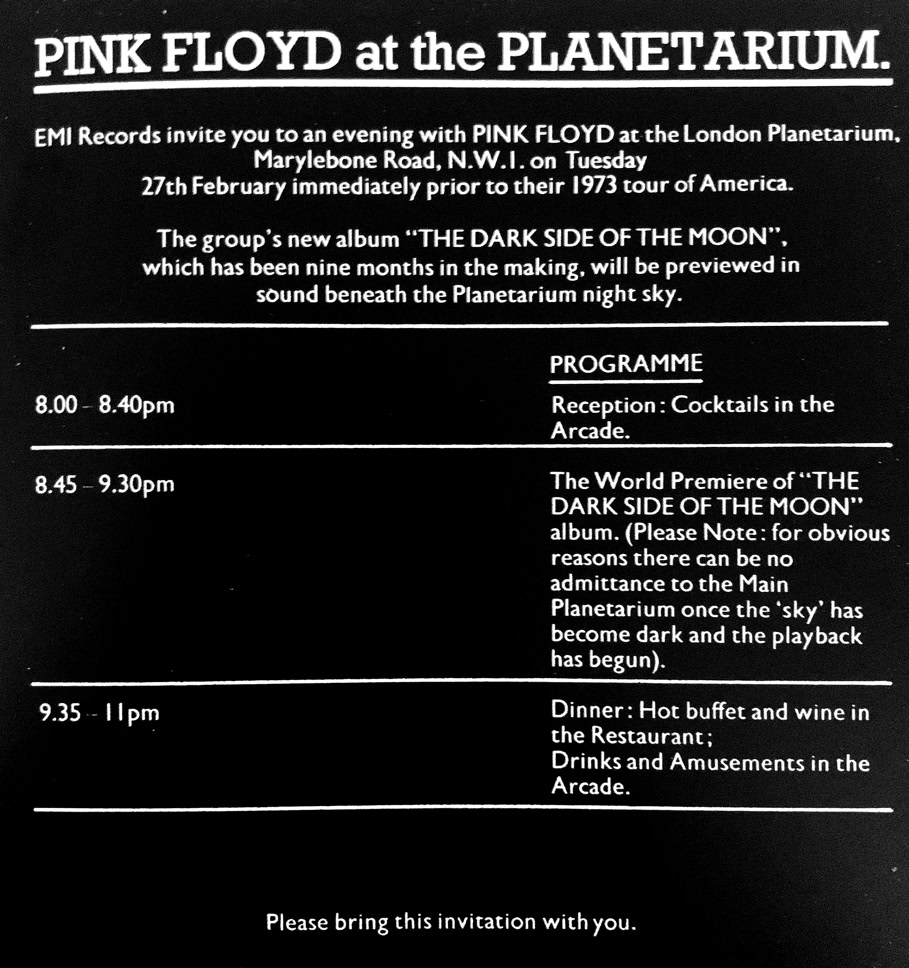
MISCELLANOUs|127 February 1973: «Dark Side of the Moon» is officially launched at Planetarium. The members are substituted by cardboards figures except Rick (the other band members refused in protest at what they believed to be an inferior sound system brought in by EMI).
Roger Waters:
«Nicky, Dave and I thought it was so daft that we tried to get it stopped. The only point of the reception was to make a really first-class presentation with a quadraphonic mix, so that it was something special. We didn’t have time to do a quadrophonic mix so we said «you can’t do it» but EMI wanted to do something so they just went ahead. We refused to go. I think it was pathetic»
Cited in «Pink Floyd», Rick Sanders, 1976.
RECORD RELEASE|1st March 1973 «The Dark Side Of The Moon» was released in the UK. It reached No. 2 in the charts. In France, during the first five weeks, «Dark Side of the Moon» breaks new records with sales estimated to 100 000 copies
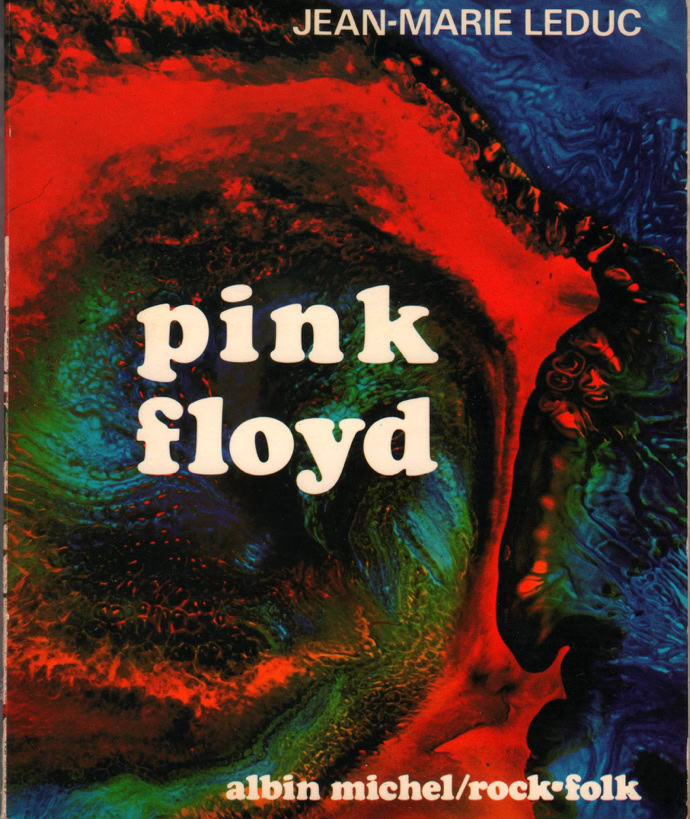
Interviewer: «Quelle a été la répartition des personnalités dans le groupe? Qui était le leader? Roger Waters?»
Mason: «Roger, oui, certainement. Et puis ensuite, tout le monde, cela dépendait du moment»
«Pink Floyd», Jean-Marie Leduc, Mars 1973.
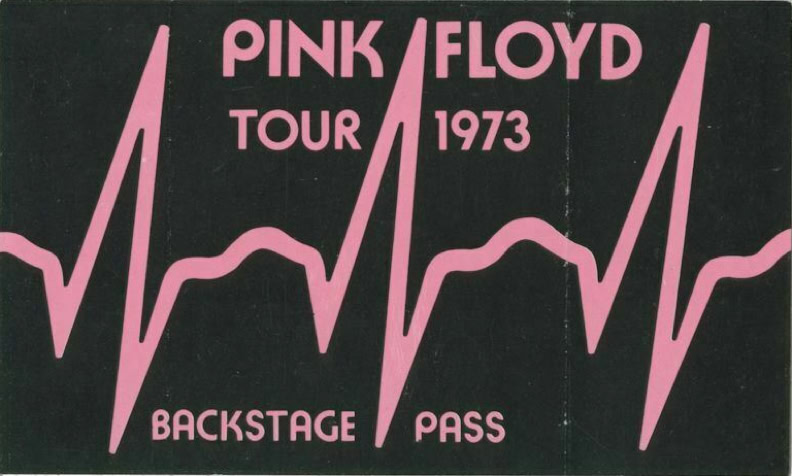
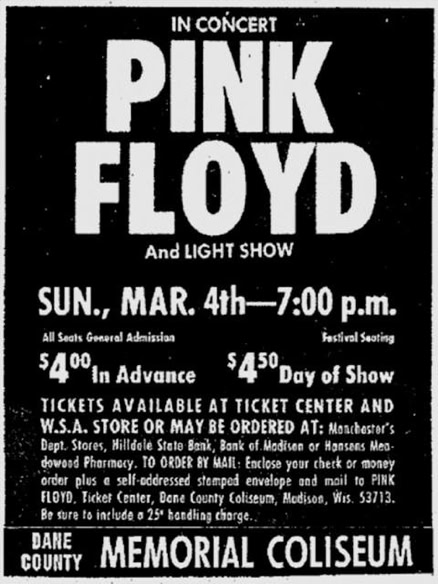
MAIN EVENT|3 March 1973, the band fly to USA for a North-American tour. The first American concert was close to be cancelled due to some visas troubles as Madison Capital Times Newspaper on 25 January 1973
CONCERT DATE|4 March 1973 Dane County Memorial Coliseum, Madison, USA
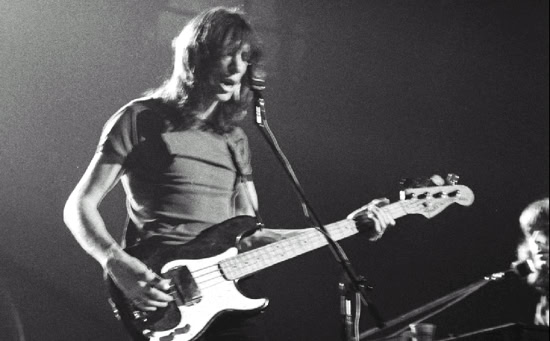
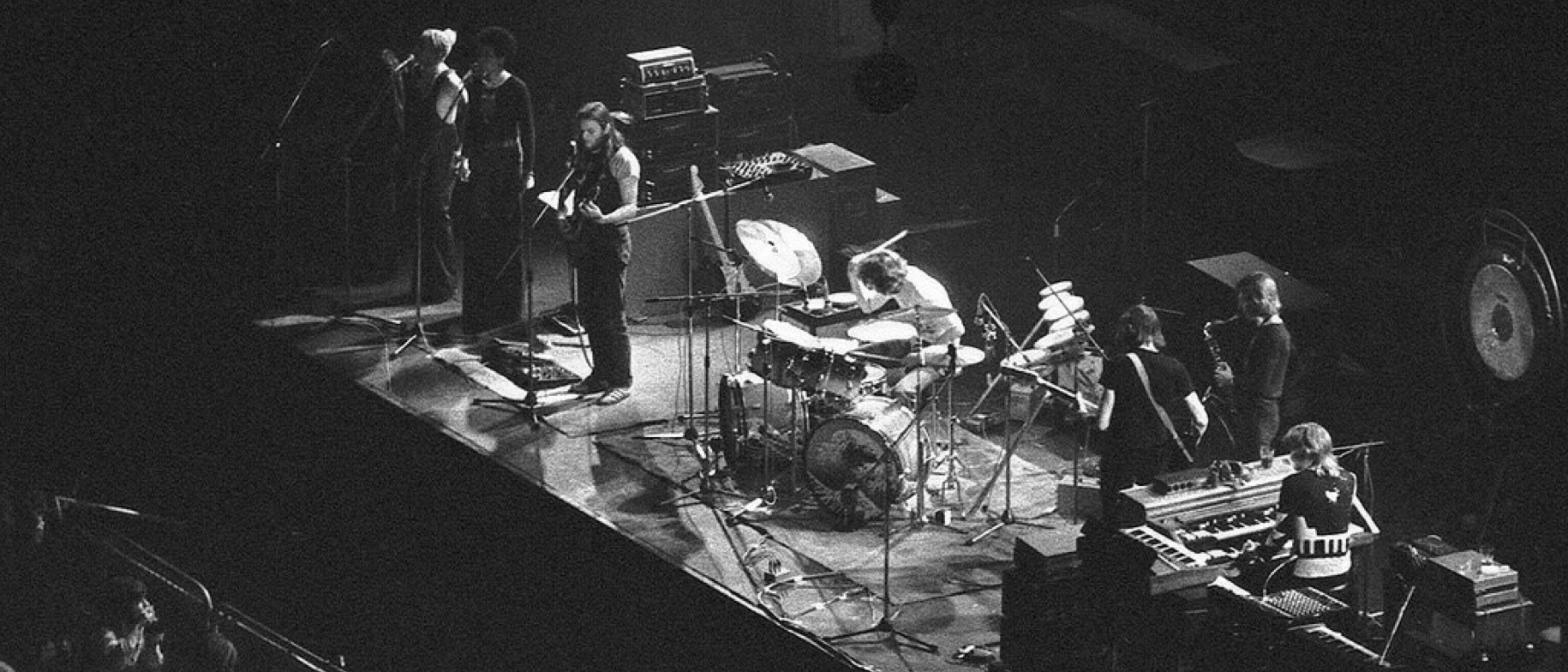
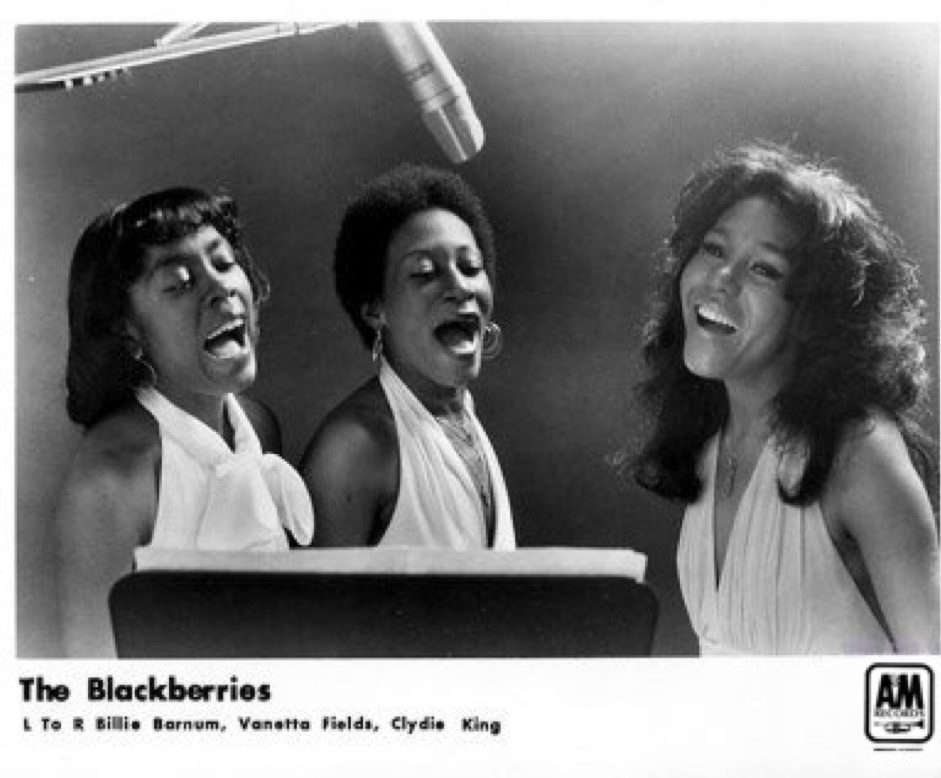
The 4 March gig see the first appearance of female backing vocalists in the Floyd live history. The band were joined by saxophonist Dick Parry and backing vocalists Nawasa Crowder, and Phyllis and Mary Ann Lindsey.
Pictures by Keith KOEGLER
«They began with a song entitled Obscured by Clouds and before it was over the Coliseum had been obscured in a pinkish-colored cloud editing from the footlights and taking the audience of 9.000 completely by surprise. Pink Floyd, an English experimental rock group, kicked off their current American tour at Dane County Coliseum Sunday night, showing a definite grasp of the visual and electronic potential of their music. Once referred to as psychedelic music, Pink Floyd has updated and come around into something loosely labeled space rock, mixture of some hard-driving sets, electronic gimmickry and quadriphonic sound. The gimmickry was Floyd’s focal point Sunday and they exploited it to its fullest to add an unusual dimension to their performance. The smoke turned from green to purple as Floyd broke into one of their more recognizable hits Careful with that Axe, Eugène, a song interrupted by blinding, flashing lights. The group used several special video effects ranging from the sound of cash registers in a piece called Money, to a soundtrack of what was apparently an Apollo flight in a song entitled Breathe (…) The accompanying light show, which received second billing and can only be described as overwhelming, tended to dwarf some of songwriter Waters’ more sensitive lyrics. In one entitled Time, the group sang about «Hanging on in quiet desperation since its the English Way» (sic)* No matter how you felt about their music, after watching Pink Floyd’s exhausting performance, you know «quiet desperation»just doesn’t quite make it»
«Pink Floyd Clouds coliseum with haze of space sound», Wisconsin State Journal, 5 March 1973
David Gilmour:
«It started from the first show in America. People at the front shouting: «play Money! Give me something I can shake my ass to!»
Mojo, March 1998
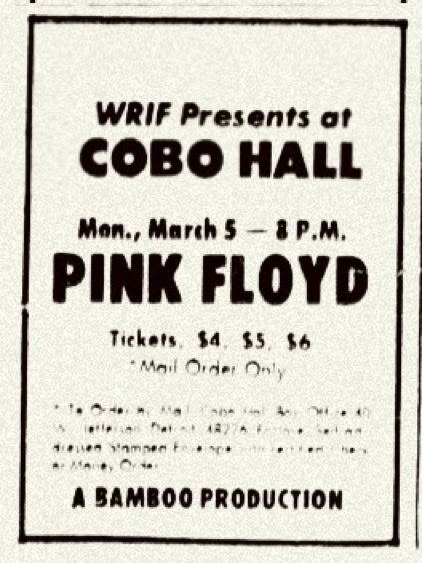
CONCERT DATE|5 March 1973 Cobo Arena, Detroit, USA
« Everyone at Cobo on Monday night Including Pink Floyd, who- were in the middle of their sold-out concert thought that someone had dropped the Big One. One guard dropped Into the approved Civil Defense H-Eomb crouch and cowered. The explosion left people dared. A heaw sneaker horn was pulverized as if it had been fragged by a hand grenade. inree people were slightly injured. "I didn't know what it was." said Bill Kish. owner of Star ..Security. what had happened was that one of the onstage flash-pots, used by the Floyd for special effects, had too much I black powder in It. When It went off, It went off Nke a . 137mm howitzer. Then, in the concert's second half, the group blew out about 60 percent of the speakers, including the entire quadraphonic "Circle of Sound" that they had painstakingly set up at Cobo. The Floyd performed works from "Meddle," and as well, two cuts from their forthcoming album, "Dark Side of the Moon": "The Great Gig in the Sky," and "Money." PINK FLOYD is a superb group. They utilize some of the best effects of Musirjtie Concrete, and as well. often dwell In those monochromatic regions where Terry Riley has done some of his finest chord and syncopative experimentation. Combinations of tape delay, echo, whit sound and distortion season the quartet's guitar, bass, drums and keyboards which Include a VCS-3 synthesizer. If they don't blow themselves up first, their explorative music will add a lot to the field we call «pop»»
«Flashpot Goes Berserk So Do; Pink Floyd Fan», Detroit Free Press, 7 March 1973
Glenn Povey:
«Pink Floyd’s technicians accidentally overloaded the pyrotechnics, which were detonated during the climax of Careful with that Axe, Eugène. The resulting explosion blew up the PA system and showered the crowd with debris. After a short break to determine damage and casualties (there were none), the second half of the show resumed without incident»
«Run Like Hell», Q Special Edition, October 2004
Roger Waters
«It was fantastic; we used to have these bins that were specially made that were made of mild steel to put the charges in. In a number called Careful with that Axe, Eugène, there’s a particular point and I scream loudly and there’s these bangs that go off behind us. And we’s ordered these bins to have a 1/2’’ steel bottoms and 1/2’’ steel sides and they came back and they were 1/4’’ steel bottoms and so we said «no that’s to enough» and we sent them back (…) I(ve no idea of the physics involved. And inside this bin holding it down is a stage weight. A big 14lb stage weight, and it exploded. Went off like a bomb (…) The top of the bass cabinet that it was standing on, which we made of 3/4’’ marine ply. How nobody was killed we will never know. There was a guy sitting 3à rows back in the audience coped a piece of this marine ply; hit him in the stomach. All the speakers, every single speaker in the gear blow immediately. I just remember feeling this hot blast on the top of my head and seeing the back of the Hammond organ in slow motion on go spiraling up into the air. Of course, the audience thought it was fantastic. They thought it was absolutely wonderful, they were on there feet for, seemed like hours»
«Off the Record», 11 March 1985.
Nick Mason:
«During one earlier gig at the Cobo Hall in Detroit, an over-enthusiastic application of flash powder coupled with a stage weight containing an air bubble in the casting nearly ended our careers in one bang At the salient point in ‘Careful With That Axe’, instead of the boom and flash we expected there was an explosion of monumental proportions which blew out the cones of virtually every speaker we had. leaving the remainder of the show sounding rather thin. Alarmingly, pieces of shrapnel flew overhead hitting at least one member of the audience who fortunately refused to be hospitalised, and took a T-shirt in lieu of damages. Our road manager Chris Adamson remembers that the blast sent Roger’s bass speakers ten rows into the empty seats behind the stage, and the road crew spent the following day rewiring all the cabinets before the next show»
«Inside out: a personal history by Nick Mason», Nick Mason, 2005
CONCERT DATE|6 March 1973 Kiel Auditorium, St. Louis, USA
Pictures by C. PETTY
«With a mechanical sigh, the hydraulic lift elevated the large splintered mirror 20 feet above the stage of Kiel Auditorium. Behind the mirror, a white plastic tube like the one an astronaut would wear for oxygen tensed for a second and released jets of thick smoke. A hidden floodlight colored the smoke bright orange like some futuristic sun. From each side of the stage, four laser beam projectors resembling large home movie cameras were trained up toward the mirror and switched on. Like invisible, magic thread, pinpricks of red laser light shot up at the mirror, now rotating slowly. The mirror cast the tiny rays, bright as fire, around the cavernous ceiling and walls of the hall, which was packed to the last seat.
A rock band, dwarfed by electronic equipment, eased moodily into heavy plodding music, almost a soundtrack to the spectacle surrounding it. The recent concert almost didn't take place. During the previous night's performance, in Detroit, a stage gimmick exploded, shattering $4000 worth of speakers. Shrapnel-like pieces of metal flew into the audience, injuring a few persons. Besides that, a stage crewman got sick, the equipment bus broke down on the highway and the musicians’ plane was delayed in the fog. And that was only the third night out from their native England.
Due to the frantic but professional work of the light and sound technicians, the speakers were replaced and everything was ready for blast off for the St. Louis concert only two hours behind schedule. But the sellout audience of almost 11,000 showed none of the usual restlessness. Most of them had stood in pouring rain while the band was setting up. Now they crowded in front of the stage, watching with curiosity as the sinister-looking machines were being assembled. There were miles of thick electrical wiring strung around like tracks in a railroad yard, leading from the ten 700-watt amplifiers to banks of huge speakers at each side of the stage and in the back and at the sides of the auditorium: Live quadraphonic sound.
In center stage stood the mirror tower like a proud god. This was the most diabolical piece, festooned with silver metallic lights hanging in rows like sails on a ship mast. To the round mirror, which was actually made up of many tiny mirrors like those of the glamorous ballrooms of the big band days, there was fastened the plastic coil hose. Its origin was a smoke-making machine not unlike those the Navy boats use to elude pursuers. With the trays of dry ice filled and installed in their proper casings the 11 tons of musical, electronic, visual and pyrotechnic gear was in place. Almost lost among this unnerving assembly were the four young, unassuming lads known collectively as Pink Floyd. They had casually wandered around the stage, assisting in microphone and instrument adjustments, chatting amiably, generally displaying a good deal less ego and “rock star mania” than is usual at these spectacles. A technician offered an explanation: "You know, they're just regular people. Not stars ... simple people.”
The house lights faded and the four youths took their respective places behind the drums, bass, electric guitar and an assortment of keyboards including piano, organ, mellotron and six synthesizers.
An enormous roar erupted from the crowd as the master of ceremonies announced the band. The well-rehearsed, carefully timed, three-hour Pink Floyd Aural-Visual Extravaganza came to life»
«Pink Floyd: the theatrics steal the show», St-Louis Post Dispatch, 27 May 1973
CONCERT DATE|7 March 1973 International Amphitheater, Chicago, USA
Photographies by Mark CAMPBELL
«Pink Floyd must have given some bad shows in their time, but I've yet to see one. One of the few really good practitioners of musical psychedelia, they surfaced in Britain in 1969 as a sort of space rock group; now they bring whole atmospheres of sight and sound with them. Last night they brought them to the Amphitheater—* as atmospheres go, something else. The acoustics, you may'recall, are not helpful; Pink Floyd's special 860-degree sound system Couldn't help but suffer. But this was one of the few concerts there lately that’s seemed possible to review as 'a musical event.
Besides their own sound system, the quartet brings i with them their own lighting, special synthesized effects, and an array of gadgetry that looks like it could enable the crew to literally take off for outer space. A battery of lights slowly rises up and down behind them like an ascending or descending space ship, topped by a mirrored, reflecting hemisphere with lights in-' side. Dry. ice billows out in obscuring clouds. Three ' drums of fire explode unexpectedly, shooting flames toward the ceiling.
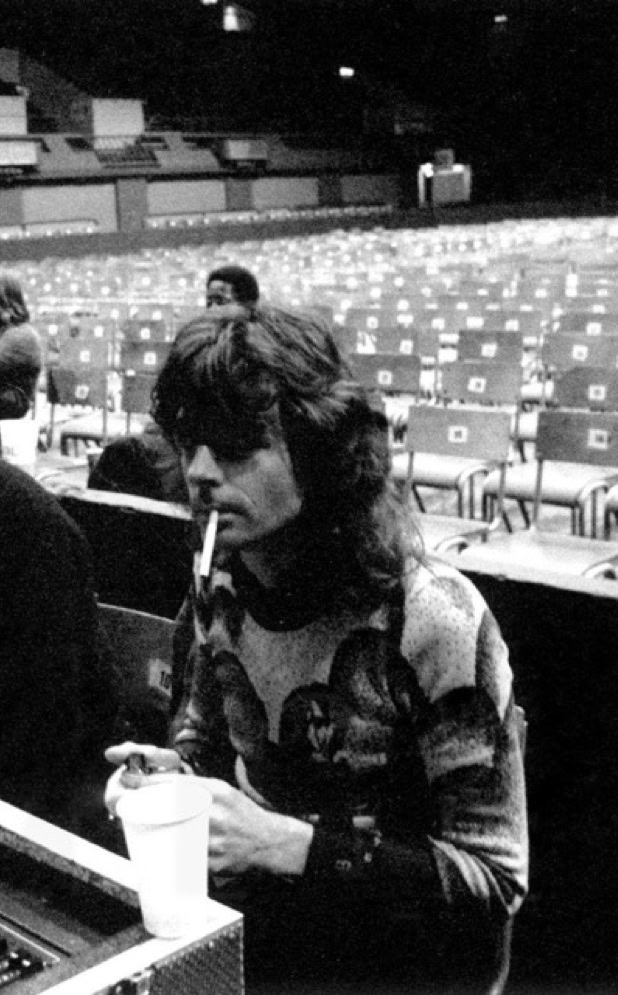
It’s all very programmed, part of the package; as the clouds surround him, the keyboard man smokes a cigaret and checks out the house [not bad]. But it is all done, well, tastefully, and it works in perfect combination with the free flowing combination of guitars, drums, keyboards, and synthesizer. It’s head music, trip music—easier to experience than describe.
This time the group brought with them for the first time three female singers with Afros using them for an occasional song and chorus. As usual, they did the whole show themself, splitting it into two parts and not speaking more than a “thank you” during each. The first, five or six long swigs in all, was older Pink Floyd from the group’s “Saucerful of Secrets” days when they “set the controls for the heart of the sun.”
The second half was a run thru of their new album, “The Dark Side of The Moon,” combining gentler vocals and the more rocking instrumental influence that has crept into their approach on such songs as “Money.” The rest of the set reflected the usual Pink Floyd interest in lunacy [perhaps incurred around the time one of their ex-members was put away], time, space, and spaces between friends.
The crowd scene, de rigueur these days at Amphitheater affairs, didn't materialize this time until almost the end of the first set. At that time the customary Morons’ March down the center aisle stepped off smartly, with the usual results that all those people standing in front of the stage made it sort of hard to see. I have to admit I felt almost glad when one of the plainclothes ushers burst a space-usurper’s balloon.
Things are, by the way, getting stranger at the Amphitheater. In the lobby they are not only peddling hotrod decals and shirts, but “invisible dog” leashes. Pretty soon it’s going to be as weird outside as in»
«Pink Floyd’s musicality transcends gimmickry», Chicago Tribune, 8 March 1973
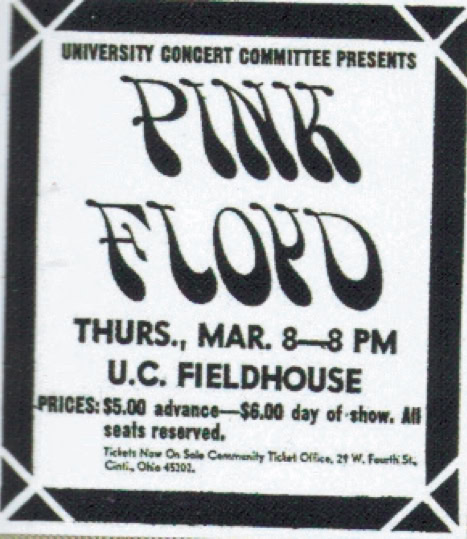
CONCERT DATE|8 March 1973 University of Cincinnati Fieldhouse, Cincinnati, USA
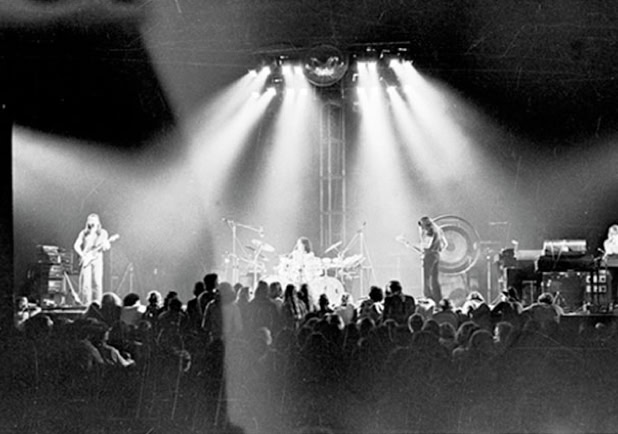
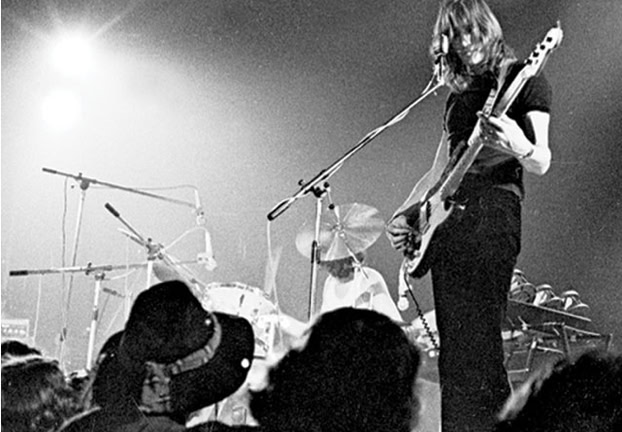
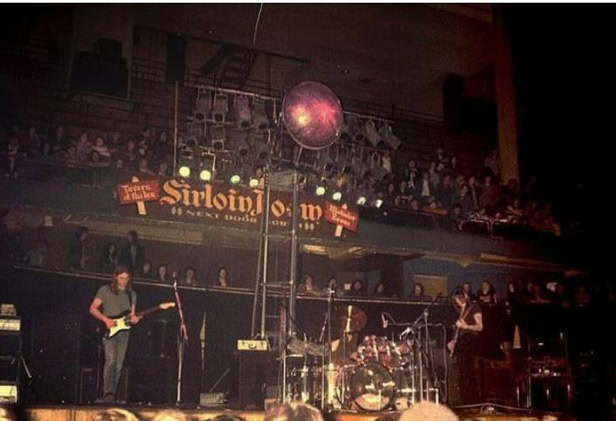
«Pink Floyd — also known as the Intergalactic Light Show and Flying Buzz Saw — dropped their saucerful of secrets on the UC Field House last night, bringing visual innovations and (surprise) some music as well On their third trip to Cincinnati in less than two years, the four Britishers gave another stunning performance, on the whole, but one laced with much of the redundancy- that’s characterized their long musical monologues.
They’ve been working in the large framework that the Moody Blues use so effectively, except Pink Floyd's colorings run much darker, bordering on Marat Sade at times. Until now, the length of their compositions has been their chief weakness, plus a lack of real musicianship. The concert's second half — one composition from their new album, “Dark Side Of The Moon” — hung together and worked better than anything I’ve heard from them thus far. It carried vocal and instrumental variety, interwoven segments and a three girl chorus, as well as the visual mind-blowers and added a new dimension to the group from which they can build.
“Echoes,” from their “Meddle" LP, opened the first set, as the three monstrous hydraulic light towers hissed up to perch over Rick Wright. His intro on one ot several keyboards gave way to David Gilmour’s snarling, buzzing guitar line that rarely left E minor, while ghostly clouds of dry ice gas oozed past their feet down over the stage.
Bassist Roger Waters underpinned an interplanetary interlude with his unique technique of massaging his strings with a steel slide, resulting in a spatial effect — sort of like the universe's breathing. Wright cut back to a cathedral-like organ break, and the number closed with a vocal duet by him and Gilmour.
Two numbers from their soundtrack album, “Obscured By Clouds,” followed. Wright got an intriguing bagpipe tonality from one of his keyboards, probably a Mellotron, to open the first, while Gil-mour used a rare (for him) jazz chord to close the second. Despite a lot of comparatively empty repetition in between, there was never a dull moment because of everything else that was going on. Nick Mason’s transparent, strobe-lighted drums, for instance. And a new visual contraption you might call the “fly light.”
This little psychedelic gadget is a large hemisphere like an insect eye glaring over everything, with light projected both through it from behind and onto its multi-mirrored surface. PINPOINTS of violet and scarlet stabbed and spun their way through the music, onto the ceiling to become “stars." Another combination produced laser-like crimson rods jutting out, while jets around it spit gas — sort of a Blue-Eyed Susan, at one point.
No performance of theirs would be complete without their lunatic thriller, "Careful With That Axe, Eugene," a tender tune which drove my college roommate screaming from our room the first time played it for him. Waters' bass didn’t treat it as carefully as they wrote it, however, staying on one level instead of pulsating slowly, diabolically up to his scream— at which point three charcoal burners full of flash powder exploded and singed the short hairs off the arms of the first four rows, to say nothing of a Field House full of eyeballs.THE FIELD HOUSE, incidentally, is another of those wonderful halls Cincinnati seems to have so many of for rock concerts. Their acoustics and design are such that you’re always a bit afraid that someday, someone will lock the doors, turn on the cyanide, put down another floor and blithely play basketball over us all.
Several thousand ticket-holders had to funnel first through! one double door, then r— through two (count ’em) r smaller door to get inside, without benefit of cattle prods. But it was worth it to hear a group that is beginning to add more serious musical thought to probably the most imaginative visual show anywhere.
«Thinking Pink wins out», The Cincinnati Post, 9 March 1973
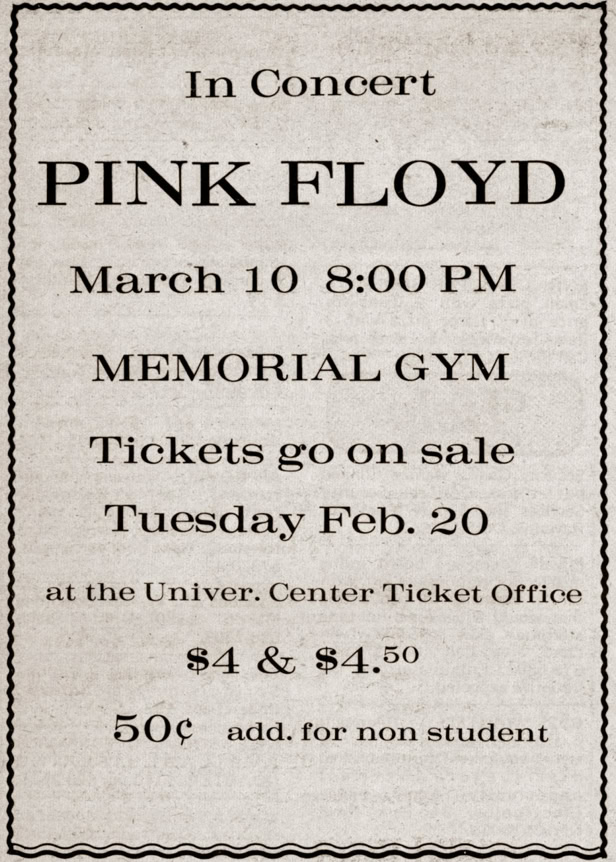
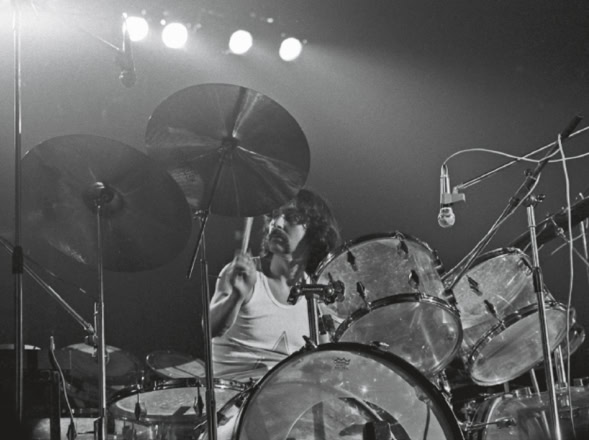
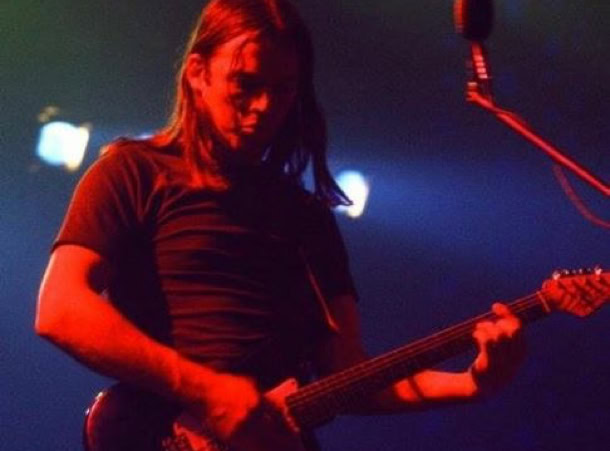
CONCERT DATE|10 March 1973 Memorial Gymnasium, Kent State University, Kent, USA
6800 crowd according The Daily Kent Starter newspaper.
Pictures by Joe SIA (left) and J. Ross BAUGHMAN (right)
«You wanna know what the mood of that place was? Roger scorned me. Roger Waters personally scorned me from being able to be up on stage, when every other major act I’d worked with had no problem with this.When they were ready to come out and do their sound check, I was out there right on the wings of the stage, and Roger looked towards me and said, “What’s this guy up here for?” And I said, “Well I’m part of the furniture, I’m part of the woodwork, I’m Kent State here.” I introduced myself in a friendly way. I was trying to be ingratiating, but he wasn’t having any of it, and he said, “You’re finished.” So I just kind of looked around, and all the other people running security and running the concert just looked at me and gave me that smiling shrug, like, “Hey, Roger Waters has spoken.” I wanted to reason with him, but he wasn’t having it.
So to shoot my photos I had to squeeze into a scrum of annoyed photographers crouching in front of the stage. They had already staked out their turf. The band was snarling at the crowd. Roger was literally insulting the audience. Someone would shout out a request, and Roger would come back with something like, “Shut up, we’re trying to do something more important up here.” I was just trying to take some decent pictures—and I was impressed with the music, and I loved the band, and I loved that album—and I was really excited about this, but they were feeling incredible pressure to be in total 100 percent anal compulsive control over that concert. Oh, and you know what the other thing was? They wouldn’t even let us shoot the entire concert. We were limited to the first few songs—and this was the first time I had ever heard of this. «To me it was outrageous. I remember thinking, “What? They are telling us we can only shoot the first twenty-five minutes of the concert?” Which is absolutely normal now. I think that—as a veteran concert photographer, having shot photos with carte blanche red-carpet treatment, this was the first time I had ever known this to happen. Not long after this, I covered both Paul McCartney and Wings and the Rolling Stones for a couple of cities, and both bands embraced me as one of the guys.
A handful of these Pink Floyd photos turned out okay, though not compared to all the other concerts I shot where you see I’m right next to these guys. For Pink Floyd I was there for only enough time to take maybe twenty or thirty frames for the whole concert, and only just a few photos even turned out, compared to other concerts where I would have had, like, fifty pictures that I really liked. I think that concert was more important to them than people realize. That shirt David Gilmour is wearing—I think it’s a red and blue shirt and the star is yellow. I think it wasa Viet Cong shirt, but it may well have been that he added “Kent State” to it. I am pretty sure his shirt says “Kent State,” and you know what that tells us? They knew that Kent State was the closest you could get to the Viet Cong here in America. You could not find a revolutionary red and blue shirt with a big yellow star on it in the campus bookshop, because that was just too darn left, anti–Vietnam War revolutionary, so he must have made it. What I think you are seeing here is Pink Floyd celebrating Kent as something they cared about. What I find ironic about this is that they couldn’t have been less congenial. They were alienating the audience because they were such artistes »
Jason Prufer. «Small Town, Big Music.»
Michael Solomon (promoter):
«It was unbelievable. The first thing I remember is that they did the show in quadraphonic. There were speakers at the back of the gym and there were speakers all the way up on the right and left side above the bleachers. They brought in the most amount of equipment that I had ever dealt with. I remember that they brought in this forklift and when they started rolling it across the gym floor, you could see the floor buckle and I happened to be standing right there with Keith Raymond, who I worked with and we looked at each other and I just said 'stop! please stop! We can't bring equipment in this way.' So then Keith and I looked at each other and I said 'find the money and go find 20 kids that we can pay $20 a piece and get them to hand carry all this equipment, otherwise we can't do this show.' And we did! So we moved all the equipment into the gym by hand. That's the first thing I remember about the show "The second thing about the Pink Floyd show that I remember was that we were worried that there might be some drug overdose that night so we worked with the local hospital and the local police and everybody else to set up like a care unit down the hall from the performance. It was a good thing that we did that because it was unbelievable how many kids were in there hallucinating, just having out of body experiences, out of mind experiences--it was kind of fun to walk through there and overhearing what people were saying. Nobody died and nobody was actually having any serious problems but it was wild. I just remember someone saying 'I saw god, I saw god out there.' Stuff like that.
"The other thing was that this was The Dark Side of the Moon Tour and ya know where there's that giant explosion on the album? For that part of the concert they did this really amazing thing where they caused this big crash at the back of the stage off to the side and there were a couple of us standing in that general vicinity and right on cue there was an actual giant explosion that was so powerful that it left all of our ears ringing for days. Their show was the most technically brilliantly production I had ever witnessed. Being able to bring that to the gym--it was an amazing event».
kentfloyd Website May 2014
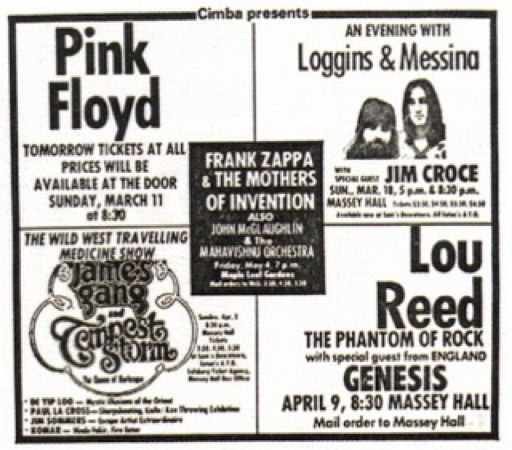
CONCERT DATE|11 March 1973 Mapple Leaf Gardens, Toronto, Canada This gig was sold out in 90 minutes According «Record World»
«THE most incredible audio visual experience I have ever witnessed is the only way I can sum up my feelings following the long-awaited Toronto debut concert by Pink Floyd. The total attention of the crowd was gained from the very first moment of the show when three banks of multi-coloured lights rose out of the darkness shedding a glow on the quartet. Then spotlights hit a metal disc, which reflected tiny spots of light onto the ceiling, giving an immediate star-like effect, which took us off on the first stage of our two and a half hour journey into space. The effect was dramatic, but • one wondered why so startling so early in the show? What could they do to develop this? That thought was not left long in the mind as the music became increasingly space-like, and the lighting took us deeper into the void. Most of the programme, fittingly, was taken from their newly released album — " Dark Side of the Moon." Despite the fact that the album has been in the racks for only a couple of weeks, it seemed that many of the crowd were already aware of the music, showing instant recognition to each new work. But it should be stressed that the lighting effects. were extra dressings — icing for a birth-day cake of superb, tight rock. While the keyboard work of Richard Wright is inevitably the dominating factor. David Gilmour's guitar created sounds which took the crowd along on their space-shot, and Nick Mason on drums and Roger Waters on bass never let anyone forget that they were being entertained by a great hard-driving rock group»
«Pink Floyd», New Musical Express, 24 March 1973
AWARD| 11 March 1973 The band received a golden disc for the Canadian sales at Toronto by the Capitol’s CEO Arnold Gosewich
Pictures by Alain RENAUD
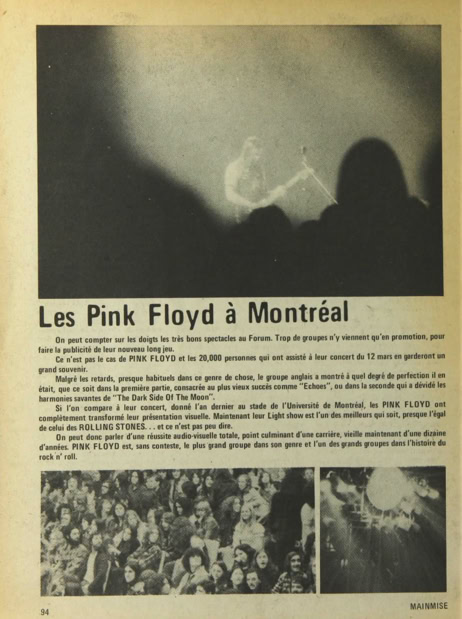
CONCERT DATE|12 March 1973 Forum de Montréal, Montréal, Québec, Canada
Nick Mason:
«We discovered one of our backing singers had disappeared, the reason being thatch had been arrested with her boyfriend for holding up a grocery store»
«Pink Floyd Inside Out», Nick Mason, 2005
«Ils étaient plus de 15.000 hier soir a hanter le Forum de Montréal que la musique sidérale des Pink Floyd transformait en un lieu d’exaltation de la lumière et du son. Plus de 15.000 dans des tenues et des styles où ils récréaient pour leur compte et dans un autre lointain l'équivalent de ce qu'on appelait naguère les foules bigarrées de l'Orient/Plus de 15.000 jeunes que d aucuns insistent tant pour ne voir que chevelus, débraillés et libertaires alors que d'autres, perçus à leur tour comme charnus, maquillés et réfractaires, se réunissent fréquemment aussi dans un même but entendre un concert. Car les Pink Floyd sont écoutés avec fascination, et la participation qui s'exprimait autrefois par des transes s'est avec eux intériorisés sans rompre la fête. Et d'abord la fête de l'attente car il est acquis que l’heure de retard qui ouvre ces rendez-vous du Forum prédisposent à la montée vers le son. a la fois carnaval et carême avant les Pâques Avaient donc échappé aux couples de policiers qui vérifiaient à tous les dix pas du hall d entrer billet et colis suspects: des ballons, des soucoupes volantes, des avions gonflables et des serpentins qu'on se renvoyait à qui mieux mieux des gradins vers l'orchestre.
Puis quand les lumières s'éteignent enfin dans les cris qui s'élèvent, l'obscurité est soudain traversée de mille sources lumineuses et de détonations. Feux de bengales, briquets, bougies, pièces pyrotechniques: les Pink Floyd sont accueillis par une Chandeleur. C’est qu'un concert des Pink Floyd célèbre de quelques manière les épousailles de la lumière et du son Comme l'indiquent les titres des premières musiques présentées: Echoes et The Heart Of The Sun. Comme le réalisent dans une sorte d éblouissement ces gerbes de sonorités hors du monde qu’ils tirent des entrailles de l'électronique, liées à la lente ascension des projecteurs. au frémissement lumineux qu’un tamis rotatif projette sur la foule attentive. aux tremblotements bleus qui naissent du martèlement de la batterie, aux geysers de fumée colorée qui giclent du haut du plateau. La scène est un lieu de haute-tension Les Pink Floyd explorent méthodiquement tout le spectre du son Enveloppée par leur musique, une foule saisie d'ivresse auditive le parcourt avec eux. du cri aigu des sirènes au son lourd des murs de Jéricho»
«La fête de la lumière et du son», Le Devoir, 13 March 1973
«Sur un fond ombragé d'un grand soleil orange, de construction raffinée. Pink Floyd apprivoise l’électro-acoustique. Les jeux de lumière se multiplient à l'extrême richesse de leur musique, dont l'intensité dramatique peu commune engloutit le public au coeur de sublimes visions murmurantes. Ce public est plus intellectuel pour ce groupe "rock " qu'à l'ordinaire. Attentif cer tes. mais avec un rien de passionné dans l'oeil. En somme, un public de plus de 15.000 personnes, venues cher cher, lundi soir au Forum, des réminiscences de Pierre Henry. Stockhausen, ou Xénakis. Et Pink Floyd lui en a fait entendre et voir de toutes les couleurs, du vert émeraude au rose flamand. Les quatre musiciens sont immobiles. Un immense gong à droite de la scène retient d'abord l'attention. Il semble vouloir attiser le feu qui accompagnera les diverses nuances baroques. Lentement mais avec autorité, les premiers accords retentissent. Au fil de la technique, les notes se transforment, se moulent au contact de l inspiration floydienne en une effervescence sonore cosmique. Le guitariste David Gilmour laisse couler ses doigts sur les cordes. Dès lors, le spectre du génial Syd Barrett. premier Pink Floyd entre tous, flotte au-dessus du nuage opaque de fumée qui semble vouloir engloutir les spectateurs. D'une volupté musicale exceptionnelle. les musiciens attaquent une piece célèbre: "Echoes' . Comme sous pression depuis longtemps, le décor éclate et l'ascension météorique prend forme. Vivant à même l’espace, dans un climat angoissant. La musique de Pink Floyd s’accentue au double rythme des pulsations cardiaques, atteignant un degré éblouissant de maîtrise sonore comme un brûlant souvenir d’une lave volcanique un soir de Pompéi. Malgré les frémissements, le public reste calme. Revenant à un style plus nouveau, moins étoffé de leur polyphonie coutumière et caractéristique. Pink Floyd jouera la plupart des pièces de leur dernier microsillon. "Dark Side Of The Moon". Puis, d'un coup, le moment semble religieux. On débouche au coeur même de la science-fiction. "Set The Control For The Heart Of The Sun amène un flot ininterrompu de notes qui s'obstinent, dansent, bafouillent, se frappent dans Taller-retour de I im mense salle. Reflétant de mieux en mieux la libre création comtemporaine, le groupe puise l'intensité sonore voulue à meme leur foisonnant maté riel électronique. Et tout au long du spectacle, tandis que les musiciens fouillent dans leurs souvenirs et leurs dernières oeuvres, des techniciens à l’arrière-scène s'assurent de l'excellence des réverbérations. Puis le rythme prend une place de choix au centre des interprétations. At taquant une de leurs célèbres compositions, "Obscured By Clouds ", musique-thème du film «La Vallée» de Barb et Schraeder (sic). Pink Floyd franchit le mur des constellations, au-delà des hurlements de voix et des cris déchirés. Finalement, une pièce intitulée "Eclipse" raconte que malgré toutes nos pré occupations. le soleil est toujours éclipsé par la lune. En rappel. Pink Floyd surprend encore. Battant la mesure, les milliers de spectateurs assistent en musique à la naissance et à la mort d'un monde étrange, fou et profond. "One Of These Days" se confond aux murmures de l'extase, prend vie. s'anime et se cour be. se désintègre et s'envole en poussière. Pink Floyd entre dans la nuit, se mêle aux oiseaux, alors que s édifie dans un nuage de narghilé le nouvel olympe de ces dieux panachés de rose»
«L'Apocalypse en millions de décibels», Le Devoir, 14 March 1973
«The Forum is packed to the rafters. Pink Floyd has returned to Montreal after 16 months. Kids have hitchhiked in from Quebec City and further environs to see what is probably the last legitimate underground band in existence. The microphones got held up somehow at Kent State a couple of nights ago, so the show’s gonna be a little late. Bass guitar player Roger Waters is killing time playing Official NFL Football in the dressing room. Outside, a couple of hundred people, many of whom have just bussed in from far-away places, are trying to get in through several means. The place inside is floating. Beach balls are flying around, and someone produces a big inflatable Air Canada 747, but it doesn’t fly very well. Frisbees are making the rounds.
The lights finally go out, and the matches are lit and someone even produces a roman candle. Richard Wright strikes the first note of Echoes on his organ, and the place explodes with applause. The people are like fruit begging to be picked. And harvested were we all by the time Echoes had finished its 20-minute run. Pink Floyd displayed what must be one of the most stunning — if not the most stunning — visual shows in entertainment today. The musical display was also pretty remarkable — the band has a $100,000 quadrophonic sound system, with big speakers in each comer of the arena. Hie effect is breathtaking. As Wright played his Moog and tape recordings on Echoes. 300 pounds of dry ice started doing its thing. Then a big. whirling disc hanging over the stage threw out thousands of glints of colored light.
Then, with Wright noodling around on the Moog, the song moved into its chilling Dawn of Time sound montage and the disc overhead started smoking.
Pink Floyd plays the eeriest music ever, and Set Controls For The Heart of The Sun is the eeriest song of them all. It’s played over a subtle mid-Eastem riff and gets deeper and deeper into a psychedelic groove. Then, on the number, Wright cuts loose the moog on the quadrophonic system, and people are going bananas everywhere. The big disc is an angry red sun above the band. The show peaked with this number, which was accompanied down below by a beautiful stage show of red and green smoke mingling and swirling in front of it all. The second half of the show, Floyd played cuts from its just - released album. Dark Side of the Moon. This part of the show was into a very mellow groove, but it wasn't nearly as cosmic or satisfying as the soaring first half. Also, the audience didn’t know the new songs, best of which is On The Run. There were, however, some soulful lines from the three sisters who sang here recently with Leon Russell. When an audience knows the songs, it inevitably makes for a more interesting show. The most effective visual part of the show came on the first numbers after intermission, On the Run and Money. Out from behind the band flashed the red raw energy of four lasers, shooting off the big mirrored disc like tracer bullets. Wright played organ noises that sounded like a Star Trek phaser overloading. Then from the back of the hall came four more interstellar laser bullets, eight real lasers in all. (Rock hands can buy lasers: they're about the only ones who can.) Local musician Bob Segarini said, “I’m not sure which I’d rather be at this show tonight — a deaf man who can see or a blind man who can hear.” Indeed, the visual show probably surpassed the musical show, but not by much. The visuals were truly stunning, but Floyd's musicianship, especially Waters’ and Dave Gilmour’s vocals, is endlessly pleasing. Floyd is a rare — perhaps the only — highly intelligent, tasteful heavy rock band. Pink Floyd does not jolt you; its music gives you a smooth vehicle to float in. The group does not concern itself with snappy intros and cutoffs or quick changes in tempo. Its music just drifts, and drifts, then drifts some more. Pink Floyd has sold out each of its concerts on its recent East Coast tour; kids waited overnight on the sidewalk to get Floyd tickets in Toronto. The group is unknown to the general public, and it is doubtful that most Black Sabbath and Alice Cooper fans know much of them. They are still an underground band, even though their recent album music has shown an uncharacteristic commercial awareness. Pink Floyd will probably be just about the biggest group around when video cassettes soon appear. Until then, if you want to get any of their records here, you're going to have to stand in line today. You wouldn't believe how big Pink Floyd is in this province. They could have easily sold out two shows here»
«Floyd at Forum - A sensory overload», The Gazette, 13 March 1973
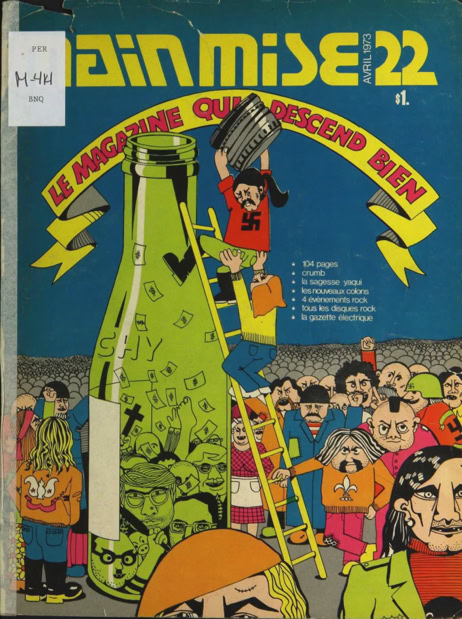
The concert was reviewed on the April issue of the French-Canadian magazine « Main Mise »
CONCERT DATE|14 March 1973 Music Hall, Boston, USA
Pictures by Ron POWNNALL
«Pink Floyd, flashing into Mi sic Hall, Wednesday March 14, bewitched the sett-out ai dience with its inspired misical and theatrical performance, Amidst so many groups which mistake showmanship for nxisicai ability, Pink Floyd stands cut as being unique and original. Foregoing the use of a warm up group. Pink Floyd assumed the fuli responsibility for the success or failure of the show. That responsibility nestled in good hands, for by the end of the evening, the audience sat stu ruled at the misical adventure that is a Pink Floyd concert. Finding their places in darkness, Dave Gilmore's piercing lead gjitar joined with the deep throbbing bass work of Roger Waters, Nick Mason’s thunderous dramming and the quick keyboard work of Richard Wright, As they launched into their opening song, “Careful With That Ax, Eugene” from their album entitled “Ummapimma”, a silver encased disk resembling the nose of a jet began to rise towards the stars, Suddenly smoke began to pour forth and: lights began flashing. The mesmerizing effect of the music perfectly Gomple merited the fascinating light show. The “ball of fire”, aispended in center stags,threw swirling darts of tight racing through the audience. Coupled with nusic one would expect to hear emerging from an extraterrestrial spaceship, the light show had the effect of making one feel he had just stumbled onto Merlin’s cave of supematural secrets.
Pink Floyd, in command of their music, “Set the Controls for the Heart of the Sun” and blasted into a cosmic clashing of elements. The lighting effect followed the beat of the song, one moment stow and mournful, the next angry and tu nu Itous. Sounding like the pounding hoofs of galloping horses, the music raced across the concert hall, bounced off the outermost rafters and walloped the viewer, making himfeel he had jail witnessed the Charge of the Light Brigade- from under the horses hoofs.
Following “Heart of the Sun”, Pink Floyd act the hall reverberating with the electronic eloquence of “Echoes”. With pittari screeching and pillows of smoke billowing forth, “Echoes” demonstrated the thematic versatility of the group. Characterized by changing tempos expertly engineered. Pink Floyd's creation delighted the mdience. After a bedlam of applaitc, the group took a short break before beginning the second half of the concert.
While most of the materiel from the first hour was older, more established songs, the source for the recond psrt wts from iheir newest album “The Dark Side of the Moon.” Beginning with the sound of a cash register ringing up sales, snd closing with chirchbell cnimei, “Dark Side” lights up this dde of the concert series of interrelated, episodic journeys into the frontiers of music, Ihe new material illustrated the creative innovations being explored by Pink Floyd. With the encore of “One of These Days'*, Pink Floyd closed one of the most visually exciting and musically satisfying con certs of the season.
A concert which challenged Pink Floyd’s visual experience was the theatre antics of the super Mr. Alice Cooper at the Boston Garden, March 26. Alice has a certain flair for exposing Ihe sublime as the absurd and the absurd a9 utterly ridiculous. Cooper’s attraction rests in his outrageous udaclty in acting out fantasies the rest of us would hesitate to tel) our psychiatrists, let alone perform on stage In fifty ■six different cities, to be seen by approximately eight million admirers. Monday night was a rough night for Alice at he was victim*cd by a mad dentist with a drill that wouId have been more liable for the Jolly Green Giant than ninety pound Alice, lie parodied the American belief that cleanliness is next to godliness by fighting off a giant cavity (as big as a man) with an equally large tooth brush, and then going to meet his Maker (whoever and whatever that may be) as he lost his head on the guillotine. Appropriately, he sang “I love the Dead’*. Returning from the dead he celebrated his resurrection by singing "School's Out" and throwing pictures of himself to the audience.
Levels of reality, or un-reality, are explored through dances of fantasy, through the theatre of the absurd which Alice choreographs. The tense, dynamic, energised, electronic nvisic pro dice it by Cooper, Neal Smith, Glen Buxton, Dennis Dunaway, and Mike Bmce real Us in arch songs as "Dead Babies", "Eighteen", and "No MOrc Mr. Nice Guy."
The encore was a show In itself us 'Telephone Is Ringing" and "I Got You Undo- My Wheels" meet the excited applause of an audience gone as cruey. probably as Alice, It all ended on a note of parodied patriotism as Kate Smith sang "God Bless Ameiicu" on pre-recorded tape , and Cooper and Co. sail fed the American Flag.
The Stars and Stripes and the Union Jack provided the background for Berk, Bogert and Apptce at Music Hell, March 28. Jeff Beck, this time around, has teamed with drummer Carmine Appice and bass player Tim Bogert, both of late of the Vanilla Ridge and Cactus. The result is good, with strong iunky rock n'roil nines reminiscent of the late sixties rock scene, while still being innovative in their own right. The music is. for the most part, locomotive-fast pace and evenly spaced chords producing a high energy level. In contrast to the rock-theatrics of Pink Floyd and Alice Cooper, Beck, Bogert and Appice just play fine music with few frills and flukes».
«Pink Floyd challenged by A. Cooper’s Theatrical Antics», Boston Mass Media, 23 April 1973
«(…) One of the tightest acts in the business, precisely organized, musically together and neatly coordinated with a plethora of intriguing visual effects»
New York Times
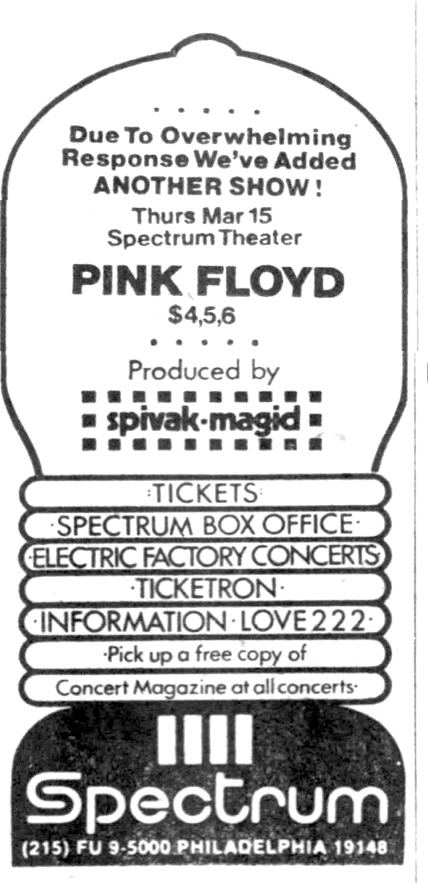
CONCERT DATE|15 March 1973 Spectrum Theater, Philadelphia, USA
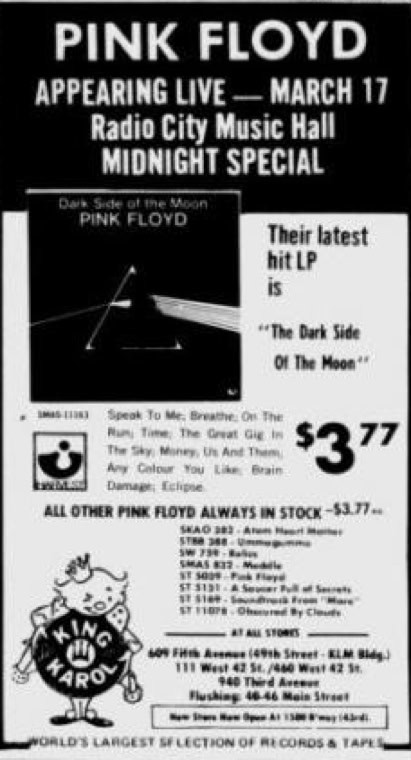
CONCERT DATE|17 March 1973 Radio City Music Hall, New York City, USA
Due to technical problems, the concert only begin after midnight
Nick Mason:
«Arthur Max transferred us from coloured slides and 35mm projectors to something bigger. Even the whole cherrypicker thing what we debuted at Radio City Hall»
«To Infinity... And Beyond!», Uncut, May 2019
«Time apparently has no meaning for New York's rock ‘n’ roll audience. Radio City Music Hall was full yesterday morning from 1:30 to 4:15 as Pink Floyd, a British group, went through its audio‐visual paces. Pink Floyd itself is a quartet that has hung together for a long time (since 1964) with relatively high stability in terms of personnel. The result is one of the tightest acts in the business, precisely organized, musically together and neatly coordinated with plethora of intriguing visual effects. Yesterday's program began with a varied group from earlier albums and continued, after a break, with the band's latest release, «Dark Side of the Moon» The first half was, the more interesting, full as it was of Pink Floyd's characteristic “sci‐fi rock,” with a predominance of long, brooding instrumentals highlighted by Rick Wright's inventive work at piano, electric piano, electric organ and synthesizer, plus a clever 360‐degree sound system. The second half was more fragmented and conventionally rock in its roots. Visually, things were dominated by a huge sphere hung above the stage on a futuristic light‐tower scaffolding. The ball emitted steam in a way that suggested photographs of the sun and its corona, cast dappled mirror‐dots throughout the hall, and even came forth with a few needle‐like red lasers. In combination with the Music Hall's own fog effects, it all looked pretty spectacular».
«Pink Floyd offers Rock in Music Hall», New York Times, 18 March 1973.
«It was here that the Pink Floyd turned out an exciting set last week, with a stage half a-block long, and a 6,200 seat theatre on four levels as their basic props. It was billed as a midnight concert, but was then rescheduled for one a.m. to allow a presentation of the film "Tom Sawyer” and the Music Hall’s Easter Show to precede it. But through the evening there was a long and lively queue of people outside waiting for the several thousand non-reserved seats on the orchestra levels, and one over-enthusiastic guy even tried to break through a side door. As the doors opened at midnight, some of the audience were trampled in the crush and pushing-match to get inside. At one-thirty the lights dimmed, the audience- stood, clouds of steam shot upwards from the vents in the stage, and the Floyd rose into view on one of the elevators: three light towers, with a reflecting dish mounted on the centre one, created a glowing, hypnotic effect as you looked at the stage. The elevated stage section reached its full height, then began to inch slowly forward, and the crowd roared approval — they seemed younger than the crowds I've seen at Floyd concerts before, mostly male and teenage. The Floyd obviously have a cult following here, similar to the Allman Brothers and the Dead. Special mention ought to be made of the Floyd's lighting and sound crews who seemed never to miss a cue, and the 20-speaker quad system with speakers on all levels of the hall gave a close, almost headphone .sound. The music start-* ed with some of their well-known, older pieces like “Careful, With That Axe Eugene". “Obscured By Clouds” and '‘Echoes'* which ended the first half. The second half was the new album “Dark Side Of The Moon”, (on which they used three black girl singers! with an encore of “One Of Those Days”. The fifteen-foot dish hanging from the centre tower glowed and steamed in the lights, and at one point as the red spots caught it the effect was of red laser beams flashing through the dark hall. Other times when the lights caught it it looked like one of those mirrored globes they had at '30s balls. The Floyd were at their best, and the stage presentation was one of the best I’ve seen in a hell of a long time. They played well, everything cooked, it was professional, tight, and just short of being phenomenal. The . thing -was* the Floyd understood the Radio City Music Hall and used it to its best advantage. The audience came to be dazzled — and they went home happy. It was a memorable evening, and one which will be talked about for years»
«Floyd: at home in Radio City», Sounds, 7 April 1973
«Last week in New York, Radio City Music Hall was used to its best advantage thus far as Pink Floyd (Capitol) played to a capacity audience for a 1 a.m. concert. The group, well known by now for its visual and aural effects, held the audience in captive attentiveness. A huge silver globe hung suspended from the ceiling, shooting out streams of colored smoke, and blinding white lights aimed at the globe shot back into the audience with dazzling, almost psychedelic effect, especially at one point when the globe and the rays of light froze still, stopping time for one bizarre, incredible moment.
The group performed many of their by now standard concert songs from their several albums, most highlighted by David Gilmour’s powerful lead vocals. Most exciting, however, was the material from their newest album. "Dark Side Of The Moon." These songs are more melodic than anything the group has done before. In fact, at times, a distinct Moody Rlues-like quality could be heard. "Brain Damage" and “Eclipse" were magnificently rendered with the help of three excellent black women doing back up vocals, another first for the group. Radio City Music Hall has never before used sound to even good advantage, but Pink Floyd changed all that, as speakers were placed throughout the theater to create a wall of sound. Some of the special audio effects were chilling. Musically, group members Nick Mason, Richard Wright, Roger Waters and the aforementioned Gilmour created a three dimensional tapestry of melody and sound in a concert as uniquely effective as it was superb. Definitely, this was one of the very best live shows ever in New York»
«Pink Floyd stunning at Radio City», 7 April 1973, Record World
«Rising amid a cloud of red fog in utilizing the magnificent facilities of this grand old hall, Pink Floyd wasted no time in mesmerizing their audience of 6,000 plus as the group continued their latest U.S. tour. In keeping with past tradition of expect the unexpected, the Floyd magnificently utilized special lighting and stage effects and performed material from their latest Harvest/Capitol album. “The Dark Side of The Moon” as well as older material in fully entertaining the stunned gathering. In what would seem to be one of the highlights of any staged rock performance, a huge silver disk, set twenty feet above the band, circled in a cloud of red fog and was occasionally hit with powerful white spotlights which sent thousands of light stars rushing throughout the hall creating a magnificent cosmic effect. The remaining special effects, were limited as Radio City would not permit possibly dangerous events to occur on stage hut regardless, Pink Floyd once again kept their tradition of “cosmic consciousness” alive and left many in the crowd in eager anticipation of future Floyd appearances»
«Talent on Stage», 31 March 1973, Cash Box
«With so much talk over the past year about rock getting more and more theatrical, everyone seems to have forgotten Pink Floyd. The Rolling Stones stunning stage setting last summer drew national attention, even in the newsmagazines. The theatrics of Alice Cooper have been covered to a fare-thee-we?*. The costumes of David Bowie and Edgar Winter and Roxy Music have been photographed and commented upon again and again. But aside from Alice Cooper, a freaky little ensemble from the beginning, the grotesque theatrics of the past year have been something new for the rock concert audience. Meanwhile, there was Pink Floyd. This fine British band has been around nine years to be exact. They are the world’s foremost proponents of “Space Rock,” a category they inhabit virtually alone. They have been exploiting this style since their beginning, while other better known bands have dabbled in everything from rhythm and blues to reggae and back in the hope of finding rock’s next big sound. Pink Floyd has had no doubts.
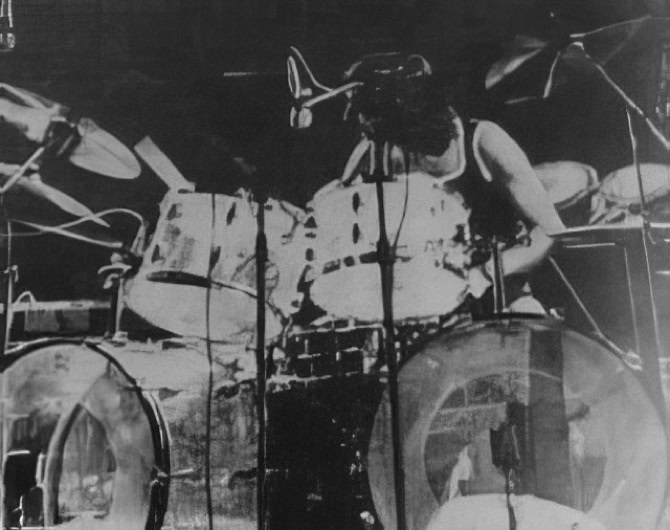
Once the favorites of a small cult following, Pink Floyd has now gone public, if the audience on the current tour is any indication. Their New York show was scheduled for the unlikely hour of 1 a.m. to take place at cavernous Radio City Music Hall after the final movie showing. While Floyd’s roadies set up their elaborate stage equipment in a quick 90 minutes, 6,500 fans braved the late-winter winds on the sidewalks outside, two across and three blocks long. It was worth the wait. Pink Floyd has arrived on our shores with a stage setting that is a veritable Rube Goldberg dream contraption. It is more astounding than the Rolling Stones movable mirror and enough to make Alice Cooper send his gallows back to the prop shop for refurbishing. At center stage, to the rear of the band and atop a giant spotlight tower, they have engineered a six-foot sphere which lights up, spins at different rates, spouts smoke, sends flashing dots of light in swirling patterns throughout an auditorium, and have managed to make the ball shoot out red laser-like rods of light. This infernal machine is not only an eye-catcher, however, but an integral part of the music the band plays. Floyd is known for its gadgets, specifically a special sound system which is installed in the round, with speakers on all sides of the audience. By moving a lever similar to an airplane’s joy stick, the sound being made at any particular moment can be made to swirl around the house. This, with the mechanical ball device, would be enough for any band, but at Radio City the band had more. Smoke, for instance, which they dispersed through the ball. And strobe lights rigged to trigger inside the transparent-skinned bass drums when they are hit. And lots more.
«Space rock is an area only Pink Floyd inhabits», The Central New Jersey Home news, 1st April 1973
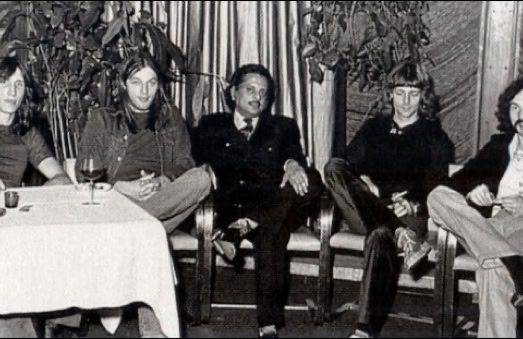
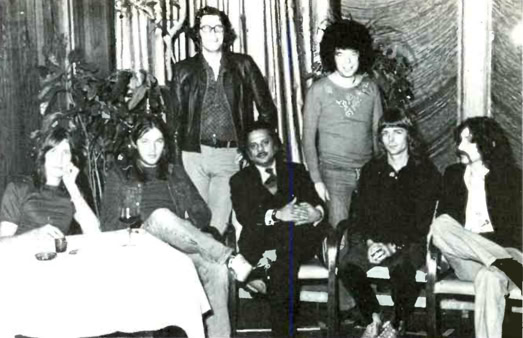
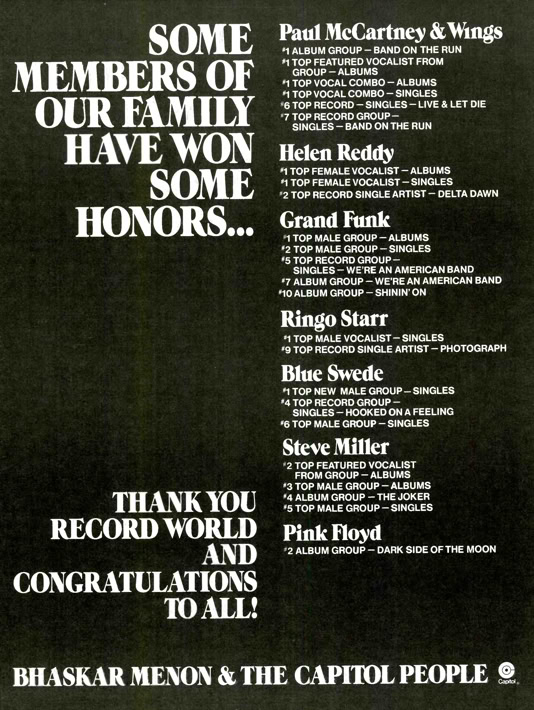
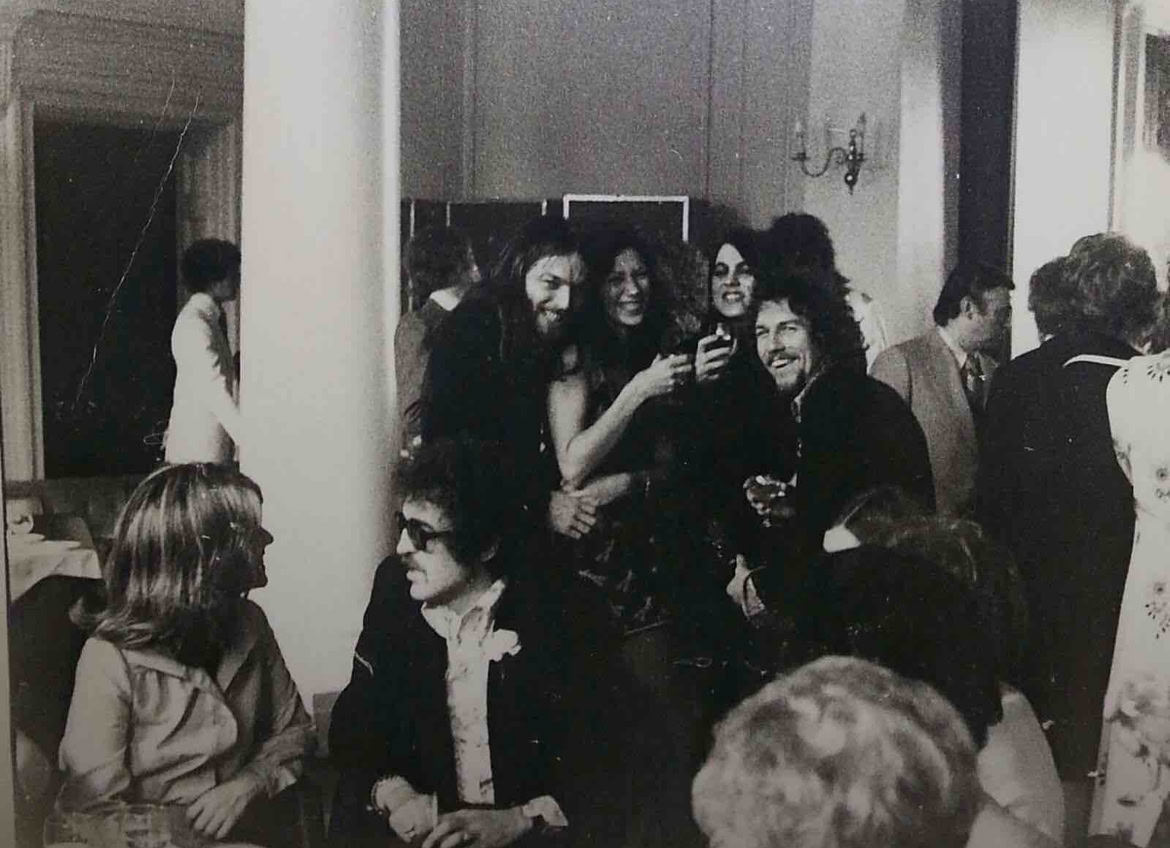
MISCELLANOUS|17 March 1973 The band is invited by the director of Columbia Bhaskar MENON and Steve Sru YAHM at the Four Seasons Hotel of New York, USA.
On the left: Mauri Lathower, Bashkar Menon, Steve O’Rourke and Al Coury. On the right with Steve Sur YAHM
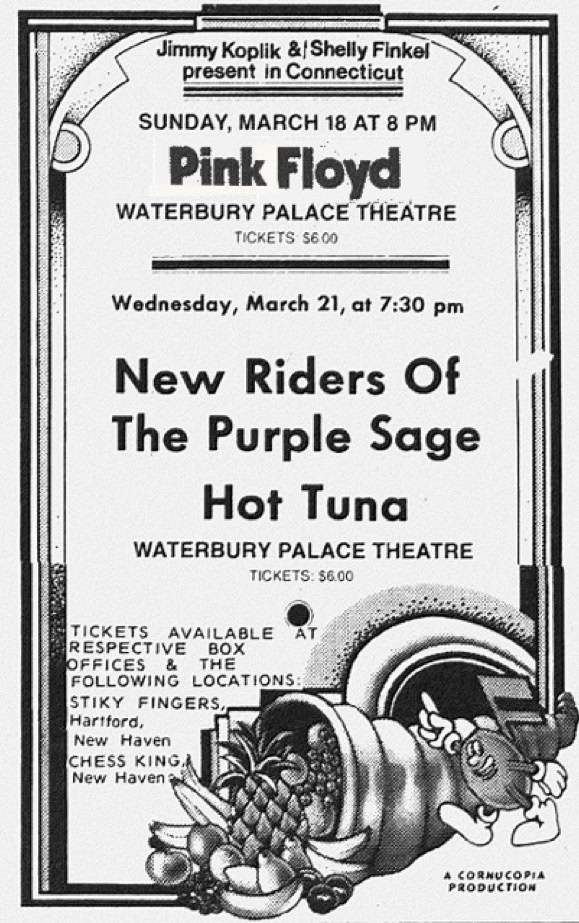
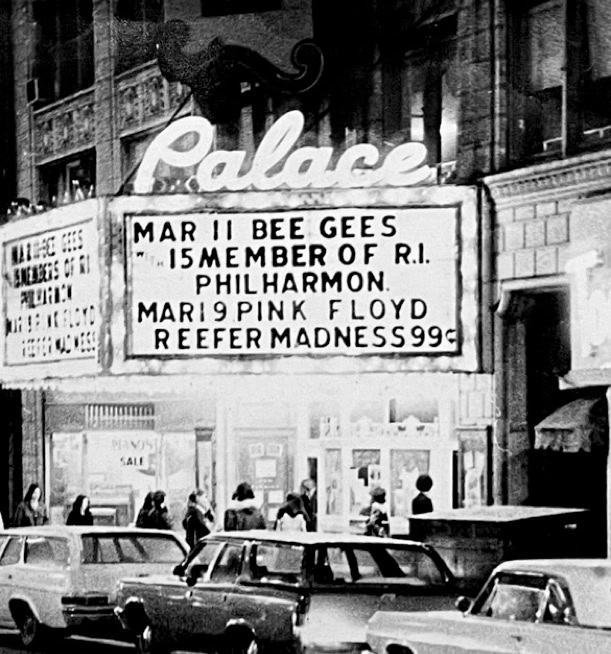
CONCERT DATE|18 March 1973 Palace Theater, Waterbury, CT, USA
CONCERT DATE|19 March 1973 Civic Center, Providence, USA
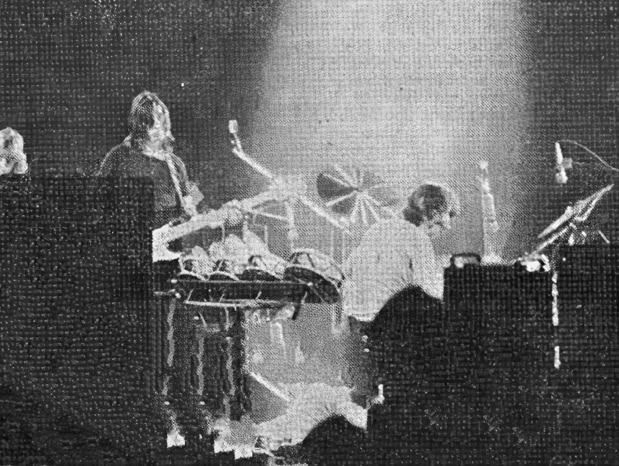
«The 360-degree sound of lhe British quartet grabs the audience al the Providence Civic Center Monday night. On stage, the members of the group got it on with organist Rick Wright bathed In a shaft of light seemingly coming In from outer space. With rays of light as a back-drop bassist Roger Waters Is silhouetted on stage, far right. Free-form rock at ils best»
«Pink Floyd space music circles Civic Center», Providence Journal, March 1973
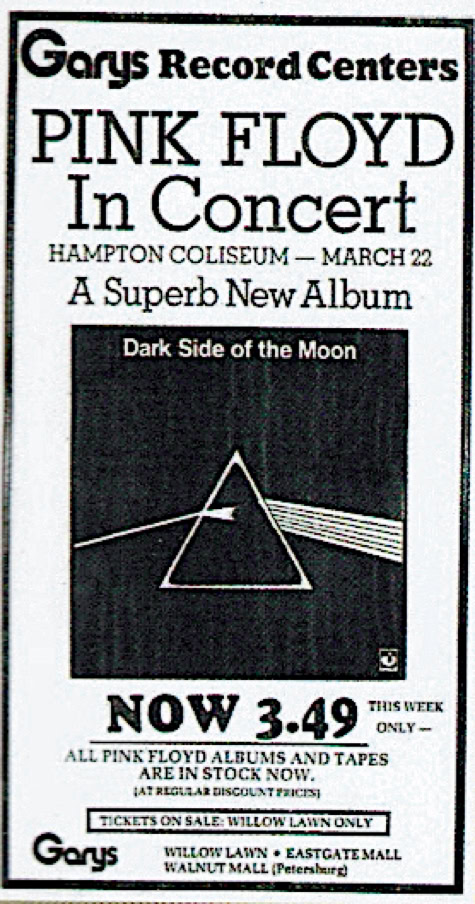
CONCERT DATE|22 March 1973 Hampton Coliseum, Hampton, USA
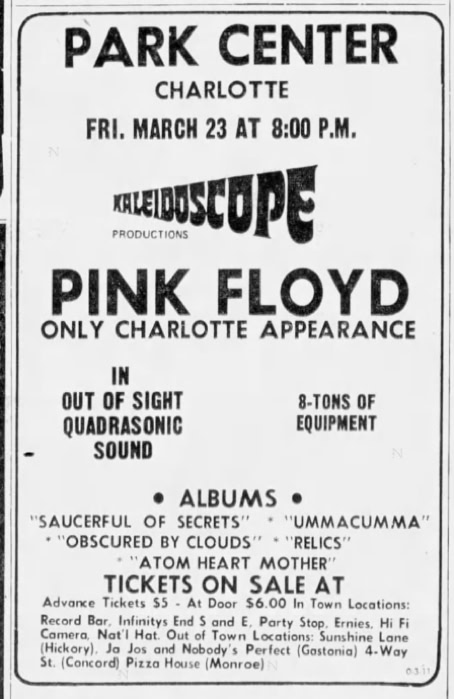
CONCERT DATE|23 March 1973 Charlotte Park Center, Charlotte, USA
«A sizeable segment of young America practically hung from the rafter Friday night at the Pink Floyd sight and sound shows in Park Center. It was a jam session in that it was standing room only then some. Pink Floyd is an experimental rock group specializing in quadrophonic sound and mixed media sensations. It is not a disappointing organization. Regular instrumentation includes two guitars, organ and drums. But sound equipment and lights argument the instruments to the point of taking over.
What Pink Floyd is a gong, moody, cymbals kind of music messenger, not above using pyrotechnics, electronic locomotive sounds and whoops vaguely reminiscent of Martin Denny to emphasize mood.
Pink Floyd is Spike Jones with visuals and without laughs. Outside the Auditorium itself, bunches of customers wandered the corridors in search of seating and many simply squatted in convenient open spaces. Pink Floyd is a thoroughly equipped and disciplined organization. Vocals were few and to the point. The name of the game was mood through sight and sound. And the description of the mood was lugubrious and mystic.
With an 8 p.m. scheduled opening, the group started at 8:15. Customers were still pouring in main-floor ticket holders sat on bare floor. Audience reaction was that of high reception to the point of being participatory on a sensory level. In other words, everyone seemed to groove nicely»
«Sound lift kids on ‘Pink’ cloud», The Charlotte Observer, 24 March 1973
«A sizeable segment of young America practically hung from the rafter Friday night at the Pink Floyd sight and sound shows in Park Center. It was a jam session in that it was standing room only then some. Pink Floyd is an experimental rock group specializing in quadrophonic sound and mixed media sensations. It is not a disappointing organization. Regular instrumentation includes two guitars, organ and drums. But sound equipment and lights argument the instruments to the point of taking over.
What Pink Floyd is a gong, moody, cymbals kind of music messenger, not above using pyrotechnics, electronic locomotive sounds and whoops vaguely reminiscent of Martin Denny to emphasize mood.
Pink Floyd is Spike Jones with visuals and without laughs. Outside the Auditorium itself, bunches of customers wandered the corridors in search of seating and many simply squatted in convenient open spaces. Pink Floyd is a thoroughly equipped and disciplined organization. Vocals were few and to the point. The name of the game was mood through sight and sound. And the description of the mood was lugubrious and mystic.
With an 8 p.m. scheduled opening, the group started at 8:15. Customers were still pouring in main-floor ticket holders sat on bare floor. Audience reaction was that of high reception to the point of being participatory on a sensory level. In other words, everyone seemed to groove nicely»
«Sound lift kids on ‘Pink’ cloud», The Charlotte Observer, 24 March 1973
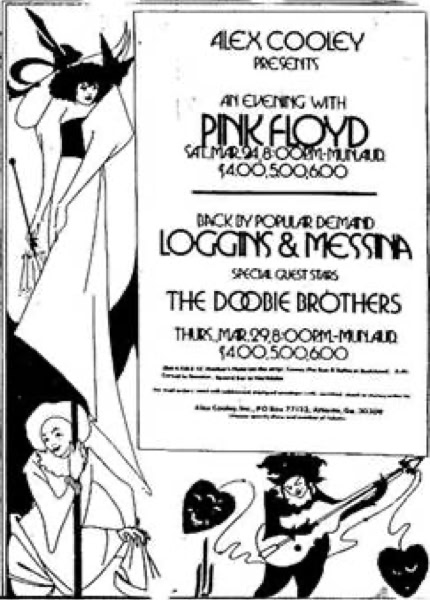
CONCERT DATE|24 March 1973 Municipal Auditorium, Atlanta, USA
«We walk into the Aud Friday night. I’m feeling skeptical. I’m afraid I’m expecting too much. I’m not an easy person to please. Inside people are standing, finding seats, playing with balloons and beach balls. It’s all familiar. We’re a multitude, packed tight as a corncob. The lights go down low. I’ve never seen so may pilot lights. Nick Mason’s drums are painted with a seascape. Expansions of amplifiers and electronic equipment and.speakers span the stage. Gilmour, Mason, Waters and Wright come out. They tune for a bit. Their first set begins, a collage of earlier songs. John Cage once said he thought music would reach the level when consonance could be achieved with the use of electronics. He might’ve had the synthesizer in mind. They play “Set The Controls For the Heart Of The Sun”. The mikes are on echo. Beneath the banks of multicolored lights.
Roger Waters evokes his bass and voice through waterfalls. He assaults a gong 360 degrees of flame. A space suited figure hangs aloft. The lights are in constant trajection. I think they’re the care of Mick Lowe. “Careful With That Axe, Eugene” begins somewhere in excess of first worldly. Musical plenty. Rick Wright, only his head showing above his equipment, is doing extraordinary things back there. There’s an organ and something much like it, but a different device, that evades like a comet. “Echoes.” I haven’t heard the word transversing for awhile. None of them seem to be setting the pace. They just fall into step. Gilmour delivers spurts of lead. He adjusts controls at his feet On a plastic white table with sunken control' panel. Below Nick Mason’s drums a strobe light animates them. Both Gilmour and Wright occupy regulators.
Distant sound that rushes close and recedes. What sirens sound like through a tunnel. Music traffic at rush hour. Intermission. Somebody yells boogie. People laugh, llie white light seems strange. It’s time to stretch. They’re playing “On The Run”. Pure fever. The action of the song’s taking place behind the music. Nick Mason’s drums urge. There’s the sound of footsteps running. Meeting a deadline. Reaches culmination and I picture engines spitting the exhaust of ignition that fade and the ill result is all too evident as the footsteps spend. Three black women come on stage. They are petite. There’s an unrest raining and sensitive piano. “The Great Gig In The Sky.” Clare Torry. Her voice wails. Beautiful control. “Money it’s a gas / Grab that cash with, both hands and make a stash / And I think I need a Lear jet”. The audience whimpers. Dick Parry joins them for the sax stint. The organ drips notes from every speaker in the house. “Us And Them.” A masterpiece. A highly palatable organization of music. Wright is the self-assuring bellows providing fuel for the rockets. Parry is a perfect escort. Mason’s percussive is relentless. Gilmour bites off crisp notes from his guitar. “Any Colour You Like.” Wright effuses organ notes like yawns. Waters takes a thumping ride through the low register. Thank you. Goodnight. I’m happy. The huge room resounds with clapping. More, More. Waters leads them back for an encore. Controls are readjusted. What’s it gonna be? The sound of wind comes over the speakers. An E-string begins to vibrate. “One Of These Days.” 1 can’t thank whoever invented quadraphonic. Moog synthesizer eclipses. Gilmour evokes whining notes from his fender. A mirrored sphere rises behind the stage, rotating, casting pinpricks of light everywhere. Lowe turns everything on. The music fades. Pink Floyd exists. I’m happier. Happiest»
«Sceptics enjoy Floyd sound» , The Spectrum, 29 June 1973
PRESS MENTION|April 1973: A canonical interview of Roger and Nick is published on the April issue of « Zig Zag » magazine.
MISCELLANOUS|April 1973 the band Unicorn is invited to playing at the wedding reception of Ricky Hopper (friend from Transatlantic days).
David Gilmour, one of the guest, joined the band to play a jam and a rendition of Neil Young’s «Heart of Gold». A week later the Pink Floyd guitarist phoned the band to say that he had just installed a studio at his country retreat and asked if they wanted to demo some songs there. The band immediately accepted.
A few days later they travelled up to Essex to Gilmour's estate. He showed them into the studio and said there was no need to bring any of their gear in from the van. They recorded three songs and David added some Fender Pedal Steel Guitar which he had just bought on his last American tour and was learning to play. They were invited back on several occasions to record.
Some months later, Gilmour will produce their first solo LP
David Gilmour:
«When I first saw them and while I was impressed by their vocal harmonies, their tightness and the fact that it was the drummer that sang the lead vocals, it was the songs themselves that I liked the best. Ken Baker's songs, while firmly seated in the American country rock genre had a very original and unusual wry English feel in the stories he told. The one that really made me notice was 'Sleep Song', about a trip to the dentist. Not a common subject for the popular song. Largely on the strength of this I invited them to my tiny home studio in Essex to record some demos. This was the start of an association that was to cover two and a half albums over the next couple of years»
« Melody Maker »
MISCELLANOUS|Late April 1973, the promoter Robert Paterson announces that Floyd will give a benefit show on 18 May at Earl’s Court.
Steve O’Rourke:
«It is now normal proceedure for the Floyd to play for charity in Britain, as we don’t get an opportunity to play here much. Part of the reason for that is there there are not many venues suitable to cope with the Floyd’s vast amount of equipment, now nearly 12 tons. There’s just nowhere to put it»
Cited in «Melody Maker»
Nick Mason:
«En mai 1973, j’ai reçu une carte de Robert me proposant de produire son disque solo. Le jour où la carte est arrivée, j’ai appris son accident, il avait sauté par une fenêtre et était paralysé à partir de la taille. »
«Pink Floyd, l'histoire selon Nick Mason NED.», Nick Mason, 2005.
MISCELLANOUS|May 1973, The New York’s Alvin Ailey Dance Company present a ballet composed of Pink Floyd music (among others)
MISCELLANOUS|8 May 1973, David and Roger attend the Roy Buchanan concert together
MISCELLANOUS|The group decide to make a special programme for the Earl’s Court concerts
Marchbank (designer company):
«For a special concert given by the Pink Floyd at London’s Earl’s Court, all proceeds going to the «charity shelter», the usual beautifully produced full colour glossy programme was felt to be inappropriate. Instead it was designed as a scrapbook, compiled by Marchbank from the band’s extensive archive of cuttings and personal photos from all stages of the Floyd’s history. It was printed in just pink and black»
Some pages from the 15-pages programme. You can see the complete issue on this page
CONCERT DATE|18 May 1973 Earls Court Exhibition Hall, Earls Court, London, England
First appearance of Dick Parry on sax and backing singers on stage.
Photographies by David Warner ELLIS
«I hope every manager, agent, promoter and musician in the land was at London's Earls Court on Friday. I hope especially that the people responsible for the David Bowie concert were there, and even more especially, I hope that those who are due to present rock concerts in this vast arena later this year were there, too.
For on Friday evening — and on Saturday loo — the Pink Floyd demonstrated in no uncertain way exactly how to present a show In front of such a massive audience. They were faultless in every department, and at the end of the night 18.000 fans left Earls Court shaking their heads in bewilderment. The Floyd have always been Innovators, both in their music and In their stage effects. At Earls Court, the two were combined to lake us all on a fictional voyage not only through time, but through the minds of Messr Waters, Wright. Gilmour and Mason, to whom the credit for the evening's entertainment Is indubitably due.The material they played differed little from previous Floyd shows in London, except that their current work " Dark Side Of The Moon " came in the second half of the show. The first half as Roger Waters put it, was for oldies, — Set The Controls, Careful With That Axe Eugène and Echoes — ait of which were greeted with whoops of delight by the partisan underground following to whom each Floyd concert is a celebration of almost religious fever.
Each piece was delivered with the casual knowhow of musicians who have played the same music time and time again. As We have come to expect from the group there was a quadraphonic sound system rigged up which enabled instruments and tapes to be delivered from every corner of the hall. The mysterious patterns of sound were each accompanied by visual effects to stimulate the ideas they create. During " Set The Controls," Waters' gong burst into flame, like the very planet he was heading for: during " Careful With That Axe " an inflatable man arose from behind Nick Mason, his green luminous eyes piercing through the white smoke that curled around the stage during most of the show; and during " Echoes " there was the traditional silver ball bouncing out rays of light which flickered across the hall and enveloped the whole scene in an aura of somehow untouchable beauty. A short Interval was Interrupted by loud heart-beats and as the group took their places on tho stage again, a roar of approval greeted the music the fans had come to hear. For the next hour we were treated to an elongated version of *' Dark Side of The Moon ", accompanied by three girl singers a saxophone, a preponderance of specialised lighting effects and — surely the surprise of the night — the sight of a large model aeroplane skimming over our heads and crashing into a ball of fire at the back of the stage.
After five minutes of consistent cheering the Floyd returned for a brief encore, which brought the crowds down to the front of the stage. And, as we lert the scene, the final touch was provided by a troop of soldiers from the regular ranks who shone brightly coloured searchlights into the sky. An evening to remember. And all for charity, too»
«A perfect Moonshot», Melody Maker, 26 May 1973
The « spaceman », a prop who was later abandonnes
Then came Echoes when, during the wind and crows sequence, tons of dry ice poured over the stage and swirled around to feet of the group and into the 18,000 strong audience giving a very effective MacBethian blasted heath scene. The second half featured «Dark Side of the Moon» complete with girl negro singers, a saxophonist and insane laughter which made full use of the quad sound system.
It has been said that the Floyd relied too heavily on taped effects to liven up their performances. Now they have integrated the tapes into their performances so well that the tape deck becomes another instrument contributing to a homogenous group sound rather than a separate entity.
The only disappointment for me was Great Gig in the Sky which failed to get off the ground. The girl singer seemed strangely inhibited and never ventures beyond «Whoah – oh» and «Yeah-ah».The end of «Dark Side of the Moon» came along with rockets being fired into the roof of the hall and the tolling of the iron bell, and the knowledge that we had been fortunate, nay privileged to witness this evening ».
«Review from John Baxter and Martin Whiker Kempton», Brain Damage # 21
« I hope every manager, agent, promoter and musician in the land was at London's Earls Court on Friday. I hope especially that the people responsible for the David Bowie concert were there, and even more especially, I hope that those who are due to present rock concerts in this vast arena later this year were there, too. For on Friday evening — and on Saturday loo — the Pink Floyd demonstrated in no uncertain way exactly how to present a show In front of such a massive audience. They were faultless in every department, and at the end of the night 18.000 fans left Earls Court shaking their heads in bewilderment. The Floyd have always been Innovators, both in their music and In their stage effects. At Earls Court, the two were combined to lake us all on a fictional voyage not only through time, but through the minds of Messr Waters, Wright. Gilmour and Mason, to whom the credit for the evening's entertainment Is indubitably due.
The material they played differed little from previous Floyd shows in London, except that their current work " Dark Side Of The Moon " came in the second half of the show. The first half as Roger Waters put it, was for oldies, — Set The Controls, Careful With That Axe Eugène and Echoes — ait of which were greeted with whoops of delight by the partisan underground following to whom each Floyd concert is a celebration of almost religious fever. Each piece was delivered with the casual knowhow of musicians who have played the same music time and time again. As We have come to expect from the group there was a quadraphonic sound system rigged up which enabled instruments and tapes to be delivered from every corner of the hall. (…)
A short Interval was Interrupted by loud heart-beats and as the group took their places on tho stage again, a roar of
approval greeted the music the fans had come to hear. For the next hour we were treated to an elongated version of *' Dark Side of The Moon ", accompanied by three girl singers a saxophone, a preponderance of specialised lighting effects and — surely the surprise of the night — the sight of a large model aeroplane skimming over our heads and crashing into a ball of fire at the back of the stage.
After five minutes of consistent cheering the Floyd returned for a brief encore, which brought the crowds down to the front of the stage. And, as we lert the scene, the final touch was provided by a troop of soldiers from the regular ranks who shone brightly coloured searchlights into the sky. An evening to remember. And all for charity, too »
«A perfect Moonshot», Melody Maker, 26 May 1973.
CONCERT DATE |19 May1973 Earls Court Exhibition Hall, Earls Court, London, England
«Some weeks previously, David Bowie had done a concert there, the first time the venue has served as a rock palace, and both fans and critics had been unanimous in their verdict. The show was a disaster, with terrible sound and nobody able to see what was happening on the distant stage»
«Pink Floyd», Rick Sanders, 1976.
«Forget Bowie's problems of a week ago. This was Pink Floyd and true to their position in music their performance at Earl's Court on Saturday was a total aural experience. A quad P. A. brought an extra dimension to the sound. The waves streaked all over the massive hall and at times the organ and synthesizer were almost visible.
Masters of mood creation, Floyd began each number slowly building to a sense-shattering peak. Then they let you gently down again before the number's end. The first half was full of old favourites like Set The Controls For The Heart. Of The Sun and Careful With That Axe Eugene, instantly recognised by a partisan crowd. Then came the spectacular second half with rockets shooting out from the stage during Money, their American single. Breath In The .Air followed with aeroplane sounds, spotlights scanning the roof, and ending with a ‘plane diving from the roof, crashing into the stage, and exploding. Wow! Finally a long version of Dark Side Of The Moon and again the heavenly sounds invading every fibre of consciousness. After a ten minute standing ovation the band encored with One Of These Days, and that was it. Everyone seemed sated as we left Earls Court to a background of spotlights searching the West London sky — truly a Floyd Triumph»
«Pink Floyd», Record Mirror, 26 May 1973
«Earl's Court, une semaine après le concert de David Bowie... La perspective de retourner dans cette salle immense, à l'acoustique déplorable, où la majorité des spectateurs n'a aucune chance de voir quoi que ce soit de ce qui se passe sur scène, ne m'enchantait guère. A cause de tout cela, le concert de Bowie n'était rien moins qu’un vol collectif. Que les Floyd fassent le même coup, même si l'on considère que l'intégralité de la recette allait être versée à une œuvre très méritoire (Shelter). c'était un peu dur à avaler. C'était sans compter sur le sens du spectaculaire dont ont toujours fait preuve les Floyd. et les ressources de leur fabuleuse sono. Le Pink Floyd fit ce que Bowie (ou plutôt son management) n'avait pas voulu se donner la peine de faire : ils organisèrent leur spectacle en fonction des proportions gigantesques de ce stade de 18.000 places, et pour cela ils déployèrent le maximum d'imagination... et de moyens. Et incontestablement, ils tirèrent le meilleur parti possible de ce cadre disproportionné.
Le répertoire fut sans surprise : ils débutèrent sur un instrumental et enchaînèrent sur une version profondément modifiée de - Set the control for the heart of the sun ». mais bien sûr. l'essentiel se composa d'extraits de «Meddle ». dont bien sûr « Echoes ». et surtout du dernier album : « Dark side of the moon ». Selon ce qui semble être l'habitude du groupe, on a pu par contre noter une certaine évolution dans l'interprétation de tous les morceaux, mais de toute évidence il faudra attendre un temps avant de voir se dessiner en concert le prochain album du Pink Floyd. comme ce fut le cas pour les précédents.
Mais c'est au niveau de la mise en scène que le groupe innova, allant plus loin qu'il n'était jamais allé dans ce domaine, utilisant finalement à son avantage le handicap que représentait en principe le fait de jouer dans un cadre pareil. Je ne pense pas que le Pink Floyd puisse faire beaucoup mieux, maintenant. à moins qu'il ne fasse construire sa propre salle, totalement arrangée pour le show du groupe. Et qui sait, il en arrivera peut-être là !
D'où j’étais, au balcon, les quatre musiciens m'apparaissaient minuscules, mais enveloppés dans un halo de couleurs changeantes, créé par un fantastique arrangement de projecteurs, tandis qu'à chaque roulement de batterie de Mason des éclairs s'échappaient d'en dessous de son instrument, par la vertu de quelque stroboscope. Mais c'est leur sono quadriphonique qui. dans cet immense bâtiment provoquait le plus grand choc, en prenant des proportions titanesques. Comment décrire l'impression ressentie lorsqu'un déluge de notes de guitare vous provient dune extrémité de la salle, alors que le guitariste n’est qu'une toute petite silhouette là-bas. de l’autre côté ? Et cette batterie qui tonne aux quatre coins d’un bâtiment aussi vaste que la gare du Nord ? Ah. si seulement Bowie avait eu une sono analogue la semaine précédente I
La première partie fut encore la moins spectaculaire. Composée d'anciens morceaux. comme « Set the control... » déjà cité. « Careful with that axe. Eugene » et surtout de larges extraits de « Meddle » ; elle permit surtout d’apprécier plus que jamais l'esthétique quasi parfaite de la musique du Pink Floyd. Ceci dit. lorsque Waters poussa son fameux cri. qui prit une ampleur plus inhumaine que jamais, doublé d'une violente explosion à l'arrière de la scène, on avait beau s'y attendre, l'effet de surprise subsista quand même ... Mais ce à quoi l'on ne s’attendait pas. c'est ce que le groupe nous réservait pour la seconde partie, pendant laquelle il Interpréta la quasi-totalité de « Dark side of the moon ». Ils nous prirent par surprise : chacun vaquait encore alentour que les pulsations de ■ Speak to me • emplissaient déjà la salle de façon de plus en plus insistante. Et soudain, ce fut l'obscurité. La tension monta avec « Breathe ». sur le rythme obsessionnel duquel les faisceaux de multiples projecteurs fouillèrent le « ciel » de la salle, en balayant chaque recoin et éblouissant les spectateurs au passage. On s'attendait à chaque instant à voir apparaître le mystérieux UFO qu’ils cherchaient manifestement et. effectivement, soudain. il apparut I Suivant les injonctions de quelques-uns. tous les regards se tournèrent vers l'extrémité de la salle opposée à la scène, des hauteurs de laquelle descendait en piqué, droit vers le groupe, une petite fusée qui laissait derrière elle un sillage de flammes ! Elle alla s'écraser derrière la scène dans une formidable explosion, au milieu de l’ahurissement général... Du point de vue spectaculaire, ce fut sans conteste possible le paroxysme du concert, encore qu'il y eut quelques autres effets réussis. particulièrement lorsque, le groupe ayant joué sa dernière note, quatre feux d'artifice oranges jaillirent de la scène et allèrent se « perdre » vers l'autre bout de la salle. En fait, il semble que tout comme la fusée, ils étaient dirigés le long de câbles. L'obScurité se fit alors et un instant plus tard quatre nouvelles boules oranges saluèrent le retour du groupe pour un dernier morceau... Musicalement, par contre, le sommet fut bien sûr atteint lorsque le bruit familier d'un tiroir-caisse annonça le fantastique - Money ». salué par des cris de satisfaction. Et Dick Parry était là avec son saxophone pour donner toute sa dimension au morceau et d'ailleurs aussi pour en ajouter une à plusieurs autres. Le Pink Floyd s’était également assuré la participation de trois choristes, indispensables pour l'interprétation de « The great gig In the sky ». mais qui. elles aussi, participèrent plus largement. Cela laisse peut-être entrevoir dans quelle direction le groupe va maintenant enrichir sa musique, poursuivant la vole ouverte par Money sans pour autant renier ce qui a fait son originalité jusqu'à aujourd'hui. Une chose est certaine, en tout cas : aussi bien scéniquement que musicalement. le « vieux » Pink Floyd a plu que
jamais son mot à dire, et on peut sûrement compter sur quelques surprises à venir …»
«Pink Floyd à grand spectacle», Best, June 1973
«Earl’s Court Halle in London. Fassungsvermögen: 18000 Personen. Normalerweise Austragungsort von Industriemessen und anderen wirtschaftlichen Happenings. In sporadischen Abständen auch mal Rock-Mekka. Der Ort, wo David Bowie in einem Sound-Disaster unter-ging. Mitte Mai: Pink Floyd In Concert. Die Götter des Pop-Olymp laden zum Flug - hin zur Schattenseite des Mondes, zum Trip in die Gedanken-und Schaffenswelt der eigenwilligsten und neuerungswütigsten Gruppe der Popgeschichte. Das 18000köpfige Publikum harrt mythosgebannt, in fiebriger Andacht. Take-Off ins Ufo-Land. Utopische Sounds, gekoppelt mit dem pochenden Beat des Rock-Zeitalters, strömen aus allen vier Ecken der Mammuthalle. Visuelle und akustische Elemente verbinden sich zu einem eindrücklichen perfekten Ganzen. «Set the Controls» - der überdimensionale Floyd-Gong explodiert in einem gleissenden Flammenmeer. «Careful With That Axe Eugene» - aus dem qualmenden Hintergrund entwächst ein drohendes Monster mit hypnotischstechenden grünen Augen. Rockende pochende Herztöne leiten über zu «Dark Side of the Moon». Ein Riesenjet schwebt über die Köpfe des Publikums, stösst über der Bühne mit einem Feuerball zusammen und löst sich in Flammen auf. Das Publikum rastunersättlich. Noch einmal erscheinen sie, in banalen Jeans und T-Shirts und trotzdem unerreichbarer als David Bowie in seiner ganzen dekadenten Herrlichkeit. Aus. Götterdämmerung. Doch vor dem Riesenportal der Earl’s Court Hall geht die Show weiter. Militärcamions mit farbigen Suchscheinwerfern bestrahlen das herausströmende floydtrunkene Volk. Das graue Londoner Vorortquartier präsentiert sich als strahlendes unwirkliches Märchenland. Das perfekte Nachspiel auf ein unvergessliches Happening …»
«Pink Floyd», Pop Magazine, August 1973
Nick Mason:
There was an Earls Court gig a few years ago where we reached a real kind of peak considering the acoustics of the place, we'd really got it under control, and it was very good. And after that we changed our PA and we didn't get it quite right and we were saving money by buying cheap mixers, and things like that... we were buying 36 channel quadrophonic mixers for £1500! [laughs] Which is just silly! 'Cos of course the things are gonna fall to pieces and be endless trouble, but that's all we could afford at the time.
«Pink Floyd Story - Part 4», Capital Radio, December 1976
Peter Watts, photographed by Jill Furmanovsky
MISCELLANOUS |23 May 1973 « Pink Floyd Music Publishers Limited » is created in London (at 71 Queen Victoria Street) with Andy Mabbett as director.
MISCELLANOUS |From 28 May to 31 May 1973 Rehearsals for the forthcoming US tour
June 1973 US Tour itinerary
MISCELLANOUS |Early June Nick Mason and his wife buy a house in the south of France, near the Bill Wyman’s home.
MISCELLANOUS |2 June 1973, Nick Mason receives a postcard from Robert Wyatt, asking to produce his future solo project.
Nick Mason:
«En mai 1973, j’ai reçu une carte de Robert me proposant de produire son disque solo. Le jour où la carte est arrivée, j’ai appris son accident, il avait sauté par une fenêtre et était paralysé à partir de la taille. »
«Pink Floyd, l'histoire selon Nick Mason
Greetings from the band to the Earl’s Court crew.
MISCELLANOUS |5 June, Pink Floyd take Flight Pan American PA103 from London to New York. Departure 13:30, arrival 16:05 the band resides at the City Squire Motor Inn hotel during all concerts in New York
CONCERT DATE|17 June 1973 Performing Arts Center, Saratoga, USA
CONCERT DATE|18 June 1973 Roosevelt Stadium, Jersey City, USA
New record in the Jersey City stadium, grossing $ 110,565 (the entrance fee was set at $ 5).
«Pink Floyd, England’s four-man musical avant-garde, appeared at Jersey City’s Roosevelt Stadium Monday night, opening a series of concerts to be presented there this summer on an unusual if favorable note.
What was unusual about the three-hour performance of this electronic-music-plus-rock group was that tons of props and other paraphernalia were employed by the group to add an ultraspectacular visual dimension to the show. Smoke screens and walls of flame shot up from the stage throughout the night, and the climax of the show was a Fourth of July style fireworks presentation which fell short of displaying a flaming American flag, but included skyrockets and aerial bombs.
All these sights added to the show tended to have an overwhelming effect, and they served to act as something of a distraction rather than as a means of enhancing the proceedings. They also seemed a bit unnecessary for a group like Pink Floyd which offers quite an elaborate sound package in concert. Certainly the 10-foot rocket, which was flown from the press box above the stands over the heads of the people and down to the stage, was a bit too extravagant.
Musically, however, the group was in perfect form, and it ran through numbers from most of its records. They offset the complex electronic numbers with more listenable basic rock songs, showcasing what is the essence of their work: synthesized electronic music built on a solid base of simple rhythmic patterns. Keyboard player Rick Wright and guitarist Dave Gilmour dominated the show, Gilmour’s extended-note guitar solos being particularly outstanding. Wright apparently had such control over his bank of instruments that he was able to put his moog on automatic and walk to the rear of the stage while he was hidden from the audience by one of the smoke screens. What speaks favorably for the series of concerts is that the sound was perfectly balanced despite the fact that the group had to fill a large open-air space. The audience was seated in a wide arc around the stage set in the center of the circular stadium’s playing field, and this arrange ment compensated for the sense of remoteness from the musicians one feels at mass-audience concerts».
«Pink Floyd Rocks 'Em’», The Evening News, 22 June 1973.
CONCERT DATE|19 June1973 Civic Center Arena, Pittsburgh, USA
CONCERT DATE|20 June 1973 Merriweather Post Pavilion, Columbia, USA
«The most accurate word for what sets the music of Pink Floyd apart from most modern rock is intelligence. The Pink Floyd group has never opted for mere effect. The effects they do make are precise, well thought-out and never beyond the boundaries of either good taste. It is heartening to find a group like Pink Floyd achieving the stature of a super-group. A few years ago, their following was for the most part cultist, and their music was often considered to be “space music” or pseudo-psychedelia. One of the great strengths of the band since it began has been its mastery of technology. Pink Floyd was one of the first groups to experiment with quadraphonic sound systems. The quadraphonic development forces a bombardment of the sense that in other concerts is rarely more than one-dimensional. It is a case of 360 degrees of sound, as opposed to face-to-face confrontation. The mastered technology is of little value without music of substance. Luckily, Pink Floyd have also developed an original and quite often fascinating brand of music. For instance, in “Set Your Controls For The Heart of the Sun”, the incescant rhythm of the song gradually increases, creating a feeling of acceleration, speed and itensity one might feel in stardrive. The subdued passage that follows effectively suggests the ambiguity of spce free-fall, the twilight zone of timelessness and weightlessness. The visual presence of a flaming gong is a particularly moving symbol of the live-giving, ethereal powers of the sun. The song concludes with a rapid re-acceleration and return to normality. The song was a highlight of the concert. If Pink Floyd has one weakness it is in their lyrical development and their vocal delivery. Their strength lies in their technological mastery mixed with superb musicianship. David Gilmour has developed into one of the more astute and powerful gutarists in rock, avoding the easy path of distortion to mask incompetence. Keyboard man Richard Wright has also become quite masterful on the moog, rejecting the tendency to overuse that instrument. On the opening number, he skillfully wove dancing images around a basic drone that occasionally exploded into standard heavy-metal rock. The only sour note in the concert was sounded by the habitual small group of insensitive and seemingly mindless patrons who insisted on filling the aisles and refused to cooperate with Merriweather Post Pavilion officials in creating a safer, more comfortable atmosphere. Should the Pavilion reconsider its programming in he light of these few offenders, the Metropolitan area will suffer a loss of its most comfortable and promising rock concert hall. Pink Floyd will do a repeat performance tonight at the Post Pavilion»
«Satisfying Rock», Evening Star, 21 June 1973
CONCERT DATE|21 June 1973 Merriweather Post Pavilion, Columbia, USA
CONCERT DATE|22 June 1973 Buffalo Memorial Auditorium, Buffalo, USA
CONCERT DATE|23 June 1973 Olympia Stadium, Detroit, USA
Photography by Robert CAVALLO
«Pink Floyd is a superb group. They utilize some of the best effects of Musique Concrete, and as well, often dwell in those monochromatic regions where Terry Riley has done some of his finest chord and syncopative experimentation. Combinations of tape delay, echo, white sound and distortion season the quartet's guitar, bass, drums and keyboards - which include a VCS-3 synthesizer. If they don't blow themselves up first, their explorative music will add a lot to the field we call «pop.»»
«Flashpot Goes Berserk; So Do Pink Floyd Fans», Detroit Free Press, 24 June 1973
The concert became famous for an incident that caused a stir in Detroit. The band detonated a mortar during Careful (the scream sequence). It turned out that the barrel had been badly measured. 60% of the speakers were destroyed and many spectators received debris. A recording of the show was broadcasted during the radio series «Your mother didn’t like this» on 1976. We can hear the crew working on the light show.
CONCERT DATE|24 June 1973 Blossom Music Center, Cuyahoga Falls, USA
«When a rock group reaches the level of excellence Pink Floyd has achieved, and when it is rewarded with enormous popularity, one tends to watch for signs of deterioration in performance.
Happily, the four who call themselves Pink Floyd seem to be perfectionists. Their appearance last March at Kent State University was nearly impossible too fault, and yet they surpassed it Sunday at Blossom Music Center. You go home from a Pink Floyd concert satisfied that whatever your ticket cost - even if you bought it at scalper's rates in the bumper traficc on Ohio 8 - you got your money's worth.
Pink Floyd has mastered the ability to play at bore-crushing levels of volume—to the point where the music is physically felt— without being abrasive or offensive. No matter how loud things get there is no distortion, the complex textures remain clear, separation is maintained between instruments, and drummer Nick Mason measures out the beat with iron control. There is, in fact, a fascinating discrepancy between the group's sonic output and its visual appearance. No matter what level of apocalyptic fury the music reaches, the performers seem as relaxed, off hand and contented. This group hangs looser and plays tighter than just about anybody in heavy rock. Sunday's concert began with some relatively quiet material that demonstrated the group's ability to be lyrical and reflective when it wishes. There was more than a little Oriental flavor, with melodic lines from Rick Wright’s keyboards conjuring thoughts of the Far East. And this music has a structural sophistication that is satisfying and involving—an event- filled trip, but unhurried and relaxed. The pace quickened with material from Pink Floyd's “The Dark Side of the Moon” album and it all seemed fresh and inventive despite the high familiarity of the numbers The light show which accompanies Pink Floyd was more varied, more subtle and even more responsive to the music then in the Kent concert. It seems obvious that a good deal of care goes into tailoring the lights to the characteristics of each hall where Pink Flovd performs, and the interior surfaces of the Blossom pavilion turned out to be marvelously well-suited for the glittering gimmickry. The audience, by the way, Staged its own light show in return — saluting Pink Floyd with a glowing sea of matches, cigaret lighters and sparklers to coax an encore. (Blossom Center personnel] are declining this year to announce attendance figures, but Sunday's sellout crowd exceeded 18,000. Besides all the polish and precision, there is still an air of spontaneity about Pink Floyd appearances. The group puts you at ease with its effortless control, but holds out the feeling that anything might happen»
«Pink Floyd masterful at Blossom Center», Akron Beacon Journal, 25 June 1973.
The Pink Floyd concert was swamped with more youths and more problems with the residents of Northampton Twp. near Blossom
Kenneth Haas (assistant general manager of the Cleveland orchestra):
«Part of the problem with the Pink Floyd concert was that psychologically no one was prepared for it (the large crowd estimated at well over 20,000). Our only dismaying problems were the kids crashing the gate, rushing the fences and littering»
CONCERT DATE|25 June 1973 Convention Center, Louisville, USA
Backstage photographies by David ALLEN
«Pink Floyd’s glowing starship touched down briefly in Louisville last night and left the natives agape with a technically dazzling display of sound and pyrotechnics. The English quartet who pioneered electronic space rock landed with a sample of their early galactic music, mellowed out some with a complete exhibition of their new album, “The Dark Side of the Moon,’’ and then lifted off aga.in with an encore that had the sell-out crowd of near 7,000 at Convention Center in mind-warp.
Both the theatrics and the music got excessive at times, but the earthlings who paid $6 and $6.50 to get their brains damaged seemed to love it all. Dry-ice smoke, levitating stage lights, exploding bombs, fiery gongs, strobed moonbeams — Floyd left nothing to the imagination. A roadie noted proudly during intermission that the band carried a licensed pyrotechnician with them on the road, the very man who just completed the blow-up scenes in the new James Bond movie. Pink Floyd also carried with them what must be the most elaborate — and best — sound system ever to hit the Louisville rock concert scene. There were banks of speakers on all four walls and a nimble sound man had the hall swirling in quadraphonic from the opening “Obscured by Clouds’’ to the finale, ‘'One of These Days.” There was no warm-up band for this extraterrestrial group. Floyd came out, smoking, quite literally, and slowed down only for a few cuts from the new album. Richard Wright’s keyboards dominated the space sounds, though lyricist-bassist Roger Waters had the audience gasping when the gong that symbolized our star in “Set the Controls for the Heart of the Sun” burst into flames on command.
A bomb explosion in the next number so filled the auditorium with smoke that Floyd lost their alien subjects for awhile, until the deep guitar break in “Echoes” won them back. After an hour of tripping through inner and outer space, came a 20-minute break and then another hour, all the new album. Flashing lights on the front speakers during “On the Run” had the crowd transfixed again.
And even “Money,” an awful sounding record on AM radio, took off with David Gilmour’s guitar work. A trio of ladies who back Leon Russell added a nice touch to a few numbers and Dick Parry’s sax solo in “Us and Them” was especially soft and rich. When Floyd left the stage after more than two hours, their newly won subjects called them back with some pyrotechnics of their own, a sea of glowing cigarette lighters. But after one more song, Pink Floyd lifted off for good»
«Pink Floyd touches down leaving audience agape», The Courier Journal, 26 June 1973
CONCERT DATE|26 June 1973 Lake Spivey Park, Jonesboro, GA, USA
CONCERT DATE|27 June 1973 Jacksonville Coliseum, Jacksonville, USA
CONCERT DATE| 28 June 1973 The Sportatorium, Hollywood, USA
Photography by Al SATTERWHITE
CONCERT DATE| 29 June 1973 Tampa Stadium, Tampa, USA
Photographies by Jay L. HANDLER
«There were two shows at Tampa Stadium lost Friday night — one on stage, the other In the stands. The show on stage. Pink Floyd, was a beautiful dream. The other, a nightmare. The nuisance part of the program was provided free of charge by a sizeable minority of the estimated 26.000 people In the audience. Social atrocities performed by members of the crowd upon one another were frightening and distracting. Minor idiocies such as obstructing others’ view and shouting constantly pale beside the stupendous inhumanity evidenced when hundreds of fireworks were deliberately and unrelentingly shot into the densely populated parts of the field. The uncomprehensible lack of sense or respect shown by those in the stands seemed to dominate the scene for anyone on the field near the stage area. The show on stage was something else. The Pink Floyd performance represents an achievement of unmatched sophistication in the world of live presentations.
'There were no supporting^ acts. No music was played over the magnificent sound system until the Floyd themselves took the stage. Then they proceeded to fill Tampa Stadium with a quality sound. Unperturbed by the insanities of those in front of them, four superb musicians created sound upon incredible sound. They utilized three (or more) huge truckloads of equipment to produce an audio-visual experience of power and artistry. Unlike a typical "rock” group. Pink Floyd can create great volume without offending even the most sensitive ears.
To put Pink Floyd in a category with other groups is difficult and probably unfair. But what they play Is undeniably some type of “space music.” That is, the listener does not jump up and down and holler "Boogie” for Pink Floyd. Nor does he remain detached from the music simply because he is not in motion. This is one group that has the power to move souls, to transport consciousness, even while it entertains in a most pure sense.
With aplomb and taste, this quartet performed both as a unit and as individual stand* outs. And all the while that quadraphonic sound system with the countless speakers was surrounding and filling the stadium with a musical vision designed to broaden the horizons of even the most jaded listener. The concert was in two parts. The first consisted of slightly older material, including “Set the Controls" and the well-known* freak-out, “Careful With That Axe, Eugene.” Both these and the last song of the set,. “Echoes,” were brilliantly arranged productions that showed off the band's individual virtuosity as well as their powerful collective vision. The four musicians, Richard Wright, Roger Waters, David Gilmour, and Nick Mason, seem to take equal shares of responsibility and leadership.
The visual aspects" of the0 concert were original, dynamic and quite in keeping with the spirit of the total presentation. The- use of strobe lights, flashing banks of yellow bulbs, and two Hollywood-type searchlights was executed for maximum effect. And they put the firecrackers of the malfeasants in the audience to-shame with their huge pinwheels and flashing fireballs. Most of the music was from "The Dark Side of the Moon," and the Floyd were able to enhance the wizardry they first produced in the studio. Their selections sounded "Just like the record" for the first few stanzas; then remarkable improvisation and the best live build-up possible took over. Even sitting in the very outer reaches of Tampa Stadium, one became a passenger on an exotic space ship for the duration of the concert. They sing well, too. And Roger Waters beats a mean gong. Richard Wright knows what he can do with a synthesizer better than anyone since Walter Carlos»
«Pink Floyd rises above audience», St. Petersburg Times, 2 July 1973.
«The Stadium was treated to one of the best sounds it has .ever heard last Saturday night. Pink Floyd brought all of its sound to every corner of the stadium-with a dynamic force that set a few people back on their heels. Frequent fireworks set off by the crowd continued despite warnings.
"Floyd" would start easy, build slow and then erupt into cataclysmic sight and sound that more than once brought a nodding audience to its feel. Huge, volcanic, balls of fire belched from the stage in a shock treatment that'left the crowd stunned at first and then responding with cheers.
It was a 360-degree sound, a quadrophonic experience that came off surprisingly well for the open air concert. The show started while the sun was still up. That detracted some from the lighting effects and when the sun went down the neighboring Al Lopez field shone its baseball lights but there didn't seem to be any complaints from the crowd.
The group, the only grt>up, took a short intermission and then came back to present "Dark Side of the Moon." The cuts from its most recent album floated dreamily and then shattered suddenly in what grew to be the way of "Floyd" — lead the crowd along gently and then drop it on its head»
«Pink Floyd to change the pace », The Evening Independent, 7 July 1973.
CANCELLED GIG|The participation of the Floyd to the Frankfurt’s « 3rd British Rock Meeting » is cancelled due to apparently to the will to stop touring for a while
MISCELLANOUS|July 1973. David and Ginger Gilmour take vacation for the first time in Lindos, Greece.
Ginger Gilmour:
As one rounds the last corner just before you get to Lindos from Rhodes, the view still takes my breath away especially at night. The village twinkles with the streetlights through the orange trees and the boats in the bay light up the harbor like Christmas. In the distance, you can hear the cicadas and the rustling of the leaves. Night flowering Jasmine, Orange and Lemon trees create a floating fragrance. The stillness takes one into another reality of time. Storybooks are written upon such magical beauty, set off by the stars in the sky. The Knights Castle’s silhouette is revealed each night by the light of the rising orange moon. And there we were in Love, holding hands, held captive in a timeless moment»
«Memoirs of the Bright Side of the Moon», Ginger Gilmour, 2015
RECORD RELEASE| On 6 July 1973 The quadriphonic version of « Atom Heart Mother » is published in England.
Advert for the Strawberry Studios
MISCELLANOUS|August 1973, Dave Gilmour received a call from Rocky Hopper about a young talent named Kate Bush. Gilmour is invited to the weeding of Jerry Shirley
MISCELLANOUS| September 1973 The band takes a break until early September but didn’t made a come back on the road or in the studios before October!
David Gilmour:
«Last June, we came back off a US tour and decided to take a rest. For some reason it seemed to last a bit longer than expected».
«Floyd void; lunar probe list in space», New Musical express, 5 October 1974
On the left, the Gilmour(s family with Ian Moore in England. On the right, Rick with two friends; Socrates and Nikos in Greece.
CONCERT DATE| Early October An impromptu gig is held at the Union Society Cellars of Cambridge by Syd Barrett
Peter Brown:
« And this was the guy who everyone was saying was a vegetable and all that, playing some very good jazz guitar»
MAIN EVENT| The 16-minute film « A Long Drawn Out Trip » was screened on October 6, 1973 (8.15 pm) as part of BBC-TV’s arts programme called « Second House ». A special viewer was Nick Mason who rang immediately Roger Waters
Roger Waters: «He rang me to say: «Check this out! I think we should do something with this guy» So I did check it out – it was beautiful, exquisitely insane – so I rang Nick and I said, «He’s obviously fucking mad, let’s get him on board»
Nick Mason: «I saw Gerry’s film «Long Drawn Out Trip» when it was first shown on the BBC (…) and Roger and I independently saw it on the BBC»
David Gilmour: «I remember «Long Drawn Out Trip». I sa it late at night on BBC 2 and when I saw the others the next day Robe asked had I seen it. I said yes, it was fantastic. He was the one who did something about it - I just thought it was great»
«The Making of Pink Floyd The Wall», Gerald Scarfe
Gerald Scarfe:
«It was Nick who first contacted me in 1973 to ask if I would consider working with the band (…) Although I had heard of Pink Floyd, of course, I was by no means a fan. Nick seemed to me a kindly, gentle, witty soul who was very careful to treat me with respect, being extremely complimentary about my film. Nick asked me to come in his house, St Augustine’s Road, Camden, to talk over the project and to meet the others «
«The Making of Pink Floyd The Wall», Gerald Scarfe
Gerald with the film of « Long Draw-out trip ». The negatives had been lost since.
RECORD RELEASE| 10 October 1973, « Pin-ups » of Bowie is released with a cover of See Emily play
Interviewer: « Do you remember his cover of See Emily Play ? »
David Gilmour: « On « Pin Ups », right? I remember listening to it at the time, and finding it very good. But to tell you the truth, I haven't listened to it for years. »
«Je suis un cas», Rock & Folk, January 2008
MISCELLANOUS| The first public evidence of this artistic collaboration was a quintessential Scarfe cartoon of the band in rehearsal, a stone’s throw from Kings Cross station in London, in October 1973.
Gerald Scarfe:
« I spent several hours sketching all four of them while they played, during which they sent out for depressingly limp hamburger from the Wimpy Bar next door. When Roger saw the finished drawing he remarked how separate Rick looked from the rest of the group. I had in fact, for convenience, drawn Rick on another piece of paper and stuck him onto the corner of the main drawing like an appendage, and that’s how I think Roger saw Rick - an «appendage», a non-contributing member of the group (…) Roger saw my drawing as symbolic (…) Rick always seemed isolated, set apart from the other three»
«The Making of Pink Floyd The Wall», Gerald Scarfe
Nick Mason:
«I think we all sort of carry a bit of guilt about Syd but also slightly the same with Rick, that he became a little bit the one who was pushed out. I always think if it hadn’t been for Rick it could have been me»
«The Making of Pink Floyd The Wall», Gerald Scarfe
Gerald Scarfe:
«I didn’t know what I was going to meet but they were all surprisingly civilized»
« The Making of Pink Floyd The Wall», Gerald Scarfe
CONCERT DATE| 12 October 1973 Munchener Olympiahalle, Olympia Park, Munich, West Germany
CONCERT DATE|13 October 1973 Stadthalle, Vienna, Austria
The band playing Set the Controls for the Heart of the sun on stage in 1973.
Press kit
MOVIE RELEASE |2 November 1973 North American première of « Pink Floyd live at Pompeii » (titled « Pink Floyd ») at the Kent Theater in Montréal.
MISCELLANOUS | 3 November 1973 Short rehearsal at the Nick’s Home (St Augustines’s Road) with the new backing vocalists before the « Robert Wyatt » benefit show.
CONCERT DATE| 4 November 1973 « A Benefit For Robert Wyatt », Rainbow Theatre, Finsbury Park, London, England
Pictures by Mick Rock
David Gilmour is photographed by Jill Furmanovski.
Clare Torry is invited to sing The great gig in the sky for the first time in live (the second will occur on june, 30th 1990). The band invited Gerald Scarfe to attend the show too:
«Pink Floyd and Soft Machine stunned fans with two sensational shows at London's Rainbow Theatre on Sunday night. It was a splendid evening of rock-co-operation, in which both groups gave their services in aid of disabled drummer Robert Wyatt. Compere John Peel was pleased to announce that some £10,000 was raised. He said that Robert intended to carry on with a singing and recording career. The ex-Softs drummer was not present but was acknowledged by cheers from the audience. As two complex shows were performed on the same night, there were lengthy delays between sets which resulted in a certain amount of banter between the road crews and crowd. When the Softs finally came on for the second house, they were still dogged by sound problems. From my position near the right hand bank of speakers, only John Marshall's superb drumming could be heard with any clarity, although the combined keyboard riffs of Karl Jenkins and Mike Ratledge, wove an insidious pattern of great power and menace.
The Softs employed a cataract of sound in which improvised solos seemed of less significance perhaps than the overall blitzkrieg, but John's drums employed a fascinating range of tones, and his attack was at times frightening. There were no problems affecting the Floyd however, and they presented one of the best concerts seen this year; certainly one of the most imaginative and cleverly executed.
Dark Side Of The Moon, their last album was the main basis of operations, and the Floyd faultlessly combined quadrophonic sound, prerecorded tapes, lights, smoke and theatrical effects into a kind of rock Son et Lumière. There were many shocks and surprises along the way, and not having seen the Floyd for some time, I was frequently pinned back in my seat or ejected into the aisles, heart beating wildly. Heartbeats in fact commenced proceedings, pulsating through the auditorium and stilling the more excitable elements in the crowd. Clocks ticked mysteriously and with perfect precision the Floydmen slotted their live instruments into the recorded sound. The Floyd have a tremendous sense of pace. Occasionally they seem to overstate a theme or extract the last ounce from an idea, but the total effect is like coral growing on the seabed, establishing something deep, eternal and occasionally flashing with color. Overhead was suspended a huge white balloon to represent the moon, on which spotlights played, and not long after the performance began, searchlights began to pierce the gloom, and yellow warning lights began revolving in banks on the speaker cabinets. Meanwhile the music continued apace, Nick Mason excelling with his terse, economical drums, hammering home the heavy stuff where required, and tastefully bringing down the volume when 'ere a new tack or shift in course was signaled.
Dave Gilmour has one of the most difficult guitar jobs in rock, having to contain his own exuberance for the benefit of the greater whole, but making every note felt on his own inventive solos. Dave was particularly effective on the funky 'Money' which should have been a single hit for t'lads.
Rick Wright's keyboards were immensely tasteful and melodic, gently spurred by Roger Waters mighty bass lines. Instrumentally the Floyd are a finely tuned mechanism that surges ahead like an armored cruiser, oblivious to the smoke of battle. Indeed the band were enveloped in smoke throughout the performance, glowing red lights adding to the illusion of inferno and hellfire. A choir of ladies cooed like angels of mercy and as a silver ball reflecting myriad beams of light began to revolve and belch more smoke, the audience rose to give them an ovation. They deserved a Nobel prize or at least an Oscar. »
«The crowd applauded their exit * with polite enthusiasm, though few called for an encore. Not surprisingly for by this time it already looked as though the show was going to extend well beyond the midnight hour. A sizeable interlude followed before the Floyd took the stage to a rousing cheer, well earned withal and also a mark of respect for one of Britain’s premier bands, and a show of appreciation for a band which is all loo rarely seen in performance. What a fascinating contrast to the Soft Machine! For me the two bands have epitomised opposite ends of the same spectrum. The Softs, dry. un exaggerated, unashamedly exploratory. classical in the way they eschew large-scale drama and sound-effects, preferring to work within the range of natural sound form their instruments alone; the Floyd, grandiloquent, polished, fundamentally simple, romantic in the way they utilise all three dimensions of space and fill it with swirling sound with all means within the range of present electronic technology.
The pulse falls quickly in line with the pounding heart beat as the hall darkens, yet even so you start almost from your seat as the demented voice mutters in a shout from behind your left shoulder «I’ve been mad for years …» Sound seems to emerge from every comer of the capacious Rainbow Theatre, whose two-dimensional Hanging Gardens of Babylon have never seemed to be so alive and so mysterious as tonight, when the Moon will eclipse the Sun. From tape loops straight into the imposing instrumental lead in: a little stiff and out of practice perhaps, and sound ing slightly distant. But the Floyd are master showmen, absorbed though they may seem in operating the tanks of complex electronic gear, whence glow scores of red tell tale lights, for then it*s straight into that whirling Terry Riley-like section, as disembodied sounds whirl about the roof as if made concrete. Searchlights weave and probe the darkness, as if to pick out the ever-approaching roar, an’d then everyone catches their breath and ducks involuntarily as a silver plane dive-bombs the stage, as big as a jumbo jet it seems, and impacts with a spectacular explosion behind the band. Then amidst the swirling coloured smoke, the clocks, clanging and banging and ticking to the left and the right and in front and behind, and after this, and the cry of exultation from the crowd at the silver bird’s demise, the Floyd settle into a sonorous, moving exposition of their masterwork “Dark Side Of The Moon". Gilmour’s ringing filled out with confidence through “quiet desperation is the English way” and his guitar, never the most abrasive or technically wondrous, with the help of his box of tricks, soared out through space.
Time became inchoate during the second half of the performance: then the Moon itself rose behind the stage, smoking eerily (albeit wobbling slightly too. on its stilts) and with the full complement of ringers, came the urgent, compelling conclusion. And. as everybody knows, there is really no dark side of the Moon … The Moon was transformed into a Sun for an encore. “Set The Controls” I hoped, but no.' as the smoke descended to enwrap the group, it was «Obscured By Clouds». Outside. Finsbury Park was back in time and space. It did not look as though it was about to whirl away into utter darkness, but Robert Wyatt is nevertheless back with a chance»
«Dark Moon Eclipses Rainbow», Sounds, 10 November 1973
*The Soft Machine
«It would be justifiably easy to let the hackneyed superlatives tumble out but the Pink Floyd set at the Rainbow on Sunday deserves something more meaningful.
Visually it was the most exciting event I’ve witnessed this year and audially, though by no means perfect, it had the stamp of Floyd’s smooth class.
The decision to hold a benefit concert for Soft Machine’s paralysed drummer Robert Wyatt must have been a hasty one — there were a couple of technical hitches that needed ironing out — but it was well worthwhile. After Soft Machine had played a short, enjoyable opening set we waited impatiently as the Floyd tribe of roadies set out their enormous collation of equipment, including that dear old J. Arthur Rank gong. Gradually a pulsating heart beat echoed through the auditorium and ushered the band onto the stage for Breathe from «Dark Side of the Moon». For those who were at the Earl’s Court gig, the sight of a four foot wingspan model airplane gliding down from the balcony came as no surprise. For the rest of us it as almost as potent as the first taste of Floyd’s use of 360 degree sound. The intro of Money started to the left, crept to the back, the cash register came in on the right and then the sound swirled back to the stage where David Gilmour’s gutsy guitar lifted it to new peaks. If that wasn’t good enough there was also the soulful singing of the three lovely ladies used on the Dark Side album and every conceivable light show effect. Ad for their encore Floyd were enveloped in a fog of dry ice emitted from a Lilliputian sized moon suspended above the stage* «Money … it’s a drag» Maybe, but i’m glad I had enough for my ticket and I bet Robert Wyatt ain’t too unhappy with it either»
«Pink Floyd/Soft Machine», Record Mirror, 10 November 1973
*Echoes was played as encore for this gig.
«The concerts, in which the Floyd will perform "Dark Side of the Moon," are promoted by the groups themselves and proceeds will go to a benefit fund. First performance will be at 5pm and the second at 9pm. Tickets are limited to four per person and are available by personal application only. They go on sale at 11am today (Thursday). Prices: £5, £2.50, £2, £1.50. £1. Soft's manager Sean Murphy said he and Steve O'Rourke, Floyd's manager, came up with the idea of a concert independently, but simultaneously. "These two hands started at the same time in the same situation at UFO and Middle Earth,' said Murphy. "They're both marked out by the public as being extraordinary, different groups from the general theme. "They have similar attitudes and are quite similar people. Robert and Nick Mason are particularly close and the rest of them have always, been friendly. The Floyd felt a great attachment to the Softs and Robert's predicament." Nick Mason commented: "The scheme is to help Robert get off the ground with another band. That's what it's all about - it's no funeral. It's a special occasion. We're not into doing half-shows like this but there's a good reason for doing this one." Mike Ratledge of Soft Machine who was at school with Robert, said: "We and the Floyd haven’t played on the same bill for years so it's apt that the time we get together it's for Robert. “We’re glad to be able to do something. It's fantastic that it’s going ahead. Speaking from Stoke Mandeville Hospital Robert Wyatt, now paralysed from the waist down and confined to a wheelchair, told MM he hoped to be out of hospital before Christmas. About the concert he said: "Isn't it amazing? It's a dream I still can't quite believe it. It's quite an extraordinary thing for them to do»
«Floyd, Softs benefit gigs», Melody Maker, 3 November 1973
Garald Scarfe:
«The explosive visual effects that play an enormous part in the theatricality of their shows appealed to my delusions of grandeur’, and the seeds for a creative partnership were planted»
A large spherical inflatable moon was floated over the stage during this gig. Pictures of the moon were projected on its surface during the performance of Dark Side of the Moon. According Record Mirror this benefit show raised £10.000. It was the first time Nick Mason used his new drum kit with the famous display inspired by « the great waves of Kanagawa » (神奈川沖浪裏) of the Japanese artist Hokusai.
Nick Mason:
«It’s just a favorite painting of mine anyway, but we actually used it as a tour logo in ’72,1 think,” he said examining the vintage Ludwig drum kit. “It lasted really well and I’m very fond of it. I love the drums as sort of objet d’art. I have enormous affection for it, in fact, I’m having another kit made to look more or less the same because I don’t want to take this one out on tour so I’m making a new one»
«Pink Floyd: their mortal remains exhibition kicks off in LA with drummer Nick Mason», Daily News Website, 3 September 2021
Steve O’Rourke:
«No profit was mad anywhere - even trucks were loaned free»
«£10,000 boost for Wyatt», Melody Maker, 10 November 1973
Sean Murphy (Soft Machine’s manager):
«(It was) a unique atmosphere. The general feeling was very pleasurable»
«£10,000 boost for Wyatt», Melody Maker, 10 November 1973
On Novembre 1973: Release of the book on « Pink Floyd » by Jean-Marie Leduc
«Dans la collection «Rock and Folk», deux nouvelles études, l'une par Jean-Marie Leduc sur le Pink Floyd, l'autre par Alain Dister sur le rock anglais. C'est comme toujours bien documenté, solidement analysé et agréablement illustré de photos".
«Dylan, Rock et Pink Floyd», Le Monde, 23 November 1973
PRESS MENTION|In November, to replies to many reporters’ requests, EMI officially state the next album will be released the next year , produced by Alan Parsons and will be very different of « Dark Side of the Moon » (could be the « Household Objects » or « Electronic Sounds » project; see this page for more details).
Alan Parsons in Abbey road studios, late 1973.
MISCELLANOUS| From 12 November to 5 December 1973: Working session for « The Household Objects » at EMI Studios. Alan Parson mixes the sessions
MISCELLANOUS|Mid-November « Meddle » is certified as Gold Record by the RIAA
RADIO SESSION|28 November 1973 David Gilmour performs as a Unicorn guest for a BBC Radio One program.
MISCELLANOUS| Late December 1973 he band agreed to appear on a advertising campaign for the French soft drink «Gini». A photo session is held in the Marrocan desert. The deal include a summer French tour.
Roger Waters:
«Au début, c'était comme si nous avions gagné un prix, ils voulaient nous donner 50 000 livres pour des photos. Super, fantastique ! Ce n'est qu'après que je me suis dit : A-t'on vraiment besoin de faire ça?»
«Street Life», Rock & Folk, 1976.
Rick Wright:
«Mais il faut reprendre les choses du début pour comprendre. Steve (manager) était assis sur une plage, et un type est arrivé, qui lui a demandé une photo de pub du Floyd pour Gini. Steve a dit «OK. Ça vous coûtera 50 000 Livres !» (Information confirmée par le même Steve deux jours plus tard). Et de fil en aiguille, nous nous sommes retrouvés avec un contrat publicitaire, sans en être vraiment informés puisque nous n'étions pas là. D’ailleurs, Steve est notre manager, et c'est lui qui gère les finances du groupe. Qu’il se soit trompé, c'est certain. Nous nous sommes peu à peu aperçus des conséquences notre nom galvaudé et, qui sait, peut-être notre réputation atteinte aux yeux d'un public frustré. C’est alors que nous avons décidé de faire don de l'argent à l’enfance handicapée, problème que d’ailleurs nous suivons depuis longtemps»
«Echos du Palais», Rock & Folk, August 1974
Ginger Gilmour:
« Gini booked us into the famous La Mamounia Hotel, which previously had been a historical palace of the Rose City, and then converted into a luxurious hotel. As we entered the lobby of mosaics and carved plaster work, a man was walking away down one of the corridors. He had long hair and was wearing a Hawaiian Shirt. I commented to David that he looked a bit like Mick Jagger. David said whimsically, «That may be because it is Mick Jagger!» Being in the presence of all these rock legends was very new to me. I only ever saw them on telly, in a magazine or at a concert. And everything any of us, the normal public, knew about them was from the music papers and gossip. Here I was within their world. Mick was on holiday with his baby Jade and his nanny. Bianca had just left. Later, we were to meet up with him for dinner and a night out (…) After dinner, Mick suggested that we should go to one of his favorite discotheques. He said that David and I should come with him in his car and arranged another taxi for the rest of our party. He suggested that they should follow. Well, his driver drove like he was in Milan and the other car could not keep up. Their taxi disappeared as we drove through the ancient streets. I often wondered if that was intentional and Mick just wanted us. Once we entered the club, Jagger danced most of the evening in the center of the crowd, pawed repeatedly. We watched from our table in the corner. He with raised arms swirled with the music. The rhythmic beat carrying all to a fervor upon their heightened adulation. It was like a scene out of Suddenly Last Summer where Katherine Hepburn’s son was walking up the white streets into the sun with all these men admirers pawing him lustfully to his demise. The local fans devoured Mick and he loved it! When we returned to the hotel, some of the band was in the lobby. They wondered what had happened to us. David just shrugged his shoulders and did a David sheepish smile as we walked away holding hands returning to our room»
«Memoirs of the bright side of the moon», Ginger Gilmour
Roger Waters:
«Je rentrais chez moi en avion du Maroc et je me sentais très mal (à cause de l'épisode avec Gini), alors j'ai écrit le commencement du texte : « Je vendais mon âme dans le désert », et le refrain, c'est : « Comment te sens-tu, prenant les morceaux de mon âme? Comment, comment te sens-tu? Tu te sens riche? Tu te sens pauvre? Tu sens que ton temps est employé comme il faut ? Comment, comment te sens-tu ? » Ça, c'est le premier couplet. Et puis: « Les liens sont des actes de complicité / Brisent les illusions enfantines / Comment, comment te sens-tu ? » Non, je me suis gouré, dans le premier couplet, j'aurais dû dire: «Tu te sens bien, tu te sens pas bien, est-ce que tu sens que tu t es fait avoir ? » Et puis dans le troisième, il s’agit de la nuit et de la peur: «Je me tenais serré par une nuit mauvaise, à moitié dans le noir à moitié dans la lumière. Comment, comment te sens-tu? Tu te sens en sûreté, tu te sens blessé, comment, comment te sens-tu ? » (…) La chanson s'appelle Bitter Love»
«Floyd Roger», Rock & Folk, January 1976
RADIO SESSION|21 December 1973: Interview of Roger Waters for the BBC Radio show « Rockspeak »