Logo RPF general


The photographs displayed on this page were meticulously identified to correspond to the exact date and the name of the source the time they were captured.
However, errors may occasionally occur. If you notice any discrepancies or inaccuracies in the dates or other details, please let us know by sending an email here

Your feedback is invaluable to me, and we will acknowledge your contribution by citing you as a contributor. 

- 0  entries indexed on -

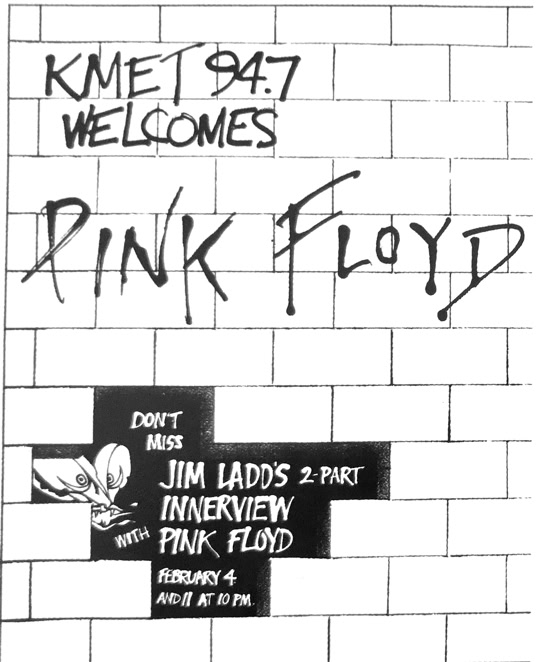
Prior the US tour, a massive promo campaign is made on the US radio. Here one of the radio advert:

 MISCELLANOUS | 1st January 1980, « Another Brick in The Wall » is certified platinum by the BPI

 MAIN EVENT | Early January 1980. The crew rehearsing the technical aspects at the Culvert studios.

Stage's view

The band rehearsing in the Leeds Rehearsal studios of Los Anglees with the additional musicians


David with Alice and the newborn Clare (top left), Roger and his son Harry (middle), Peter Wynne-Wilson and Snowy White (top right). 

Bottom: Peter Wynne-Wilson, Andy Bow, Mark Fisher and Rick Wright

 MAIN EVENT | Early January 1980. The band agreed with the publisher Chappell International Music for a record amount of £3,500,000. The deal last 5 year

 MISCELLANOUS | Early January 1980.The DJ Brian Battles is the first to reveals the hidden message on « The Wall » on his radio WLIR, New York.

 MISCELLANOUS | Early January 1980.The Canadian’s promoters and the authorities planned a Rock festival who packed together Led Zeppelin, McCartney and Pink Floyd. The promoters were counting on the release of the albums «In through the back door» (August 1979), « Back to the egg» (June 1979) but also on the release of «The Wall» originally planned for June. According to Donald K. Donald, the promoter behind the catastrophic group's gig in 1977, it seemed complicated to get the Floyd.

« Un projet de gros concert … », Le Devoir, 8 January 1980

« Un projet de gros concert … », Le Devoir, 8 January 1980

 MISCELLANOUS | Early January 1980 Pink Floyd began three weeks of rehearsals for The Wall live shows.
The musicians' rehearsals took place at Leeds Studios in Hollywood, and rehearsals for the show itself were held at MGM Studios in Los Angeles.

James Guthrie:

«Once the show started to take shape, the production rehearsals had to take place in the arena simply because the show was so enormous»

«Comfortably Numb - A history of the Wall 1978-1981», Vernon Fitch and Richard Mahon, 2006.


Gilmour:

«I was in charge of all the mechanics of making [the music] work. I had a six-foot-long cue-sheet draped over my amplifier for the first few shows, which I had memorized after that, so I’d know exactly where a rue would come from, because it could come from a floor monitor or from film. And I had one control unit to adjust the digital delay lines on my equipment, and Roger’s, Rick’s, and Snowy White]’s, so I didn’t really notice what was ping on around me terribly much»

«Comfortably Numb - A history of the Wall 1978-1981», Vernon Fitch and Richard Mahon, 2006.


Interviewer: «The Wall tour must have been a very different experience from the Animals one».

Snowy White: «Yeah. I knew what to expect by then on the road and in rehearsals. It was more of the same for me, just different songs. The fact that none of it was really anything to do with me made it a relaxing environment in different ways. I just kept to myself and played my parts the best I could. I didn’t have to worry about success or audience reaction or promotion or ticket sales. I just played. I mean, I saw the hard times going on and I just kept out of it. It was nothing to do with me»

Interviewer: «It’s an even bolder set list this time. It was just the new album and not a single old song»

Snowy White: « Yeah. That’s another brave move. You have to hand it to the band. You have to hand it to Roger, mostly, since he wrote most of the songs. But they wanted to do the whole thing. In those days, the technology wasn’t like it is now. They had these great, big 24-track studio tape machines on the road. They were massive things that were supposed to sit in studios. They used them to get some of the effects. Linking things up and making it all work was a major task. There was a lot of production rehearsal»

«Guitarist Snowy White on His Years With Pink Floyd, Roger Waters, and Thin Lizzy», Rolling Stone Website, 18 November 2020. 

 MISCELLANOUS | 19 January 1980 Roger Waters announces a concert at Wembley during « Rock on » radio show w/. Tommy Vance

 MISCELLANOUS | 21 January 1980 Pink Floyd begins three solid weeks of full dress rehearsals for « The Wall » at the Memorial Sports Arena in Los Angeles.

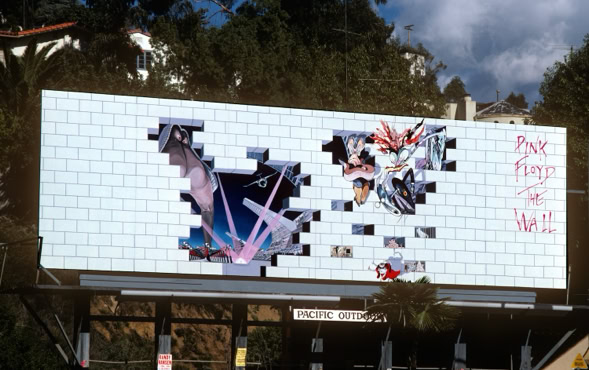
 MISCELLANOUS | 24 January 1980 A Billboard is erected on Sunset Strip in LA. To promote the album in USA.
At first a billboard depicting a blank brick wall appeared on the Strip and remained that way for several days. Over the next several weeks, the individual bricks were peeled away – slowly revealing graphic imagery and eventually the appearance of the record’s title.


Pictures by Robert LANDAU

« Pink Floyd are putting all the money they've saved by not paying the kids of Islington Green Schcol for singing ou Another Brick In The Wall to good use, you will be pleased to learn. The band have spent thousands of pounds to have a vast white, wall-like billboard erected on Hollywood's Sunset Strip. Every day workmen come and remove few "bricks" from the "wall" to gradually reveal a Gerald Scarfe illustration beneath.

All in all it's just another grand in the bank. »

« In the pink on Sunset Strip », Evening News, 24 January 1980

 MISCELLANOUS | Late January 1980. Birthday of Ginger Gilmour


 RADIO SESSION | 4 February 1980. Broadcasting of the special Jim Ladd’s « Innerview »


Jim Ladd:

«I met Roger in 1979 just as The Wall album was released and he was out here to do the live show in Los Angeles.  And I interviewed him for a radio show I was doing called «Innerview».And we did a, what was kind of a very different thing, and at the time the Innerview program was a kind of free flowing show that you would talk about all kinds of topics, but because I was so impressed with The Wall album itself, ah, rather than do a Pink Floyd interview, and I'd already done one of those with David Gilmour, we took The Wall cut by cut in order. 

And I think that Roger appreciated that because, you know, the album was new (…)»

«Am, Fm, Weather and News ...An interview with Jim Ladd by Michael Simone», Reg#11

 PHOTO SESSION | 6 February 1980 final dress rehearsals. Neal Preston shot the band.


Photographies by Neal Preston

Gerald Scarfe:

« Phil Taylor recalls the pandemonium backstage during the run-up to the opening night in Los Angeles. He remembers me painting the crossed hammers on the bass drum heads, amidst the general mêlée and confusion of the band production rehearsals»

« The making of Pink Floyd The Wall », Gerald Scarfe

Greetings for the Los Angles gigs and announcement for the concerts at New York by CBS

 CONCERT DATE | 7 February 1980 Los Angeles Memorial Sports Arena, Los Angeles, USA


Photographies unknow

The first concert of The Wall tour encountered an incident after a fire began when the plane crashed behind the wall. Waters decided to stop the show while putting it off.  It should be noted that the group must also improvise a long jam after "the last few bricks" to give the roadies time to finish mounting the wall.

Mike Tiano (Audience Member ):

« (…) Here is an example of where the visuals of the performance could elevate what audiences previously only heard. In this case, the lyrics from “In the Flesh?” took on greater depth: “Is there something eluding you, sunshine, is this not what you expected to see?” This could be construed as referring to the fact that we see the musicians clothed in storm trooper-like outfits (including armbands adorned with the double hammers), and/or that we weren’t seeing the actual members of Pink Floyd on stage as “expected.” As the song concluded, fireworks were shot from the stage to the arena’s upper regions.

Subsequently, the actual members of Pink Floyd joined the “surrogate band” to continue the show. But suddenly Roger Waters started to scream on mic for the band to stop the music — that wasn’t part of the album, so could this be a new wrinkle added to the album’s concept? With all the surprises that were in store, a new addition to the story didn’t seem outside the realm of possibility. After the music came to a halt, Waters revealed that his announcement wasn’t planned after all: the show had to be halted and the house lights needed to be turned back on because some of the fireworks had caused something (possibly curtains) to catch on fire under the roof of the arena. Looking upward one could see something was indeed smoldering up there.

The house lights flooded the venue, and a cherry picker appeared in front of the stage. A fireman holding a fire extinguisher rode it to get close enough to the embers. When he put out the fire, the audience cheered his success just as the one hydraulic not planned for the show was lowered. Roger Waters then returned to the stage to announce that with the crisis averted the show could now (must?) go on. He indicated to the band to start where they left off, and after the house lights went out the performance continued. That minor incident was washed away by everything that followed, which was evidence that Lon had not been exaggerating: Including the wonder of the mammoth inflatables, the scope of the production, and the tightness of the band performing new songs and extended versions of ones on the album. I was enthralled by what I was witnessing, and relieved that I was actually present. As the first half of the show progressed the stage crew started to add bricks on top of the others already in place. Eventually, the entire stage was filled with the white bricks leaving only an opening in the lower center. The process became a race against time: As I was already familiar with the entire album from start to finish, I could see that the stage crew was under the gun to get the all the bricks into place before the end of the first set.

During “Goodbye Cruel World,” it became even more obvious that the brick-building had fallen behind schedule. Towards the end of that song, there is a two-note bass figure that precedes Waters singing, “Goodbye cruel world, I’m leaving you today …” On the album, the length of time for that bass figure is pretty short, but at this show it seemed to go on forever since there was a point where the state of the wall provided a cue for Waters to start singing, and as the bass line droned on and on the crew frantically raced to complete the wall. The final word “Goodbye” was sung just as the last remaining brick was put into place into the final opening, which had been the only portion of the stage that allowed us to watch Waters perform before the intermission.

The lights came on and what stood before us seemed otherworldly. One of The Wall’s concepts touches on the figurative wall that sometimes stands between audience and performer, and here it was, now providing an actual barrier between the two. The second half of the show began with Pink Floyd heard, but not seen: “Hey You” started to be performed, and all we could see was the wall. Eventually, clever removal of certain portions of the wall was put to inventive theatrical use. Sections would open to reveal the musicians performing, images and film would be projected onto the wall at various points while Waters sang in front and, for “Nobody Home,” a living room set appeared through an opening with Roger Waters reclining in front of a working television set as he sang his lines. (One minor item I did notice missing from the album during this song: after Waters sang “Oooh babe, when I pick up the phone,” we didn’t hear Gomer Pyle say “Surprise, surprise, surprise!” before Waters closing line, “there’s still nobody home.” Not a big deal, especially considering there were bigger priorities for challenges that were overcome on this production. But on the album, Jim Nabors uttering his TV character’s trademark line made for a poignant juxtaposition.)

A highlight was the performance of what is probably the album’s best known song, “Comfortably Numb,” with Waters in a doctor’s smock standing in front of the wall singing the doctor’s lines (“Hello, is there anybody in there?”). The audience went wild when the spotlight hit David Gilmour at the top of the wall for his part in the song. While this became a well-known highlight for both the subsequent Pink Floyd and solo Waters shows, it was startling and exciting when it happened for the first time. The remainder of the show did not disappoint. Beginning with the reprise of “In the Flesh?,” the musicians would appear on stage in front of the wall, and would remain so for the remainder of the show, until “The Trial,” where a video was projected onto the wall — the same one used in the movie version of the album. The astonishing collapse of the wall was followed by the appearance of the musicians with acoustic instruments entering from the side of the stage to finally close this historic concert with the album’s coda “Outside the Wall” as they stood in front of the heap of bricks.

As I recall the house lights came on and the audience continued to give the show a thunderous ovation. The four members of Pink Floyd – Roger Waters, David Gilmour, Rick Wright, and Nick Mason – returned to the stage (sans instruments) to acknowledge the prolonged applause. Waters made a humorous statement, something to the effect of that there would be no encore because the stage had been demolished»

«Pink Floyd – The Wall, February 7, 1980: Shows I’ll Never Forget», SomethingElseReviews.com, 8 October 2017

« Clairement, la star de ce show était le mur. Pas seulement l’album «The Wall», bien que Pink Floyd joua tout l’album et rien que cet album. (...) La star de ce show est le véritable mur – composé de 420 briques de cartons qui blancs qui s’étalent d’un côté de l’Arena à l’autre éclairés par des spotlights suspendus à 30 pieds au dessus de la scène.  Probablement le plus spectaculaire accessoire jamais utilisé par un groupe de rock, le mur constitue à la fois une pièce visuelle centrale forte mais également un problème logistique énorme. Le concert était une production éblouissante, surpuissante, voire même dérangeante, mise en place pour illustrer et expliquer l’album – bien que le crash d’un avion et l’apparition d’un cochon géant, tous les deux puisés dans les tournées précédentes, ne furent de nouveau utilisés comme accessoires que pour juste impressionner.

Pendant la première partie, le groupe joue ses chansons parlant d’aliénation infantile et de répression pendant que les roadies construisent le mur. Au début, ils le font verticalement de chaque côté de la scène, du sol aux premières rangées de sièges, puis le mur recouvre tout graduellement.  A Mother, il commence à empiéter sur la scène; à Young Lust, on ne soit plus que quelques ouvertures; lors de Empty Spaces la seule façon de voir le groupe est d’épier à travers deux trous stratégiquement placés.  A la fin de la première moitié du spectacle le groupe est simplement emmuré.

Considérant que le groupe était en face d’un public qui ne pouvait pas le voir, le second set était astucieux. Un living-room est sorti du mur au sein duquel le bassiste Roger Waters accompagné d’un micro est assis dans un fauteuil bon marché. Le guitariste David Gilmour fit, lui, son solo du haut du mur. 

De plus, le mur a été utilisé comme un écran  pour y projeter des animations de Gerald Scarfe représentant les créatures cauchemardesques présentes sur la pochette de l’allbum. Finalement, le Floyd supprima toutes ces barrières de la façon la plus éblouissante possible. Le haut du mur trembla, les briques commencèrent à tomber et la structure entière s’effondra périlleusement sur la scène juste au pied du premier rang. Le groupe revint, instruments acoustiques en main, pour conclure le show en jouant Outside the Wall en traversant les débris. Evidemment, faire un rappel fut hors de question. Voilà pour le spectacle. Il faut maintenant voir la musique. Après tout, «The Wall», la vision vicieuse et morne d’une société endommageante qui systématiquement dépersonnalise ses citoyens est l’album le plus ambitieux du Floyd depuis des années. Et c’est aussi le LP le plus personnel et intime du Floyd depuis un moment – un disque qui réclame une grande attention. »

«Up against the wall», Performance, April 1980

Picture took by Mark FISHER just before the show

Gerald Scarfe:

«I remember, sitting in the hall on the first night of «The Wall» show in Los Angeles, when a huge drape caught fire up in the flies and Roger, very sensibly, called a halt. As Nick recalls «since the shouted command «Stop !»was an integral part of the show, it took Roger some time to convince the well-drilled road crew that this time it was in fact an emergency»

«The making of Pink Floyd The Wall», Gerald Scarfe


According to « Record World » magazine, Waters had a car crash the night of the premiere while returning to his Manhattan hotel

 CONCERT DATE | 8 February 1980 Los Angeles Memorial Sports Arena, Los Angeles, USA


Photographies by Jeffrey MAYER

John (Audience member):

«I fell in love Floyd one day in 1979 while on my way to the Colorado River in Arizona. The driver was playing this "tape" by a group called Pink Floyd. The tape was Dark Side of the Moon. That was my introduction to The Floyd and it has been sonic love ever since.

In the fall of 1979 The Wall was released and I was given a first printing of the album as a gift. When the tour was announced I told my friends we had to go.

February 8, 1980 was a special day indeed. That was the second day of The Wall tour in Los Angeles and we had tickets. We arrived early enough to park within sight of the doors and were even treated to hear the sound check through the doors. People were arriving from all over the US and guys from Arizona were sitting next to us munching mushrooms and beer getting ready for the concert.

We found our seats and were already amazed at the sight. We saw the partially built wall with the signature Floyd round screen in the back. We found our seats on the first risers of the LA Sports Arena and noticed we were right under the plane that crashes at the beginning of the show. We even noticed the plane had a Red Baron Snoopy on the nose.

The lights went out and we readied ourselves. The first song began and so did our experience...

The first chords of In the Flesh? blared through the noticeable true quadraphonic sound. The song reached its end and the plane made its dive behind the wall. 

At my young age I'd been already been to several shows but those shows had the traditional speakers. The Floyd had quad concert sound and it was noticeable. The background sounds were crisp and very audible.

We couldn't believe our eyes. The projections, the puppets, the performance. We knew we were but a few who were privileged enough to see this Opus performed live.

The group played Empty Spaces and the flower animation did their thing, morphing into what finally became Pink falling through the sky. And we noticed an additional song, What Shall We Do??. Another Floyd Wall song? During this visual and audio treat we saw the wall building brick by brick until only one brick was left out of place. Roger sang Goodbye Cruel World and at the final word the last brick goes into place and the lights went up. The crowd cheered for what seemed to be several minutes. We didn't know what to say so we just laughed and marveled at The Wall and what we had just witnessed.

At the end of intermission the lights went out again and the chords of Hey You rung out. To our amazement the entire song was sung without seeing the group performing the song. Our amazement continued to Nobody Home when Roger sat in a mock apartment and sang. The apartment even had a TV in it. Comfortably Numb concluded this part of the set and Roger walked out in a doctorís overcoat when his part of the song was done Gilmourís part began and the entire crowd literally flipped out when he appeared above the wall to sing and perform his part of the song. The solo was EPIC. Did I say EPIC?

Pink Floyd The Wall - LA Sports Arena, Feb 1980The group, along with the back up musicians re appeared all dressed in black with the hammer arm bands for The Show Must Go On and at the end of the song, the performance briefly stopped. Roger said a few words and the beginning chords of In the Flesh began with a picture of the Hammers plastered on the wall to the right and left of the group. It was, as I remembered breathtaking. The Hammers on the wall, the music and the black pig floating above the audience. It was for me the high point of the concert.

Run Like Hell was next and it thumped through the arena. Again, yet another highlight. Breathtaking, hammers marching and the footsteps very audible in the quad sound literally going from one side of your head to the next. They played through to The Trial and the band disappeared again. And The Wall became a movie screen again with Roger walking along the bottom singing the parts. WOW!

At the end of The Trial the arena shuddered because of the sound, Roger disappeared and The Wall came crashing down. The crowd cheered on and on and then we heard the familiar chords to Outside The Wall. The entire musical ensemble walked along the front of the broken Wall. Roger sang the song and they all walked out to the other side of the stage.

The core group, Pink Floyd, came out for a curtain call and it was over. No encore but how could you beat that? I know, wait 32 years and revamp the performance. My review for that show is under The Seattle Concert. It's been a long time but some things you cannot forget. This Opus was and is the highlight of my concert experiences. Of course there was the 2012 Tour. The Show Must and will Go On»

«Brain Damage website - Review», 31 July 2012

 CONCERT DATE | 9 February 1980 Los Angeles Memorial Sports Arena, Los Angeles, USA


Barbet Schroeder:

« When I watched that show in LA? I kept thinking how you could turn this into a film. And I eventually realized that there was no way you could »

« Comfortably Numb - The inside story of Pink Floyd », Mark Blake

 CONCERT DATE | 10 February 1980 Los Angeles Memorial Sports Arena, Los Angeles, USA


Tee-shirts of the crew

 CONCERT DATE | 11 February 1980 Los Angeles Memorial Sports Arena, Los Angeles, USA


 CONCERT DATE | 12 February 1980 Los Angeles Memorial Sports Arena, Los Angeles, USA


 CONCERT DATE | 13 February 1980 Los Angeles Memorial Sports Arena, Los Angeles, USA


 MISCELLANOUS | 16 February 1980 Pink Floyd started a week of rehearsals at Nassau Veterans Memorial Coliseum in New York.


Photographies by Ed GRUNDMAN

Alan Parker

«I had been in New York when the concerts were performed at the Nassau Coliseum, and I remember reading about it in the New York Times whilst filming «Fame». A casual telephone conversation with Bob Mercer, an executive with EMI, led to me meeting with Roger Waters, who lived nearby in Richmond.  On first meeting it was obvious that Roger wasn’t the typical zonked-out rock star, as we sat in his kitchen talking over the history of the piece and he demonstrated the evolution of the work with snippets of original demo tapes he’d made alone locked behind the wall of his previous house in the country. These were raw and angry – Roger’s primal scream, which to this day remains at the heart of the piece »

«The Making of the Wall - an essay», Alanparker.com

 MISCELLANOUS | The management ask to Barry Rebo of « Rebo Associates » to shot the shows on video for further private screening.
See the page about the videos for more details.


 MISCELLANOUS | Contrary to what might have been feared, the status of Rick (who had been relegated by Roger to the role of simple musician for the tour) calmed relations within the band.


Richard Wright:

«I liked playing live. I was quite prepared to swallow my pride to go out and play with Dave and Nick. And, strangely enough, there wasn't any animosity onstage »

«The 30 year technicolour dream», July 1995.


Roger Waters:

«It was a fait accompli, Rick was being paid a wage, he seemed happy with that, we were happy with that, and that was the end of it - or maybe he wasn't happy with it but it's not something we discussed. Backstage it was all pretty separatist - separate trailers, none facing each other - ha-ha - with all our little camps. The atmosphere was awful, but the job, the show, was so important that certainly on-stage I don't think that affected me at all ».

« Danger band imploding », Mojo, December 1999.


Richard Wright:

«It just seemed to me another example of why I'm not sad to leave, because the band had lost any feeling of communication and camaraderie by this time. But bands can go on-stage and perform music even if they hate each other. It was a band that I felt was falling to pieces - which of course it did (...) ».

« Danger band imploding », Mojo, December 1999.


Nick Mason:

« When Roger wanted to fire Rick after The Wall even the rest of us thought: « Now our band is better ». With our next album that turned out not to be the case. It took us forever to admit that ».

«A band is like a marriage, with multiple husbands » by Martin Stolz, Die Welt, November 2014.

 RADIO SESSION | 19 February 1980 First part of the seminal interview of Roger Waters and David Gilmour about « The Wall » by Jim Ladd is broadcasted

19 February: Interview by Jim Ladd with Roger and David

 CONCERT DATE | 24 February 1980 Nassau Veterans Memorial Coliseum, Uniondale, Long Island, NY, USA


Photographies by Robert MIYARES

Marc A. Schuman (Audience member):

«From the time the album was released and the shows announced, everything having to do with The Wall seemed like it was rock history in the making. And at the concerts, it felt that way from the beginning to the end of the shows. These shows were among the few actual live performances of The Wall by Pink Floyd, soon after the album was released. I was lucky to have excellent floor seats for N1. Due to the complexity of the stage props (which included giant puppets and mechanical arms adding bricks to the Wall as the concert progressed), the American shows constituted of only two sets of shows, one in NY and the other in LA. This was the first performance, on a Saturday night»

«1980-02-24 Pink Floyd (The Wall)», Marcalstudios.com


Hundreds of ticketless fans used police barricades to shatter two windows and bolted into the Coliseum on opening night. No one was harmed or arrested.

Photography by Bill O’LEARY

«Pink Floyd’s concert presentation of its album «The Wall», which received the first of five performances at the Nassau Coliseum on Sunday night, was a real old-fashioned, grand-style event in rock history -- at a time of retrenchment and miniaturization in which such events are supposed to be passe.  This show will be receiving only 12 performances in this country, seven in Los Angeles earlier this month and these five. All have been sold out ever since they were announced, with desperate pleas for tickets from all over the country. "The Wall" has been the No. 1 album in the country for several weeks. The reason for the small number of performances is that this is without question the most lavish stage show in the history of rock-and-roll. Cost estimates from the Pink Floyd office seem vague and contradictory, but it's clear that in the short run, at least -- not counting intangible gains in prestige that might ripple back into added album sales -- the band will lose a lot of money. One figure places the outlay for the myriad special effects at $1.8 million. And the sheer bulk of the props would make conventional touring impossible. The show is divided into two parts of roughly one hour each, and is devoted entirely to extended versions of the songs from "The Wall," including one song printed on the album sleeve but not actually performed on the album's two records. The decision to stick singlemindedly to "The Wall" seems a little odd, because Pink Floyd did include some of the special effects from previous tours, principally a big model airplane that sails over the crowd's head and crashes and a gigantic inflatable pig that lumbers out into the arena, glowering over the audience. If there are visual references to the past, why not musical ones?

But there was so much going on that there were no real causes for complaint. The principal theatrical conceit of the show is a gigantic wall that roadies build, block by cardboard block, throughout the entire first half of the show, until it entirely obscures the stage end of the hall. There are also wonderful animated films by Gerald Scarfe, extraordinary monster puppets illustrating characters from the songs, many smaller vignettes and effects and, finally, the gargantuan destruction of the wall. Almost incidentally it might be added that everything went off without a hitch, and that the sound was spectacular.

After the smoke cleared, however, the question remained as to whether all this served any valuable artistic impulse. There are some who find Pink Floyd's music incidental at best, and naturally the live stage show does tend to distract from whatever is going on aurally. The four members of the band have never courted individual fame. They and their eight ancillary musicians seemed content to act as technicians, toiling in the service of the event. No doubt some of the music was prerecorded; it would seem impossible for the film cues to have worked so well otherwise. This isn't really very bothersome, but it may worry more humanistically minded souls. More serious, though, is the actual worth and depth of «The Wall», apart from the spectacle. The various metaphorical uses to which the idea of a "wall" is put seem reasonable enough. But the whole doesn't really cohere in any sort of inexorable, continuing way, partly because the music lacks the dreamy repetition of the best of Pink Floyd. And the final scene, with the band as a sort of neo-hippie bunch of folksingers celebrating old-fashioned virtues amid the smoldering rubble, seems not only banal but also self-denying, given this band's past accomplishments»

«Pop: Pink Floyd stages lavish show on «Wall»», New York Times, 26 February 1980.

 CONCERT DATE | 25 February 1980 Nassau Veterans Memorial Coliseum, Uniondale, Long Island, NY, USA


Photographies by Joe SIA.

« That lean and hungry look was in their eyes. They had waited by the dozens all day, ambling around the Coliseum grounds and muttering, “Anybody got tickets?” There was the occasional ticket to be had from scalpers, but . these went for $200 a piece. By nightfall the T-shirt vendors congregated in droves. Some other entrepreneurs sold satin jackets for $20. Mick Jagger pranced by. So did President Carter’s son, Chip, trailed by a cadre of Secret Service agents.

Expectation was almost viscerally intense — a small mob of the ticketless broke two glass doors trying to burst in. only to be repelled by mounted police — because Pink Floyd was finally in town. Absent from America for three years, the band was doing only four shows in Los Angeles and four here at the Nassau Coliseum in Uniondale, Long Island. Busloads of fans came from as far away as Chicago to attend this first East Coast date. The paucity of dates, according to the Floyd, was because the show was too expensive to transport and mount in more than a couple of cities. At first this explanation seemed both laughable and typical of Floyd’s lazy attitude toward touring, but after seeing the show it makes sense. This was a million-dollar spectacle that may well have been the ultimate rock musical so far. The two-hour program was entirely based on the band’s ambitious concept album, *The Wall,” which has topped the national charts for two months now. Tracing a youth’s retreat into numbness after being brutalized by Brave New World social forces, the album concept was translated into a staggering visual tour de force.

To begin with, a wall of 340 cardboard bricks — adding up to a 30-foot high and 210-foot wide span — was erected around the band during the performance. This fostered the sense of the central character’s fading individuality, as he met with conformist pressure at home (his shrill mother was depicted by a gigantic overhead balloon with a hideously distorted, grumpy facial expression) and at school (his authority-mad teacher was depicted by another 20-foot balloon — with flapping feet and pompous waving arms — that moved by marionette strings). Early on, as the Floyd droned about the “thin ice of modern life,” an 18-foot wide cardboard airplane was buzzed by wires over the crowd, finally crashing into the wall. The first half of the night then concluded with singer Roger Waters peering out of the last remaining crack in the wall for the moving plea of “Goodbye Cruel World.”

The second half was simply mind-boggling. A portion of the wall collapsed outward, revealing a stage set of a college dorm room — bed, lamp and TV (tuned to the Olympics). Waters sat forlornly watching the tube and singing the ballad “Nobody Home,” about the protagonist’s twisted, loveless life. A 30-foot pig balloon with headlight eyes (the only carry-over from the band’s Orwell-obsessed “Animals” tour three years ago), was then floated over the crowd. An animation sequence — created by Gerald Scarfe, a British political cartoonist — followed, showing rows and rows of iron hammers goose stepping like Nazis. The protagonist — who in the animation looked like a brother of “Saturday Night Live’s” Mr. Bill, was pummeled by the hammers and indicted for having “feelings” by a wormy-looking judge. The climax came as the cardboard wall crashed down, while the Floyd’s 360-degree sound system boomed an earthquake simulation and smoke bombs flared. The protagonist had broken through his constraints. meaning he had found refuge with an equally alienated, artistic group of outcasts. Waters & Co. returned briefly as medieval minstrels — strumming acoustic guitars and whistling — before disappearing for good. So what is the upshot of all of this? Easily it was the best Stoned Rock concert of them all, but it was also a glorious children’s fable and rock fairy tale. Pink Floyd, for all of their intellectual pretensions, restore wonderment to a medium that desperately needs it »

«Pink Floyd may have created the ultimate rock musical», The Boston Globe, 26 February 1980

 CONCERT DATE | 26 February 1980 Nassau Veterans Memorial Coliseum, Uniondale, Long Island, NY, USA


Photographies by Mike Jr ROMANELLO

« Pink Floyd’s “The Wall" is a grandiose show that has to be admired, if for nothing else, for the sheer audacity of the logistics involved. During the process of the show, which is playing through tomorrow at Nassau Coliseum, a wall 40 feet high and 120 feet wide is constructed across the stage, cardboard “brick” by “brick” (actually they look more like slabs) until the musical group are completely obscured by it. After the intermission the wall serves as a screen for the projection of giant stills and animated cartoons relating to the musical narrative and at the end the wall comes crashing down, raising a haze of (simulated) dust.

Because of the complicated nature of the show it is being given limited exposure, only five days here and seven days, earlier, at the Los Angeles Sports Arena. As a result, the Nassau Coliseum shows are drawing people from all along the Eastern Seaboard and from Canada. The wall symbolize the life of a man who systematically cooperates in blocking himself in, retreating under the pressures of other people, until at the end the wall is forced down and he has to confront himself — presumably for the better.

The subject matter has been described by more than one critic and reviewer as self-pitying and that seems a fair evaluation of the loose narrative line, which follows a boy mistreated by teachers and smothered by mother who grows up to become a rock and roll star with all the ensuing rigors of maintaining health and emotional stability and an honest love life that that entails. This is hardly new stuff. We’ve been over this road before and dredging up sympathy for the unsatisfying rich, famous life is tough for most of us. What is happening, however, as is evident at the Coliseum, is that fans latch on to individual aspects of this latest Pink Floyd work and take from it what they want. The track "Another Brick in the Wall, Part 2,” for instance, has become a jukebox and radio favorite, t an instantaneously catchy hook, a chorus of I . chanting, “We don’t need no education/ We don’t need no thought control.. .Hey. teacher, leave us kids alone!” For a teenager this is an irresistible theme. For anyone else the musical hook is irresistible. Besides who doesn’t occasionally want to yell, “Hey. leave me alone!” While it doesn’t seem likely at this point that “The Wall” will match the phenomenal success of “Dark Side of the Moon,” an album that crossed a variety of age and musical taste boundaries, individual themes from it should achieve a lasting place in the Pink Floyd lexicon. “Mother,” for instance, has a lovely folk melody feel to it. “The Trial,” in a completely different area from the rest of the album, has the haunting sound of expressionistic German music of the 1930s. “Comfortably Numb," as performed by guitarist David Gilmour at the top of the wall, built to an explosion of 1980s psychedelia that, judging from the mental applause meter, was the hit of the evening. The group eventually comes out from behind the wall. Even with amplification, not seeing the group is not what fans pay money for. The show also has a double sound at times, the instruments of Pink Floyd members being duplicated by other musicians who, presumably, amount to “alter egos,” following the story's psychology, and probably also to achieve what is done by instrumental overdubbing on record. The sound is clear and overwhelming, as befits the physical scope of the concept. Some of the other effects include a fighter plane, flying across the ceiling at the start, to “crash" into the wall, which begins partially constructed. Giant balloon blowups of Teacher and Woman As Sex Object also are used. The projections are by Gerald Scarfe, who did the illustrations for “The Wall” album and his human figures are disturbingly — and intentionally — nightmarish and ugly. His abstract pattern of marching claw hammers (preparatory to breaking down the wall) proved a welcome relief. Hut why the giant balloon pig flown out at one point, presumably left over from the group's 1977 "Animals" show? And the building of the wall progresses so slowly that, if you’re the least bit restless, you might be tempted to run up and lend a hand »

«It is Pink Floyd, but is it a concert ?», Daily News, 27 February 1980

 MISCELLANOUS | 26 February 1980 The same day James Guthrie is awarded for the album at the Grammy Awards ceremony

The sound crew for « The Wall tour »

Bob Ezrin, 1980.

Bob Ezrin:

«I was asked to be involved with the show and I couldn't - I was going through a divorce and fighting for custody of my children. That and another incident, where in my naivety I took a phone call from a friend who happened to be a journalist and broke my non-disclosure with the band when he teased information out of me, so upset Roger, who was already feeling very nervous and was dealing with the Rick situation. That was it.  I was banned from backstage. I went anyway, New York was sort of my territory, all the security at the venue knew me from Kiss and Alice Cooper. When the Pink Floyd security said, "He can't come in," they said, "Like hell he can't!" I had to buy my ticket, but saw the show. 

It was flawless and utterly overwhelming. In "Comfortably Numb," when Dave played his solo from the top of the wall, I broke into tears. It was the embodiment of the entire experience. In the final analysis it produced what is arguably the best work of that decade, maybe one of the most important rock albums ever»

« Danger band imploding », Mojo, December 1999.

 CONCERT DATE | 27 February 1980 Nassau Veterans Memorial Coliseum, Uniondale, Long Island, NY, USA


Photographies by Bill O’LEARY (left) and Waren ABBOTT

«Apprehension crept up the spines of the turnpikes leading to Nassau Coliseum, as it always does before a rock event at which too many fans vie for too few seats. Teen-agers clawed at Chartered buses in hopes of scoring spare tickets to Pink Floyd's first east coast shows in two-and-a-half years. Scalpers asked $80 a ticket, two police impersonators seized tickets and cash from scalpers, and real cops arrested the fake ones. Fans came from as far away as Toronto and Cincinnati. Pink Floyd was presenting a major concert in the most desolate month of a depressed season, and everyone from Steve Walsh of Kansas to the hustling throng of homemade T-shirt vendors wanted to be part of the event.

 During sides three and four, the animated films of Gerald Scarfe splashed in multiple images across the huge wall which roadies and house crew built out of numbered bricks to hide the musicians from view. As Roger Waters' antifascist lyrics floated from giant speakers, cartoon hammers goose-stepped threateningly along the wall, and a serpentine judge in a comic-strip stadium sentenced the Pink character to a life term of being himself. The crowd was so quiet you could hear a pig drop. And when the white wall of plywood and styrofoam fell at the show's climax, a cheer ran the length of the arena. But as soon as the legion of fans got wise to the arty British foursome's latest stage gambit, groans took the place of the cheers. There was to be no more pulsing, electrified music - only a parade of Floydian minstrels who strolled the stage with folk guitars (for a tongue-in-cheek encore) and were gone. The production simply followed the Wall LP: the Floyd had written no rock music to succeed the Wall's collapse. Still, what kind of rock spectacle is capped with a visual effect instead of a song? Does the Floyd stage appearance signify a move to serious theatre, or just a big, Watery joke on the rock audience ?»

«Gaze into the rock void with Roger Waters & his Pink Floyd», Circus, February 1980.

 Jill Furmanovsky:

« During Pink Floyd’s tour Roger Waters was having one of his purges and I became persona non grata for a period of time »

« The Moment », Jill Furmanovsky.

Photographies by Jill Furmanovsky, New York.

 CONCERT DATE | 28 February 1980 Nassau Veterans Memorial Coliseum, Uniondale, Long Island, NY, USA


Photographies by Bob JENKINS

«Pink Floyd finished their abbreviated U.S. tour (if tour is the right word for 12 shows in only two cities) Feb. 28, at the Nassau Coliseum with a masterpiece of magnificent staging which proved that the group's live performance of The Wall is the high-water mark of achievement in Pink Floyd's peculiar art form. The Wall, the current number one album from those enigmatic English artists Roger Waters (bass, vocals), David Gilmour (guitars, vocals), Richard Wright (keyboards) and Nick Mason (drums), tells the psychologically horrifying story of a rock star who _withdraws from the pressures of modem life by building a wall of defenses around himself. After a period of lonely searching in total mental isolation, he is forced to con-front himself and the life he has been hiding from, a traumatic experience which leads to the revelation that all along there has been something right for him beyond his wall and the persecutions of life. Although the basic story-line   of The Wall is perceived without too much difficulty, there are also, several more obscure, minor themes and sub-plots which run throughout the work, the meanings of which are hinted at in the lyrics but cleverly not  revealed, leaving room for the imagination to further develop them. The remarkable visuals which accompanied Pink , Floyd's' performance served as an additional stimulus for the . imagination by introducing a series of intentionally disturb-ing images.' 

Grotesque giant inflatables of a schoolteacher, a mother, and a wife loomed overhead at appropriate times, while film and slide projections appeared behind the stage to represent certain evens. These visuals were very well done, as they had a bizarre, nightmarish quality which enhanced the fear expressed in the band's lyrics. Perhaps the _most artistically brilliant ..of these was a symbolic animated Wm which showed two beautiful flowers shyly approach each other to "mate." However, in the course of mating the flowers become two menacing ugly beings in-tent on killing each other. As a representation of the darker side of dating and marriage, this film was extremely effective in its horrible accuracy. Most imposing of all of course was. the 40-foot high wall steadily assembled throughout the first half of the program, representing the ever increasing-isolating defenses of the central character. The last brick in the wall was placed by Roger Waters, who did so after the painfully resigned song The music, the groups addons and the special, effects all complemented each.other well as parts of a. whole, although exactly what that whole was is not entirely clear. The show, which was filmed for cinema, release in the months to come, = certainly was not a nick concert, for at times one seemed to feel more as if one were watching a play. An example of this was "Comfortably Numb," for which Roger Waters, in the role of a doctor preparing the withdrawn and fearful rockstar for a Concert, sang to the wall while acting out his part with impressive stage presence. The rock star, represented by David Gilmour, appeared on top of the wall at the opposite end of = the stage to sing his response = to the words of the doctor. Trough this physical separation, Gilmour's character is effectively portrayed as being mentally . and spiritually removed from the doctor, a type of portrayal more typical to Broadway than to a concert hall. With the success of the live performance of The Wall something 'more than a concert, Pink Floyd has demonstrated that it is no longer essentially a rock group. Instead, led by the Creative = force of Roger Waters, the group treats an unexplored middle ground among musicians,   playwrights, poets, directors and actors. After the  group's latest show, an outstandingly successful exploration = of this unique territory, it will be interesting to see where Pink Floyd leads us next»

«Pink Floyd in Nassau», The Pionneer, 13 March 1980

«Last Thursday disciples of the rock ensemble Pink Floyd flocked in drove ; to see the band at its final world appearance for its latest album , The Wall . The pilgrimage to Long Island s Nassau Coliseum was fast and furious indeed with scalpers getting seventy-five to sell over a hundred smackers for a single ticket originally sold for $ 12.50 . After enduring a five-hour drive to the show , folk such as this author were in no mood to turn around , so we paid our dues and buttoned our lips . Five clusters of loudspeakers placed strategically around the arena virtually surrounded the audience with sound ( characteristic of any rare Floyd performance ) . Pink Floyd used revolving echoes and other effects that circled around the sound towers to leave the audience breathless . The stage crew erected a wall which closed off the back quarter of the coliseum reaching roughly fifty feet tall . During this task , the audience was delighted by animation projected on the rising wall that soon separated the band from the faithful . After the first intermission and the completion of the towering edifice , the band was moved out in front of the wall again to continue its story where it left off . And a frightening story it was, written by lead vocalist and lyricist Roger Waters . The tale was indeed ab out Waters , though it could be applied to all people in one sense or another . 

The themes of alienation and isolation were embellished with frightening , paranoid scenarios of overprotective parents who transfer their own fears onto their children and antagonistic teachers who take advantage of those fears . The product is not a pretty sights . One by one , brick by brick , the tension and the torment built to eventual hysteria . The primal scream seemed to well up inside the audience-the victims of the mental assault upon locked up psychoses never before dragged into the light . It is not until the death of the protagonist that the wall collapses ,, literally . The effect was devastating , relief rushing forward , like viscous fluid emotion bursting from an impossibly tight tourniquet of the senses leaving one feeling like a participant rather than merely an onlooker to the crisis at hand . The Wall , the concert , in a word , was overwhelming . Not subtle , not arty , not an insight , not at all . Overwhelming agony and art rolled into one troubled mass»

«Pink Floyd rocks in N.Y», Hoya, 7 March 1980

 PRESS MENTION | The serious «New York Times» states in its March 2, 1980 edition that: 

««The Wall» show remains a milestone in rock history though and there's no point in denying it. Never again will one be able to accept the technical clumsiness, distorted sound and meagre visuals of most arena rock concerts as inevitable" and concluded that "the 'Wall' show will be the touchstone against which all future rock spectacles must be measured»

 MISCELLANOUS | The Floyd is obliged to stay outside UK for taxes reasons until 5 April. They choose to live on Santa Monica, Los Angeles.
During this break, the band is approached by a promoter for an open-air extra gig.


Interviewer: « (…) I heard that the rest of the Floyd wanted to do The Wall tour in stadiums. And that was one of the reasons you ultimately knocked the Pink Floyd on the head ...»

Waters: « Yes, in 1980 when we finished in New York, Larry Maggid, a Philadelphia promoter - I remember him promoting us there at The Electric Factory when we were supporting Savoy Brown - offered us a guaranteed million dollars a show plus expenses to go and do two dates at JFK Stadium with The Wall. To truck straight from New York, where we'd been playing Nassau Collsseum, to Philadelphia. 

And (laughs) I wouldn't do it. I had to go through the whole story with the other members. I said, «You've all read my explanations of what The Wall is about. It's three years since we did that last stadium and I swore then that I would never do one again. And «The Wall» is entirely sparked off by how awful that was and how I didn't feel that the public or the band or anyone got anything out of it that was worthwhile. And that's why we've produced this show strictly for arenas where everyone does get something out of it that is worthwhile. Blah-blah-blah. And, I ain't fuckin' going!»

So there was a lot of talk about whether Andy Bown could sing my part. Oh, you may laugh - this is what's happening now, isn't it? And in the end they bottled out. They didn't have the balls to go through with it at that point».

Interviewer: « So that was presumably a crucial incident in terms of the ultimate break-up of the group ».

Waters: «Ummm...I didn't see it as that at the time. It was just the way the band was. I always made those decisions, so it didn't seem strange at all. Now, of course, you can see the irony of it. But at the time it seemed perfectly natural».

«Interview with Chris Salewicz», Q Magazine, June 1980.

 MISCELLANOUS | March 1980 A the end of their off-shore exile, the band choose Moving the shows to Britain. Difficulties in obtaining performance visas for the non-British performers forced high-level negotiations with both union and government officials before the show could go on. 

Melody Maker, 29 March 1980.

« Die Größte show der Welt », Rocky Magazine, March 1980.

 MISCELLANOUS | March 1980 While the bassist takes a rest in Switzerland (he bought a house on 1979), Roger Waters stated in the press about the state of the relationship.

Roger Waters:

« We have been pretending that we are jolly good chaps together but that hasn’t been true in seven year (…) I make the decisions. We pretended it was a democratic for a long time, but this album was the big own-up … But we’re too lazy to split up »

« Up Against the Wall », Newsweek, 10 March 1980.

 MISCELLANOUS | 22 March 1980 «Dark Side of the Moon» become the longest run for an album in the American charts (303 weeks).
The previous record was held by «Tapestry» of Carole King.

Sounds, 5 April 1980.

 MISCELLANOUS | April 1980 An outdoor gig is considered in England for financial reasons.  the band choose Milton Keynes, an outdoor arena of 35,000. 
The England indoor shows was eventually moved to Earl’s Court for technicals reasons.

Articles seen in the « Daily Mirror ». April, 5th (left) and April 12th (right)

Roger Waters:

«We’re still going to be doing shows in London in mid-June, and there’s a possibility that we may even do something outdoors in the summer in England(…) that remains to be seen. But I think that we’ve penciled in 10 days at the Empire Pool at Wembley. (…)»

«Interview with Tommy Vance», BBC Radio One, 30 November 1979

 MISCELLANOUS | April 1980 Roger Waters is in Producer’s Workshop in Los Angeles and in CBS Studios in New York to mix the tapes recorded live during the 13 first shows


 MISCELLANOUS | May 1980, Germany: Electrola’s International states « The Wall » sold 1,3 million units. The best-selling of all time on the German market at this time.


 MISCELLANOUS | 2 May 1980: the south-African government banned Another Brick in the Wall (Part 2) as «prejudicial to the safety of the State».
This song was adopted as hymn by a anti-racism group 


« No doubt the South African government is wishing Pink Floyd had been banished to the dark side of the moon 10 years ago. The influence of the group's music on certain citizens has led to the banning of the chart topping album The Wall and its single, Another Brick In The Wall, Part 2. Black students have been using the song as their anthem of protest against the poor education they claim they are receiving. Some even decided to boycott school. The record company pushing Floyd's records in South Africa — CBS — has been ordered to seize and destroy all copies. Naturally the company has appealed against the decision »

« Moore on pop », The Australian’s Women’s Weekly, 11 June 1980

From left to right: « L’Express de Toronto », « Bennington Banner » and « Le monde ».

Roger Waters:

«People were really driven to frenzies of rage by it. They thought that when I said, 'We don't need no education,' that it was a kind of crass, revolutionary standpoint – which, if you listen to it in context, it clearly isn't at all. On the other hand, it got some strange reactions from people that you wouldn't expect. The Archbishop of Canterbury went on record saying that if it's very popular with school-kids, then it must in some way be expressing some feelings that they have themselves. If one doesn't like it, or however one feels about it, one should take the opportunity of using it as a starting point for discussion – which was exactly how I felt about it»

 MISCELLANOUS | 11 May 1980 Steve O’Rourke and Nick Mason participate to the « Six hours of Silverstone ». Steve finished on #4, Nick Mason don’t finish the race


« Trouser Press », May 1980.

 RECORD RELEASE | 9 June 1980 Run Like Hell  is released as a single in the US. It reached No. 53 in the charts.


 MISCELLANOUS | 27 June 1980, the band is awarded by two Silver Clef Award at the Annual Nordoff Robbins Music Therapy Centre dinner in the Intercontinental Hotel of London.

«The 1980 Music Therapy Silver Clef award for services to British music has been won this year by Pink Floyd. The award will be presented to Roger Waters of the Floyd by the Duchess of Gloucester at the music therapy annual lunch at London’s Intercontinental Hotel on June 27. The charity was set up five years ago to aid severely handicapped children through music»

Roger Waters and Steve O’Rourke at the ceremony along Sting and the Princess of Douchester.

Columbia congratulations for Pink Floyd’s US tour.

Photography by Ken Haynes

 MISCELLANOUS | On 10 July 1980, The famous Alexandra Palace caught fire.
An area comprising the Great Hall, Banqueting Suite, and former roller rink together with the theatre dressing rooms was completely destroyed. Only Palm Court and the area occupied by the BBC escaped damage. Rumours said the Floyd load-out their large material in this building

« New Musical Express », 18 July 1980.

 MISCELLANOUS | Gerald Scarfe is commissioned to improve the visual aspects (for the forthcoming movie). He used his notes taken during the US shows.

Scarfe’s memorandum, 22 July 1980.

 MISCELLANOUS | From 28 to 31 July 1980 Rehearsals at the Shepperton Studios

  MISCELLANOUS | From 1 to 2 August 1980, set-up at Earl’s Court. 3-4 August 1980 Dress rehearsals

Earl’s Court set-up.

Earl’s Court set-up.

Poster for the Earl’s Court concerts by Gerald SCARFE.

  CONCERT DATE | 4 August 1980 Earl’s Court exhibition hall, London, England

« Pink Floyd’s The Wall, which has already achieved enormous success as a set of two long-playing records, is first and finally an elaborate vehicle for the pessimism, both personal and universal, of its composer, Roger Waters. A deep distrust of parents, teachers, the military, the judiciary and other instruments of authority is hardly original, but we are forced to respond to Waters’ vision by the sheer ferocity of his venom.

The work, a song-cycle which deals with Waters’ life from his fatherless childhood through what he perceives as the repression of his schooldays to his existence (apparently no more satisfying) as a pampered and insulated rock star, was conceived from the beginning as a stage show, and its London première last night made plain that here is the longest, loudest and most anguished primal scream of all; suffice it to say that Waters makes John Lennon, once no slouch at back-to-the-womb bellowing, seem as chirpy as Paul McCartney. The Wall is, by all accounts, the most expensive rock show in history, and it certainly appears like the work towards which Pink Floyd have been progressing for years. The staging staggering: during the first half, as the double-quartet of musicians ran through the songs depicting Waters’ evolution, a gigantic wall of large white bricks was slowly erected in front of the musicians, gradually removing them from the audience’s view until, as the wounded protagonist at last shut himself off from the world, the final brick was inserted.

Huge mobiles, designed by Gerald Scarfe, quivered overhead: a raddled groupie, a sadistic teacher. An aeroplane whizzed overhead, crashing backstage.

Running through the first half, as a kind of leitmotif, is one of the work’s two wholly satisfactory songs. “Another Brick in the Wall”, delivered in three versions, contains Waters’ most objective and compassionate statements and received outstanding performances, the first and second variations illuminated by David Gilmour’s liquid guitar.

The second half, which attempts an analysis of Waters’ plight, is just as spectacular but less coherent. The motel-room sequence, glimpsed through a trap-door in the wall, is brilliantly executed, but the references to fascism, amplified by Gerald Scarfe’s grotesque animations, raise only a cloud of ambiguity. Eventually the wall is demolished, and the musicians return to sing an informal post-holocaust farewell, but once again the message is far from clear. It hardly seems fair, after all that time »

« Pink Floyd - Earl’s Court », Times, 5 August 1980.

« Wall comes down … », Post-Courrier, 10 August 1980.

  CONCERT DATE | 5 August 1980 Earl’s Court exhibition hall, London, England

Tout de suite, on est saisi par la qualité du son quadriphonique. C’est tellement parfait, précis. qu’on reste surpris. Les effets électroniques, les vrombissements d’avions, les cris d’oiseaux, les voix ou le solos de Gilmour sont parfaitement unifiés, liés, soudés : mille vibrations, ondes, soupirs, ricanements ou rires dans une boule de dentelle qui frappe aux oreilles et aux tripes. Immédiatement le regard est accroché, crocheté là où Scarfe et Waters l’ont décidé par des jeux magnifiques de lumières orangées, rouges ou bleues, noyées les unes dans les autres, flottantes, mêlées, fondues, dansantes, jamais aguicheuses ou simplement rythmiques, non, toutes en subtilité, en émotion. Classe.  Et pendant que l’on suit des yeux l'une des bêtes géantes gonflables, une sorte d’araignée-sauterelle qui se tiendrait debout sur dix mètres de haut, inexorablement, les roadies encastrent brique sur brique. Et l'on est surpris, quand le monstre disparaît, de voir que Wright est presque emmuré.

Sur le gigantesque cercle, derrière le groupe, commence le premier ballet des animations de Gerald Scarfe, qui a conçu le spectacle et réalisera le film avec Waters. C’est d’abord une tige souple et ondulante qui laisse éclore une corolle qui semble douce, gracieuse et attirante. Une autre s’approche, et l’on comprend que c’est un masculin. Pourquoi ? Vous allez comprendre : la danse qui les unit est la danse de la séduction avec tous ses trucs, ses pièges et ses duperies. Provocations, mines, rétifs, insistance du mâle. La corolle s’ouvre après un baiser et, lentement, l’étamine se transforme en chatte, promesse de plaisirs, duveteuse, tendre et moelleuse, qui tout à coup se laisse pénétrer et... gobe l’imbécile auquel aussitôt les mecs ne manquent de s'identifier. Ce sexe avide qui avale l'homme, qui lui promet les grands espaces pour mieux l'étouffer, se transforme à nouveau en un bec vers lequel se tendent d’autres gosiers, œsophages affamés. Des nacelles se sont détachées du fond de scène pendant que nous étions rivés aux atroces images. Les projecteurs qu'elles transportent se braquent sur Gilmour et, là-bas, la petite silhouette blafarde nous envoie, comme si elle jouait pour nous seuls, un filet magique et métallique, pétrifiant. Les roadies, indifférents à notre intérêt, persuadés de notre incompréhension, de notre interprétation k égoïste, montent et montent encore le mur. Des nacelles se sont détachées du fond de scène pendant que nous étions rivés aux atroces images. Les projecteurs qu’elles transportent se braquent sur Gilmour et, là-bas, la petite silhouette blafarde nous envoie, comme si elle jouait pour nous seuls, un solo magique et métallique, pétrifiant. Les roadies, indifférents à notre intérêt, persuadés de notre incompréhension, de notre interprétation égoïste, montent et montent encore le mur dans lequel s'ouvrent maintenant des espaces. On aperçoit les échafaudages hydrauliques qui portent hommes et briques. Rick Wright disparaît le premier. Et Mason n'est plus visible que d’un côté de la salle. «Mama do you think I should trust the government ?» «No ! No» hurle le public. «Nooo». Apparaît la vieille mère mangeuse d’enfants, la mante, l’autre mante, la première au visage revêche, aux cheveux gris tirés sévèrement en chignon, aux yeux bleus dont la douceur étouffe, aux sourcils délavés qui savent froncer et menacer. Scarfe et Waters sont d’intenses misogynes. Eclatent encore les images pastel de l’horrible ballet d’amour dévorant, et la femme qui gobe par sa fente, pistil lumineux et vagin obscène comme un marécage, possède l'homme et, par le jeu étonnant d’une métamorphose définitive et précise, s’éloigne comme un ptérodactyle au-dessus de la ville. «I need a dirty woman», réclame Waters qu'on voit encore un peu alors que Gilmour manifeste sa présence par un solo déchirant. Une voix de femme propose : «Tu veux un verre de vin ? Et la voici, cette femme : immense, gonflable, c’est la caricature d’une épouse-prostituée clinquante, strassée, avide, une de ces bourgeoises encore-jeunes-déjà-vieilles réfugiées dans le shopping, les crèmes de beauté, l'Austin ou la Rolls avec chauffeur. Mais ce pourrait être n’importe quelle femme vaincue par la vie, par l’ennui, une de ces femelles-contrat qui tant qu’on les désire tiennent leur engagement et qu’on répudie dès qu’elles perdent leur attrait. «Dont leave me now», gémit Waters, qui ne sait pas ce qu’il veut. Le mur est maintenant achevé, il reste une ouverture, une fenêtre à laquelle Waters apparaît quand il chante : «Nothing to change my mind, goodbye». Un des roadies longe la scène, portant la dernière brique, et l’encastre dans le dernier espace. Soixante mètres de long sur dix de haut, le symbole est dressé, une heure et dix minutes ont passé. C’est l’entracte.

Les bars sont pris d’assaut. Les ladies font la queue devant les chiottes dans le gris poussiéreux du hall de béton. On se dispute une saucisse. Ceux qui n'avaient pas cédé aux tentations, maintenant convaincus se précipitent sur les T-shirts, les programmes (on veut garder un souvenir concret), les albums (cinq livres le double «The Wall», ce qui est une concurrence carrément déloyale !) (…)  Les tremblements, les vociférations d’un orgue nous rappellent dans la salle. On repasse les postes de contrôle. Sur scène, le présentateur du début débite d'une voix au ralenti le même laïus qu'à l'ouverture, puis apparaît la doublure du groupe, visages recouverts d’une couche de maquillage blanc, corps immobiles, fantômes (symbolisant les stars dont on ne perçoit plus la personnalité ? Qui ont perdu toute personnalité ?). Le mur, le troisième mur du monde (Berlin, la Chine, Pink Floyd) les écrase. Cassé au sommet, le mannequin rose gît dans un halo de lumière crue : «Is there anybody out there ?». Le mur, barrière infranchissable entre les êtres, n’empêche pas son concepteur d’espérer. «Hey, you, behind the wall» («Eh ! vous, derrière le mur !» ), chante Waters à la guitare acoustique, par une ouverture de trois briques. Pendant qu’on fixe la tête casquée de l’auteur, un pan de mur s’ouvre en plate-forme sur la gauche, l’intérieur d’une chambre du Tropicana de Los Angeles, fauteuil plastoc, abat-jour bon marché, TV, atmosphère désuète d’une galère de musicien de rock perdu entre ennui et futilité, loin de chez lui, de sa femme, perdu dans sa légende. Sur le mur, triple écran, des images d’une autre époque apparaissent en noir et blanc. C’est la guerre. A nouveau les Spitfire, des photos de famille, Londres détruite, soldats nettes comme pour retenir les guerriers qu’ils ne reverront plus. Vera Lynn, star anglaise de l’époque, chante «We’ll Meet Again» que les soldats fredonnaient dans les Ardennes avant de crever.

Waters est seul en blouse blanche au pied du mur. «The show must go on». Tout au sommet, poussé par un rayon halogène bleu, Gilmour fait hurler sa guitare. Les deux groupes sont réunis. Deux batteurs, deux basses, deux guitares et deux claviers. Le faux Floyd complètement figé et le vrai (mais lequel est-ce ?) qui s’agite. Vaguement, parce que ni Gilmour, ni Waters ne sont vraiment des showmen, de toute manière. Explosion aveuglante, les chœurs apparaissent aussi. Sur le mur, derrière les cibles. Waters brassard frappé de deux marteaux croisés. C’est le procès et l’accusé a rougi, voilà son crime. D a montré ses sentiments : il doit être condamné. Un énorme cochon noir portant l’emblème de l’oppression se déplace lentement au-dessus du mur, et descend jusqu’à frôler le public. Les mains se tendent, tous veulent toucher l’énorme cochon noir du Floyd. «Okay Piggy, that’s enough», A la niche ! Le mur s’écroule dans un fracas épouvantable. Les acteurs du happening reviennent sur scène dans les décombres, armés le guitares acoustiques et de tambourins. C’est la ballade des artistes qui ont tout donné »

« Wall Street », Rock & Folk, August 1980

  CONCERT DATE | 6 August 1980 Earl’s Court exhibition hall, London, England

Right photography by Rob VERHORST

«Rock group Pink Floyd premiered The Wall' at Earl's Court last night, and at the end the 12-metre high structure crashed on stage to thunderous applause. 

The wall, 60 meters long, was the centerpiece in the English group's live production of the album of the same name.

The performance was described by The Times, London, as staggering. The Guardian said the rock world might never see a show like it again.

During the show, a huge modern Spitfire hurtles over the audience and crashes into the stage, and bombs blast sparks and smoke. At other times a blow-up pig, a caricature headmaster and a groupie, each about eight meters high, float over the audience. The work is based on a song cycle by group member Roger Waters and deals with his fatherless childhood, through what he sees as the repression of his schooldays to his existence as a pampered and insulated rock star»

« Premiere of The Wall applauded », Canberra Times, 7 August 1980

Rehearsals

  CONCERT DATE | 7 August 1980 Earl’s Court exhibition hall, London, England

Photographies by Pete STILL

  CONCERT DATE | 8 August 1980 Earl’s Court exhibition hall, London, England


Three of members of ABBA (Björn, Benny and Frida) attended this concert

Björn and Benny leaving Drury Lane hotel to see the Floyd’s show.

  CONCERT DATE | 9 August 1980 Earl’s Court exhibition hall, London, England


Photographies by Niels KROMAN

«En arrière-fond sonore swingue à notes feutrées une ballade des années quarante. La foule — vue des tribunes : quinze mille fourmis surexcitées — s’installe, impatiente. L’Earl’s Court de Londres est, pour le sixième soir consécutif, archicomble. Soudain s’éteignent les projecteurs. Un cri terrifiant de puissance gicle de la masse humaine. Les premiers accords de « In the Flesh » envahissent la salle : le plus fabuleux spectacle audiovisuel de l’histoire de la pop-music peut commencer. Il est l’œuvre des Pink Floyd. C’est peut-être le dernier concert de leur carrière, commencée voilà quinze ans et qui se trouve là à son apogée.

Après avoir été présenté en février dernier pendant une semaine à Los Angeles puis pendant une autre semaine à New York, ce show intitulé « The Wall » — du nom de leur dernier double album — a été joué toute la semaine dernière à Londres. Il ne sera pas rejoué en Europe, ni ailleurs. Une semaine d’installation, deux millions de francs suisses comme budget, une véritable petite armée de techniciens aussi discrets qu’efficaces, ce spectacle est intransportable en tournée. L’infrastructure est trop gigantesque. Pink Floyd — ou les « Flamants » roses selon des Français, au temps de leurs débuts, nous avaient habitués à des shows grandioses : celui-là dépasse toute imagination. Il est un exceptionnel cocktail de folie, d’invention, de trucages, de gadgets et de perfection. 

Car perfection il y a. Ne serait-ce que le son, restitué à l’auditoire avec une précision et une clarté stupéfiantes. Seuls Supertramp et Frank Zappa ont approché dernièrement ce niveau technique. Quant à l’ampleur, c’est tout simplement l’effet « sens surround » décuplé. De même pour la perfection de l’éclairage, ballet époustouflant dont les deux grues mobiles et les différents systèmes de light-shows escamotables ne sont que quelques ingrédients. Cela donnant un spectacle aux effets visuels, courts mais percutants, proche d’un climat à la fantastique et créant une ambiance délirante, onirique, baroque.

Perfection ensuite de la musique. « The Wall » a d’abord été écrit pour la scène. Le disque n’était qu’un prolongement... vendu avant le spectacle ! Un peu comme « Starmania », même si la comparaison paraît étrange. Business is business, rien ne se perd. Ce spectacle aura pourtant le mérite de nous faire redécouvrir toutes les richesses sonores de ce double album, qui couronne l’amalgame parfait entre toutes les influences du Floyd : classique, comédie musicale (si, si), rock et musique contemporaine. Perfection enfin du show. 

Ce dernier reprend uniquement et entièrement le disque « The Wall », qui raconte l’histoire d’un certain M. Pink. Ou est-ce la vie de Roger Waters, l’âme du groupe, et le véritable créateur de ce show ? Car le spectacle démarre à la fin de la dernière guerre mondiale et Waters est né justement en 1944... La seconde partie du show prouvera qu’effectivement « The Wall » est une splendide biographie, balancée sans pudeur. Alors, si la musique et le show en eux-mêmes ont été bouleversants, le côté tarte à la crème et farce surchargée du spectacle empêche de croire de bout en bout à l’histoire de ce M. Pink. Enfin, après quinze ans de route, de chefs-d’œuvre et de doutes, les Pink Floyd oseront-ils s’arrêter là, en pleine gloire, pour entrer par la grande porte dans la légende ? Car à quoi servirait-il de continuer ensemble lorsqu’on a atteint un tel degré de perfection, musicale et scénique ? Les autres derniers grands de la pop et rock-musique tel que les Who, Led Zeppelin, ou les Rolling Stones sont en bout de course et n’ont plus grand-chose à dire ; Pink Floyd est l’un des rares à avoir conservé un impact dévastateur et sa musique a été l’une des seules dans ce domaine à toucher au fur et à mesure de son évolution une exceptionnelle large frange du grand public. Qui sait si le spectacle de samedi soir à l’Earl’s Court de Londres n’était pas le dernier de l’histoire du Pink Floyd ? On en est presque à le souhaiter …»

«Pink Floyd à Londres - La perfection des flamants roses», 24 Heures, 13 August 1980


This concert was filmed by a professional crew as guide for the future feature movie.

Roger Waters :

«  It was filmed in 1980 and 1981 in London. I've got all that, and i'm putting it together. I don't want to sell it really; not because i don't want anybody to see it ... I'm not quite sure why i don't want to. But it is there and at some point it will be available for anybody who didn't see it. I've always been very reluctant to release it. Well, i've never cut it or anything but i am thinking about it now. But i've always been reluctant because it was a very strong, theatrical experience for the people who were there. But on videotape, it will be a king of historical document. It can't possibly be The Event, because you needed to be there with another 12 000 people with the quadrophonic sound and with theairplane going ... But, nevertheless, for people like you who never saw it and who are fans of the musicand are interested, it would be a very interesting document. I wouldn't call it a performance, but a record of the vent so you can at least see what happened - but you will never to be able to have "been there", if you know what i mean ...  » .

«In Studio w/. Roger Waters », US Network Radio, 1989.

« Melody Maker », 10 August 1980.

  MISCELLANOUS | The Gerald Scarfe painting, exhibited in a room at the Earl’s Court are robbed (the robbery is estimated to £30,000).

The gallery photographied by Gerald Scarfe

Gerald Scarfe:

«Harvey Goldsmith, the promoter, asked me to exhibit some of my drawings in the foyer at Earl’s Court. Unfortunately, after the last of the five performances, I lost a number of them when I rather stupidly left them overnight. The are probably, at this moment, hanging on some dodgy fan’s bedroom wall»

«The making of Pink Floyd The Wall», Gerald Scarfe, 

  MISCELLANOUS | In a tax exil run, the group has to spend a full year outside of England again. Gilmour leaves for Greece while Waters fly for Switzerland.
For Wright, the situation is a lot more complex.

Rick, Juliet and Jamie at the Wright’s home (Le Rouret, France)


Since he was fired, Rick Wright spend some time in his second home, in the French Riviera to try to save his marriage. Eventually , he will move permanently in the Greek islands where he spend his free time in his house in Lindos with a new girlfriend Franka.


« Rick and Paul Diácoulas had become friends. Rick came round to the bar every night, to see Paul – or so Paul thought. What he didn’t realize was that Rick had become smitten with Franca (then wife of Paul) – and vice versa. A classic love triangle developed – the kind of triangle without which there would be few French novels or Hollywood movies. The active one in the triangle was Franca. She’d got a lot out of Paul, but it was nothing to what she knew she could make on Rick. He was quiet, low key, unpretentious – and best of all he was rich, a millionaire many times over. Pink Floyd’s latest record had sold a million copies worldwide on its first day of release. Rick didn’t know what to do with his money; he’d bought property, a speedboat, a Hobie-cat, cars galore, toys up the gazoo for his kids. Using her sex and her cunning, Franca got everything she wanted. Rick left Juliette for her. Divorce followed. Paul signed off on his marriage as well»

«This Way to Paradise – Dancing on the Tables», Willard Manus, 1999

Franka Wright (Rick’s Wife)

«When we met, he had only one pair of jeans, his personal hygiene was questionable, and his house in Knightsbridge was shambolic»

« The dark side of Pink Floyd: Keyboardist Rick Wright's ex wife tells of the constant cheating with groupies, drugs and torrid rows which went on behind the scenes » Mail on Sunday, 3 july 2016.

  MISCELLANOUS | September 1980 First contacts with Alan Parker


Alan Parker: 

« C’était en septembre 80. J’avais beaucoup écouté le disque chez moi, ce qui m’a décidé à appeler EMI, leur compagnie de disques. Je leur ai demandés i personne n’avait songé à tirer un film de « The Wall». Ils m’ont répondu que, justement, le Floyd y pensait, mais qu’ils ne savaient pas encore comment s‘y prendre. Le type d’EMI a suggéré que je rencontre Waters. Comme nous sommes pratiquement voisins, je suis passé le voir. On a commencé à parler, j’y suis retourné le lendemain et puis les jours suivants. J’étais sur le point de partir à San Francisco pour préparer « Shoot the Moon», mais je ne pouvais pas m’empêcher de penser au sujet de ce Wall»

«Derrière le mur», Best, August 1982

  MISCELLANOUS | Early October 1980 Following the official announcement by the management of John Lennon he would take the road for a US and Europe tour on May 1981, The roadie Henry Smith is asked by producer Jack Douglas it to put together a technical team to set up the sound and visual aspects of the stage. He contacts Dick Hansen and John Conk from Pink Floyd’s Brittania Row sound and lighting company. All in all, following the advices, as Smith envisioned using video, he contacted Mark Fisher too. Smith called Fisher who flew to New York to discuss the visual effects for this tour named «One world, one people»

Henry Smith (John Lennon’s road manager):

«Playing with video would have been totally new in 1980. We immediately thought of Mark Fisher (a British based architect who had forged a second career creating the stage magic for such super groups as Pink Floyd, The Rolling Stones and U2). I called him in the afternoon, he got on a plane that night and flew to New York. By the time he got there, he already had a few ideas penciled out and we gave him a few of our ideas. A lot of what was going to happen during the show was John and Yoko on stage, drawing pictures of what the songs meant to them. So, as a song was going to be played, the audience would see a stick figure that John drew, representing what the song meant to him. It definitely would have been different and very personal»

«Roadie Henry Smith Talks About The John Lennon Tour That Might Have Been», Rockcellar Website, 3 November 2011

 MISCELLANOUS | October 1980, The management of Pink Floyd begins round of negotiations with the BundesRepublik’s Authorities
for a series of concerts planned for the beginning of  1981


 PRESS MENTION | December 1980, The German press announces the future Dortmund gigs for February 1981


Above: English advert for travel-package. 

Below: An article of « Bravo » who announces the German concerts (17 December 1980).

«Pink Floyd kommt nach Deutschland! Dies war schon immer eine elektrisierende Nachricht. Nichts ist von der Faszination  dieser Konzertereignisse verlorengegangen, sie ist größer denn je!

Ich habe zumindest ein Pink-Floyd-Konzert während jeder ihrer vergangenen Tourneen gehört - von den Anfängen bis zu The Wall.

Es waren musikalische Meilensteine, dynamische Rockereignisse, show-Dramaturie. Das war und ist Pink Floyd.

Das Jahrzehnt ist noch jung, aber mit den Dortmunder Ranzerten wird es bereits jetzt schon seinen musikalischen Höhepunkt erleben!

Welcome to Dortmund, Pink Floyd! We love you, Roger, David, Nick and Richard,

Trank you Steve, Marcel and Marek for making it possible.

Wilfried Jung Managing Director EMI-Central Europe»