The photographs displayed on this page were meticulously identified to correspond to the exact date and the name of the source the time they were captured. However, errors may occasionally occur. If you notice any discrepancies or inaccuracies in the dates or other details, please let us know by sending an email here.
Your feedback is invaluable to me, and we will acknowledge your contribution by citing you as a contributor.
- 0entries indexed on -
Gerald Scarfe shot on his studio, early 1981.
MAIN EVENT |January 1981 Alan Parker is filming «Shoot the Moon» and simultaneity begins the production of «The Wall» with Brian Morris. Gerald Scarfe begin his work.
Alan Parker:
«Eventually, I left for northern California to prepare Shoot the Moon and Roger phoned me with an idea. Why didn’t I produce the film with him, with Michael Seresin (my long time cameraman whom Roger had met separately) directing in tandem with Gerald Scarfe? The idea appealed because I could be vicariously involved with a project I had great hopes for, without having to sweat the blood that directing requires. Some hope. In January 1981 we began filming Shoot The Moon and, simultaneously, I arranged for our British production manager, Garth Thomas, to begin prepping The Wall with Production Designer Brian Morris, whom I had worked with many times before»
«The Making of the Wall - an essay», Alanparker.com
MAIN EVENT |January 1981. Snowy White declines his participation to the 1981 Wall shows. Andy Roberts takes the second guitar.
Andy Roberts:
«had got a job playing with Pink Floyd earlier that year, replacing Snowy White in The Wall live shows in Dortmund, and later London, and I had rehearsed at David Gilmour’s house, near Henley. David had a serious guitar collection in his studio and loved unusual instruments, so I took the Martin short scale down to show him, and left it with him. He subsequently wrote a song with it, Cruise, and recorded it on my guitar for his solo album, About Face»
AWARDS |On 5 January, 1981 Dick Clark announces the nominees for the eight annual American Music Awards. Another Brick un the Wall (Part 2) is nominee for the favorite signe category and «The Wall» for albums Lost against Bob Seger’s Against the wind
MAIN EVENT |Early February, 1981 the Collapse of Norton Warburg company is officially announced
PRESS MENTION |Special issue about Pink Floyd in the Spanish magazine « Populaa 1 »
A special « Pink Floyd » in the Spanish magazine « Populaa 1 », February 1981.
AWARDS |On 5 February, the band wins two Canadian Juno award for the international album of the year («The Wall») and International single of the year (Another Brick in the Wall (Part 2))
MAIN EVENT |10 February 1981, The band begin the rehearsals for the Westfallenhallen gigs. Pink Floyd move to the Hilton-Hotel at Dusseldorf and are brought to the concert venue by helicopter for each show (and took a limousine for the last 200 meters according the German reports!
« Nach dem Riesen-Erfolg der Live-show soll "The Wall" nun auch ein kino-Knüller werden Regisseur Alan Parker plant dir Verfilmung des größten Rock-Ereignisses alle Zeiten. Allerdings wird die Bühnen-Show nicht einfach abgefilmt. Die Handlung soll mit Schauspielen nachgestellt und mit Effekten der Bühneneshow ergänzt werden. Man erhofft sich von dem «Wall» Film einen ähnlichen Erfolg wie Ihn die «Rocky Horror Picture Show» hat. In einigen Kinos läuft dieser Rockfilm als Geheimtip seit einigen Jahren ohne Unterbrechung »
«The Wall wird nun verfilmt!», Bravo, 26 February 1981
Alan Parker:
«In the middle of filming of «Shoot the Moon», Pink Floyd were performing The Wall concert in Dortmund, Germany – supposedly for the last time – and so Michael Seresin and I flew on the weekend of Washington’s Birthday – a public holiday in the US – from San Francisco to Germany.
In Dortmund, it was impossible not to be impressed by the immensity of the proceedings. The concert was rock theatre on a mammoth scale – probably more grandiose and ambitious than that genre had ever before achieved – a giant, raging Punch and Judy show. The sound was awesome, the Floyd musically precise and Roger’s primal screams, the fears of madness, oppression and alienation cutting through the cordite smoke like fingernails on a blackboard. The sheer scale of the artistic undertaking was extraordinary, not to mention the engineering problems that had been overcome to present it»
«The Making of the Wall - an essay», Alanparker.com
Alan Parker and Michael Seressin fly to West Germany to intend shoot the Westfallenhallen gigs
CONCERT DATE |13 February 1981 Westfalenhalle, Dortmund, West Germany
«Die Westfalenhalle in Dortmund, ein nüchterner Rundbau mit rund 15 000 PlatVersntoottch Im - EnTraWatt der Jungon-: Mano-Loiase Suckoibcgor xen Die Fans strömen durch die schmalen Eingangspforten, wollen zu ihren Purzen und haben den barschen Empfang der Polizei am Bahnhof gar rocht richtig bemerkt. Irgendeiner hat zwar -Demo- gerufen, doch die meisten lassen sich durch die äugenden Polizisten und winselnden Schäferhunde nicht verunsichern oder gar erbosen In der Halle heisst es auf der Lesichnafel: -Wir begrasten die Besucher aus der Schweiz!
Die Arena ist sauber bestuhlt, die Zuschauer nehmen Platz und lassen sich durch lauwarme Schub«dutöne aus den VersUrkertUrmen berieseln. Die legendäre Wand, die auf drr Riesenbuhne bereits zur Hälfte steht, wird mit -Ah. da ist sie- zur Kenntnis genommen. Vor uns beginnen sich zwei sofort zu »treuen, zu welchem Zeitpunkt der Show die Wand erbaut sein wird und wann sie dann genau in »ich zusammenhrechen werde. Jedermann sieht sofort, dass die Bausteine aus Karton sind.
Was wir aus Vorschauen. Presseinformationen und ausländischen Zeitungen wissen: 200 Techniker haben die Anlagen zu -The Wall- in einer Woche mühsamer Arbeit aufgebaut 22 Sattelschlepper haben die Sound- und Lichtanlage, die De-koratiomteil« und die 40 Meter lange und 12 Meter hohe Mauer oder Wand nach Deutschland gebracht. Erstmals präsentiert eine Rockgruppe ihren Sound im 360Grad-Klang, das heisst in -Soper-Quadraphonie-, das heisst, dass vier Lautsprrchritunne in Aktion gesetzt werden Wir wissen weiter, dass -The Wall-, die achttägige Show, gegen Erdbeben. Streik und Demonstrationen versichert worden ist. dass, sollte im ganzen ausfallrn. für die -Pink Floyd- in der Dortmunder Westfalenhalle eigene Stromargregate bereitstehcr. Wir haben auch gelesen, dass die Uber 100 000 Karlen für die acht Konzerte ln wvnigen Tagen restlos ausverkauft waren. 30 Millionen Platten von -The Wall- sind bereits weltweit verscherbelt worden. Ein Film ist in Vorbereitung. Punkt 20 00 Uhr werden die ungeduldig wartenden Fan», die aus ganz Furopa angereist sind, erlöst. Roger Waters. Schöpfer der -Wall-, David Gilmour. Nick Mason und Rick Wright (sic) jifen in ihre Instrumente und Halfer 16 Helfershelfer beginnen sofort, die Boteine der Wand langsam, aber stahl ras schichten Und alsbald pfeift ein Flu#« an einem Seil entlang über die Zs-sourrköpfe. wird ein Riewnschweln '«du Hebekran in das Hallenrund gehet tanzen grosse Puppen auf der Buhne kum und werden poppige Trickfilme rtle Wand projiziert. Disnry Land ml odisch engagiertem Touch oder einfMUigontisches -Ha-sperlitheatcr-Kurz vor der Pautrerschwindcn die Musiker völlig hlrtertr Wand. Und jetzt wird endgültig klar ic Musik könnte ebensogut ab Planei dir Verstärker-orgie cingespeist wr*a Die technische Perfektion dieser BF ist derart Überwältigend. dass ein t Jo Auftritt nur noch wie eine Messe zelervrt werden kann. Es ist in der Ta» wie 11er Oper. Wie die Mozart-Fans reagiert» lie -Pink Floyd— Anhänger auf jedenTm de» Opus, das sie zu flaute hund'fah ob Plattenspieler gehört haben. De Rfrain des absoluten bupcrhit» -Ancxtnrick in the wall-<-We don’t need education- ctc ) singen die 13 OCO Zubte andächtig Zeile für Zeile mit. Und bei oll diese» f*mp. diesem einRschlif fenen vier arrivierte usikrr aufziehen.sol man noch an die antiautontare Boi the dieses Werks glauben’ - Beim Ensjrzrn der Wand, diesem angebliches irmbol einer von Zwängen und Anpasag geprägten Mas-sengesell schalt, kas» cner. der die Reise nach Dortmund zu er Vand (aus Karton) miterlebt har. nur cd müde lächeln. In einem Interview mtdm -Stern- hat Roger Water» selber pflegende Beden-n über seine -Ankern- erhoben - ob sein Werk nicht v»*cht doch -Just an-othrr bnck in the nt- sein konnte, nur ein weiterer Strmar Mauer, die uns alle umgibt.
TrotzitCspielen er und seine Kollegen, d-e fSkr durch besonders sensible Konzerte « vrscheinung getreten sind, auf ihrrr sannsmnigert. marktschreierischen Erfcdpwelle weiter. -The Show must goon» »Show muss weiter-gehen), heisst es «feiirgendwo bitter in -The Wall».
«Die Reise zue Pappwand», Tages-Anzeiger, 18 February 1981
Andy Roberts replaced Snowy White in the « Surrogate Band » on the 13 February show and remained in the line up for the rest of the tour.
Roger Waters, Caroline Christie and EMI’s publicist Bhaskar Menon photographied after the show
CONCERT DATE |14 February 1981 Westfalenhalle, Dortmund, West Germany
«Ein wenig beschleicht einen ein Unwohlsein. Es scheint, als befänden sich unter den 10 500 Menschen, die an diesem Abend in der ausverkauften Olympiahalle versammelt sind. 10 499, die über das, was da gerade stattfindet, bedeutend besser Bescheid wissen. Wenn man glaubte, Fachpublikum gäbe es vor allem in der Oper, wird einem hier rasch klar, dass es anders ist. Die meisten Zu-schauer wirken so, als seien sie 1979, als das Album erschien, bereits im vollrezeptionsfähigem
Alter gewesen, als seien sie vollauf mit der Musik sozialisiert worden. Und diese Sozialisation hält an; in der Pause rauchen vor der Halle mehr Menschen als je seit Einführung der vermeintlich weniger gesundheitshtundlichen Rockkonzerte. Dieses Publikum lässt sich das Rauchen nicht verbieten, der Widerspruchsgeist lebt, wenn auch domestiziert, fort.
Im Prinzip ist Roger Waters' „The Wall" die gleiche Show wie schon 1980. Aber: Die technischen Möglichkeiten sind inzwischen ganz andere. Die Projektionen sind unfassbar präzise, der Sound ist makellos, dabei wirklich lebendig wie auch, falls nötig, brutal, die riesigen Pup-pen, die fliegende Sau, die in einem Feuerball explodierende Messerschmitt, die Pyrotechnik - in der Summe ist die Show die perfekte Überwältigung, gigantisch, gigantomanisch. Und doch: keine Illusionsmaschinerie.
Man kann beim Basteln der Mauer quer durch die Halle zusehen, Waters steht als krummes und dürres Männlein um seinen Bass gewickelt völlig unscheinbar im Mahlstrom der Bilder herum, am Ende klampfen die zwölf Musiker in ihren ausgewaschenen 'T-Shirts ein kleines Liedchen. Insgesamt vermisst man die Band, Pink Floyd, nur dann, wenn Waters nicht selbst singt.
«The Wall» ist ein lebender Organismus, in dem neben den Cartoons von Gerald Scarfe Kriegsbilder aus dem Nahen Osten, Tote des aktuellen Terrors und sei-ner Verfolgung, unschuldige Opfer und Anklagen gegen jede Art von Gewalt und Fanatismus auftauchen - es regnet die Insignien der Religionen ebenso wie jene des globalen Kapitalismus. Das depressive Individuum verschwindet im Allgemeinen, alles ist groß, welterklärend. Wa-ters lässt längst die Begeisterung der Mas-sen zu- und entlarvt sie bitter.
Der bis an die Schmerzgrenze geführte faschistische Aufmarsch -mehr Richard Loneraine („Richard III.") als Riefenstahl, führt das atüklatschende Publikum als verführbare Masse vor. Der Wille zum Friede ist da nur noch eine Geste vom Terror entfernt. Waten ist viel zu klug, um ei-nem hoffnungsfrohem Ende zu trauen. Er lacht nur böse »
«Im Mahlstrom der bilder»
Backstage picture of this show
CONCERT DATE |15 February 1981 Westfalenhalle, Dortmund, West Germany
Photographies by Stephen SCHINDLER.
CONCERT DATE |16 February 1981 Westfalenhalle, Dortmund, West Germany
Photographies by Peter KOKS.
Peter KOKS:
«(It) was an evening we all will never forgot. Spectacular, fantastic, beautifull… any superlatives you can come up with»
«Concert Tour exhibits», Fleeting Glimpse Website
CONCERT DATE |17 February 1981 Westfalenhalle, Dortmund, West Germany
Photographies by Peter Troffer
CONCERT DATE |18 February 1981 Westfalenhalle, Dortmund, West Germany
CONCERT DATE |19 February 1981 Westfalenhalle, Dortmund, West Germany
CONCERT DATE |20 February 1981 Westfalenhalle, Dortmund, West Germany
Left picture by Hugh GRIMES
«Pink Floyd's werelds populairste symfonische rock-formatie, blijft een nogal controversieel gezelschap, ook binnen de gelederen van de medewerkers aan deze krant. De discussies tussen voor- en tegenstanders laaien herhaaldelijk op. Nadat Bert van Manen in augustus van het vorige jaar uiterst enthousiast uit Londen terugkeerde na het zien van de live-show The Wall, blijkt Kees Baars na een avondje muurkijken in Dortmund daar heel anders tegenaan te kijken.
Alsof één muur in Duitsland nog niet genoeg was, hebben die Engelse muzakkenvullers Pink Floyd gemeend er nog eentje aan toe te moeten voegen, zoals we laatst in Dortmund met eigen ogen mochten constateren. Ze hadden al die witgeschilderde Blue Band-dozen toch nog staan en dat varken lag ook maar te verrotten. Bovendien hadden die grote marionetten, dat modelvliegtuig en die tekenfilms veel geld gekost en het zou zonde zijn om daar niet nog wat geld mee te verdienen. Via astronomische toegangsprijzen en uiterst dubieuze verkoop-
trucs brachten die tien dagen Dortmund alleen al zo'n 10 miljoen gulden (f. 10.000.000.—) in de kassa's. Het sleutelwoord in deze Oplichterij Van De Eeuw was natuurlijk dat het allemaal heel indrukwekkend was. Nu, dat was het ook. Ikzelf was er bijvoorbeeld erg van onder de indruk, dat ik tussen al het hout, karton, plastic, papier en de vele muzikanten wel degelijk de vier leden van Pink Floyd zelf op het odium aantrof. Als Pink Floyd over vijf jaar weer zo'n grote decortentoonstelling houdt, zitten de leden ongetwijfeld thuis met een goed glas wijn en wat te knabbelen ernaast voor de open haard. Het was natuurlijk geen toeval dat we daar tijdens De Muur reeds een voorproefje van te zien kregen; zelden heb ik iemand, gezeten in een leunstoel bij de tv, treffender zien uitbeelden waar het nu eigenlijk om ging: dat je dus het beste thuis had kunnen blijven.
Voor 55 gulden heb ik zo'n twee uur naar allerlei tapes zitten luisteren, naar tekenfilmpjes gekeken die ik allang op tv had gezien en naar een stapel oude dozen zitten staren, die op het laatst nog omdonderde ook.
Zouden deze aan hoogmoedswaanzin lijdende apenkoppen vroeger gewoon in een keldertje begonnen zijn met oude radio's en een microfoon van de bandrecorder, vroeg ik mij voortdurend af. Als je op een gegeven ogenblik hopen geld verdient met je slappe achtergronddeuntjes, kun je de mensen nu eenmaal voorschotelen wat je wilt, is mij weer eens pijnlijk duidelijk geworden. Wat deze James Last van de popmuziek doet, heeft niets met rock & roll of artistieke prestatie te maken en is derhalve niets meer dan behang, en daar heb je nu eenmaal een Muur voor nodig»
«Pink Floyd Blue Band», Oor, 11 March 1981
End of the German tour. Photographies by Rob VERHORST.
PRESS MENTION |The German magazine « Bravo » celebrate the great success of the German’s shows.
J. Guthrie, R. Wiliams and N. Taylor shot at Westfallenhalle
MISCELLANOUS |The band and their families stay away from England to avoid the taxes until April.
AWARDS |25 February 1981 On the Grammy awards ceremony held at the Radio City Hall, Pink Floyd lost in the category Album of the year
Left: David, Alice and Dixie (photography by Ginger GILMOUR). Right: Carolyne and Roger Waters (photography Barry PLUMMER)
MAIN EVENT | Early March 1981, the band sues the accountants of the Norton Warburg company for fraud.
The amount claimed by the band is between of £1,500,000 to £2,000,000.
RADIO SESSION | 7 March 1981 Nick Mason is interviewed by for the 3rd North American Rock radio Awards, WPLJ
MAIN EVENT | Early April 1981, The band books Earl’s Court for additionnal shows for inclusion in the future movie
Left: Record Mirror, March 28th. Right: Sounds, April 4th.
Alan Parker with his producer Alan Marshall.
MAIN EVENT | Early April 1981, The movie is officially announced
«Pink Floyd have started work on a £ 7 000 000 full - length feature film of their best-selling album «The Wall». It will be made at Pinewood Studios and will include live coverage of a series of concerts the Floyd plan to play at Earl’s Court from June 13 …)»
«Floyd start on a £7m Wall film», Melody Maker, 3 April 1981.
Evening Standard, 3 April 1981.
Alan Parker:
«It was a bit later when Roger said to me you have to meet Gerry Scarfe and we all met in Roger’s house in Sheen. Gerry brought this fantastic storyboard he’a already done, a gigantic thing, yards long. So I started working on it »
«The Making of Pink Floyd The Wall», Gerald Scarfe.
Above: one of the first mention of a new company called « Pink Floyd film production ». Following the collapse of « Norton Warburg » and the cost for the production of the film, the financial structure of the band was reorganized around the following items (with the help of e lawyer Norman Lawrence):
Four Pink Floyd’s revenue collecting companies for the UK royalties, the albums sales and some fees: « Nick Mason Music Limited », « Roger Waters Music Limited », « Dave Gilmour Music Limited » and « Richard right Music Limited ». There is four more companies for the American market called « … Music Limited (overseas) »
A clearing house, « Pink Floyd Music », whom the shareholders are the members of the band and Steve O’Rourke. This structure pays overhead, salaries, fees and other expenses
Some investments companies where the band has taken shares:
Options in Lloyd’s bank, share portofolios and bridging loans for £600,000
Personal investments companies with Norman Lawrence
« Morntaine Ltd » for Nick Mason, « Ramogan Ltd » and « Taminea Ltd » for Rick Wright, « Tecarte Ltd » for David Gilmour and « Raphia Ltd » for Steve O’Rourke.
The annual revenues was estimated around £3 to £5m by year since 1973. The personal assets were composed of houses in the south of France (Rick and David), Greece (Dave and Rick), London (the four members) and personal vintage cars of Nick Mason (the late asset will be a great help in the come-back of the band on 1986).
RECORD RELEASE | 3 May, «Fictitious Sport » by Nick Mason is released
From left to right: advert for UK, US and French markets
MISCELLANOUS | The third draft for the screenplay of «The Wall» was completed around this date. When the Tiger broke Free is included to support one scene.
RADIO SESSION | 30 May 1981 Interview with Nick Mason on BBC one
Nick Mason, photographied on May 1981 by N. MURPHY.
MISCELLANOUS | Since the Floyd had to fulfil their obligation to deliver an album every two years, the idea of a compilation album with new material was broached by the record company.
«There’s the strong possibility of an anthology LP of old Pink Floyd material being readied for issuance this fall»
«Pink Floyd’s riding high», New Pilot, 29 May 1981
MISCELLANOUS | The Soviets’ newspaper «Komsomolskaia Pravda» states the band is composed by « four honest artists» and «The Wall» as a «try to reduce the bond between the west establishment and the mass» !
MISCELLANOUS | Pink Floyd is indirectly involved in a warehouse fire in which the group's pyrotechnic devices were stored. A farmer was killed. The threat of a lawsuit looms over the group which could be financially critical
MAIN EVENT | « The Wall » is certified this same month Silver Disc for 58,000 copies sold in Austria
MAIN EVENT | The storyboard of «The Wall» is completed. The part of live footage is now pretty reduced. This can explain the following concerts was only partially shot by Michael Seressin.
The « Nobody Home » sequence included some live footage.
Alan Parker:
«As the script developed it retained many of the elements of the show. One of the original intentions was to inject Pink Floyd as a band throughout the piece – to act as narrators whenever our imagery began to flag. To this end it was decided to put on five more concerts in London where the band and some of the theatrics could be filmed»
«The Making of the Wall - an essay», Alanparker.com
MAIN EVENT | A new run of concerts are planned at Earl’s Court
Nick Mason:
«Nous faisons bientôt une autre série de concerts à Earls Court à Londres. Ceux-ci seront filmés pour le film que nous allons tirer de « The Wall ». Au départ, nous pensions filmer directement en studio, mais pour obtenir l’atmosphère recherchée ce n'est pas possible. Ce sera les dernières fois que nous jouerons « The Wall » sur scène. Après nous serons occupés par le film, et je crois qu'il s'écoulera un bon bout de temps avant que nous montions un autre show».
«Charlatans ?», Rock & Folk, July 1981
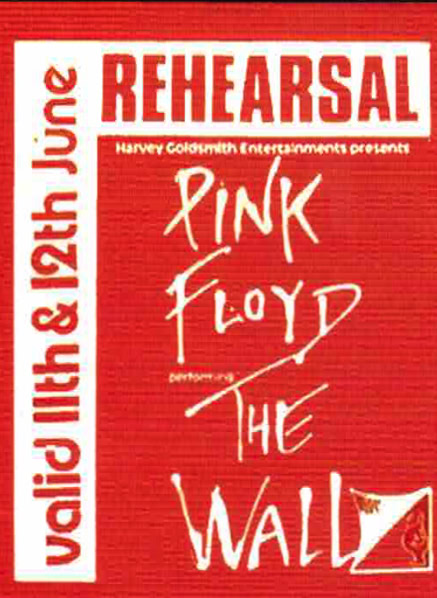
MISCELLANOUS | Rehearsals at Earl’s Court from 11 to 12 June. The rehearsals were filmed by Alan for the close-ups who would be used in the movie. The songs were the Happiest Days of our lives, Another Brick in the Wall (Part 2), Mother, Is there anybody out there ? among others
Pictures of the 11th June rehearsals
Alan Parker:
« Back in England, the concerts were put on at Earls Court in June and over five nights we set about with multiple camera crews ready to capture the necessary footage. The filming was a total disaster. Michael and Gerry didn’t gel as directors, or even realize what exactly they should be doing. As for myself, I was quite useless as an impotent director and even less useful as an impostor producer and began chain smoking for the first time in my life. From the start, the dilemma was that the needs of the film compromised the show. The concert, better organized and ticking along as it always did, could not be spoiled by the requirements of the film crews, most of them befuddled and rudderless – completely in the dark in more ways than one (the fast Panavision lenses needed had no resolution and so the resultant rushes looked like they had been shot through soup).
As I sat alone in the backstage area among the curious plastic chairs, picnic umbrellas and Astroturf it was clear that we couldn’t go on like this. Either we abandoned the film, or I had to come out of the producer’s closet and start directing proper. Roger and the band had also come to the same conclusions »
« The Making of the Wall - an essay », Alanparker.com
The second drummer Willie Wilson got ill on the eve of the first show and was replaced by a roadie on drums.
CONCERT DATE | 13 June 1981 Earls Court Exhibition Hall, Earls Court, London, England
Photographies by Mark FISHER
«The theme for this concert was the double album "The Wall". The concert was very much a feast for the ears and the eyes, with the combination of visual effects and music providing an excellent evening's entertainment, particularly in its technical expertise.
At the start, the stage was set with a partially built wall across the front. Once the introduction was complete there was a loud bang with several flashes and the band started with equal impact. The music of the first half consisted of the tracks from the first album of 'The Wall', except for a few additional sound sequences.
On stage there were two drummers, two guitarists, two bass guitarists, two keyboard players and four backing vocalists, including Roger Waters (bass guitar), Richard Wright (keyboards), Nick Mason (drums) and Dave Gilmour (lead guitar). Interesting visual effects were constantly being used and the lighting employed light banks above, behind and in front of the band. There were also two fully mobile hydraulic lighting platforms on stage which were lit underneath and had spotlights operated manually on top. As for visuals, the opening sequence included a rather large model aeroplane flying across the ceiling and crashing into the wall, and a large puppet representing the Schoolmaster went for a walk across the front of the stage! To complement the music at points in the first half some excellent animations were projected onto a large screen behind the band. During this half the wall on the stage was gradually added to, obscuring the band, until, just on the interval, the last brick was fitted precisely into the wall.
For the second half most of the action took place in front of the wall, where the band had since moved all their instruments. This half included some very good solo pieces, one of which takes place in a lounge scene set into the wall, with an armchair, coffee table and TV showing a war film, the sound track of which was heard over the PA. There was one heavy rock number that made use of a very large batten of lights controlled by a sound to light system. Once again, this was complemented with images from three movie projectors using the wall as a screen with pictures and animations including the well known sequences as seen on BBC TVs 'Top of the Pops'. The appearance of a huge pig from behind the wall was spectacular to say the least as it proceeded to dance about above the audience. In the finale, the wall was pushed down and the evening ended with the band walking on as strolling players with acoustic instruments including an accordion, guitars and an oboe. This last scene earned the band a standing ovation.
The concert was very impressive and it was well received by the huge audience. There was certainly never a dull moment and if your interest wandered you may easily have missed something»
«Pink Floyd - The Wall concert», Electronic & Music Maker, August 1981
CONCERT DATE | 14 June 1981 Earls Court Exhibition Hall, Earls Court, London, England Goodbye cruel World is filmed during this gig for the future movie (who included, at this time, some live sequences). The footage along their live sequences was not used but can be seen on future BBC’s documentary entitled « 7 Ages of Rock » broadcasted in 2007.
« Du 4 au 13 juin se déroulait dans la gigantesque enceinte d'Earls Court une exposition d'antiquités. Le 14, les badauds qui avaient par mégarde dépassé la date limite ne furent pas trop dépaysés par ce qu'ils découvrirent à la place : un show de Pink Floyd. Sauf qu'ils se trouvèrent singulièrement abasourdis par le Son & Lumière grandiloquent déployé tout au long du spectacle. Car il s'agissait d'un spectacle beaucoup plus que d'un concert, filmé les cinq soirs durant en vue d'un long-métrage, et qui vous a été minutieusement conté l'année dernière dans ces mêmes pages. Pas question .par conséquent de vous ressortir du descriptif à tour de bras, le mur pierre par pierre, les animations image par image, les actions plan par plan, etcétéra. C'est exactement le même topo qu'à Earls Court en août 80 ; fouillez donc votre collègue de « R & F », ou utilisez le bon de commande. On va causer du reste. C'est-à-dire de tout et de rien, selon l'optique. De rien parce qu'une fois enlevé le spectacle, gratté la formidable démonstration de technicité-au-service-des-fantasmes, on se demande ce qui subsiste. De tout parce qu'il faut évoquer la musique, même si elle est indissociable de son contexte théâtral, et aussi ce fait flagrant : chacun sait que le thème sous-jacent de « The Wall », à travers l'exposition caricaturale des relations de l'individu (Waters en l'occurrence : il y mêle son histoire personnelle) avec le reste de l'humanité, est l'incommunicabilité de l'artiste (Waters personnifiant, représentant le Floyd à lui seul, c'est patent) avec son public. Or, cette superproduction (volontairement ?) exhibitionniste et prétentieuse en est la plus parfaite illustration. Jamais on n'était allé aussi loin dans le cynisme — ou dans le désespoir. Ou dans le sens du bizness. Et il faut avoir atteint le degré de popularité du Floyd pour proposer ainsi à un public acquis depuis des millénaires un spectacle parfait qui le comble tout en lui criant sa vanité à la figure. Exemple idéal que celui des doublures : le groupe qui entame, au milieu des éclairs pétataradants, bénéficie d'une ovation monstrueuse ; il s'agit des illustrissimes Andy Bown, Andy Roberts, Willie Wilson et Peter Wood. Corny gag, isn't it ? « Not what you expected to see », ricane le pseudo-Waters... Le public ne bronche pas. Il ne bronchera jamais. Marche à fond dans tous les panneaux. On se prendrait à parier que les doublures pourraient assurer tout le concert sans déclencher d'émeute. Bien sûr, instrumentale-ment, ils font le poids : Peter Wood (claviers) est un session-man réputé, Andy Bown (basse) un Status Quo d'occasion.
Les dissemblances physiques sont gommées par la distance, et si l'on considère le statut de tâcherons utilitaires désormais attribué à Mason et Wright, seules la voix de Waters et la guitare de Gilmour sont vraiment à même de faire la différence. Les choses seront simplifiées la plupart du temps puisque les huit joueront ensemble, les faux calquant note pour note sur les vrais. Autre preuve d'inutile perfection. Comme la qualité sidérante du son, pas une mince performance dans ce genre d'arène géante. Mais tout ceci est affaire de technique et de gros sous.
La musique elle-même, j'ai eu tout loisir de l'apprécier. Non seulement une position excentrée, complètement à gauche en surplomb quasi latéral de la scène entachait ma perception visuelle de l'ensemble, mais en plus une armée d'individus aussi louches que zélés s'est évertuée pendant toute la première partie à obstruer ce maigre champ de vision au moyen de briques en carton empilées les unes sur les autres. Il paraît que c'était le but du jeu. J'eus le temps d'apercevoir à la longue-vue un Gilmour gras et (toujours) imberbe, deux accompagnateurs chevronnés, et un Waters en jeans, chaussures de sport neuves et t-shirt numéro Un (tant qu'à faire), coiffés de ces éternels écouteurs qu'ils portaient bien avant la mode du walkman et dont les méchantes langues pourraient vous expliquer l'utilité dans un grand ricanement sarcastique. En fait, la musique produite par les quatre ou huit Floyd ou même par Waters seul (les ballades acoustiques), celle que les millions d'heureux possesseurs de « The Wall » connaissent par cœur, est largement supportable. Disons que ce n'est peut-être pas ce qu'ils ont fait de pire (ils ont souvent essayé).
Le problème est qu’elle n'est certainement pas rehaussée par les dessins animés grotesques, les saynètes mettant aux prises de hideux pantins, les diapos gerbeuses et autres catastrophes aériennes qu’on nous bombarde à tire-larigot (et l'inverse n'a aucun intérêt : Pink Floyd comme bande sonore d'un carton sur la copulation racontée avec des fleurs... ?!?) ; encore moins par les inévitables solos d'orgue et de guitare : quoi de plus attristant qu'un sole de Gilmour au milieu d'un morceau ? Deux solos de Gilmour. Il l'a fait, ne me demandez pas si c'était avant ou après « Another Brick In The Wall », parce qu'ils le jouent trois fois. Enfin, tout se déroule dans le bon ordre et, insensibles aux voix off, aux balayages de projecteurs et au swing poussif des Rois Fainéants, les fourmis achèvent leur pan de mur blanc. « Adieu, monde cruel », chantonne Moody Waters par la dernière brèche, qui se clôt. On applaudit, c'est l'entracte.
La seconde partie est évidemment du même tabac, avec le Mur en plus, qui du coup devient protagoniste. Son avantage par rapport à la première est d'inclure les rares instants d'émotion de cette longue mascarade : la chanson de la chambre au Tropicana, qui fleure bon son « Berlin » (courtesy of Bob Ezrin, voir aussi le thème du « Trial ») et la très courte séquence Vera Lynn ; ainsi que le seul moment amusant, quand le speaker-croque-mort Gary Yudman (?!) vient déblatérer sur le ton jovial du magnéto à court de piles les mêmes recommandations prodiguées au début, avec le plus grand sérieux ; mais cette fois-ci trois fois plus longtemps : « Ne prenez pas de photos, tout appareil sera confisqué... restez assis à vos places, toute personne trouvée hors de son siège sera liquidée... à la fin du show, faites attention à votre voisin, tout le monde sera ainsi en sécurité... soyez prudents en rentrant chez vous, n'écrasez personne, ne vous faites pas écraser... etc, etc... » Fureur (programmée) de la foule et nouvelle apparition des gros Pink flanqués des doublures... Tout fonctionne à merveille, idem quand l'énorme cochon planant vient survoler la masse. « Vous aimez notre cochon ? » se moque Waters — « Ouaiaiais ! » hurlent les cochons de payants, armée de moutons traités comme des chiens. L'écroulement final du mur n'arrange rien : Pink Floyd est aujourd'hui dans une position unique et insensée par rapport à des gens qui adulent du groupe une image antithétique de la réalité, ou du moins de ce que Mr Roger Waters aurait voulu qu'elle soit. Voilà où on en est. Waters est fou, mégalo, parano. Riche et malheureux, il triomphe. La foule des admirateurs tranquilles, bafouée, est heureuse, elle en redemande. Tout va bien. Des milliers de lecteurs alléchés par l'enseigne « Pink Floyd » râlent sec, ils conspuent l'anathème. Cet imbroglio me donne la migraine. Juste comme un double-album de ce groupe qui n'existe plus que dans l'esprit de ses dévots, sur les pochettes de disque et les affiches de concert. Est-ce bien là l'essentiel ? Ce soir-là, le speaker caverneux beuglait, dans un sursaut d'ironie suprême : « After ail, this is a rock'n'roll concert »... Je préfère quant à moi ne pas me demander ce que cette entreprise de maçonnerie hollywoodienne a à voir avec le rock »
« Vibrations », Rock & Folk, August 1981
« (…) On Sunday, things went awry with not one but two of the hydraulic lifts meant to raise the Floyd, their doubles and their equipment from the depths of Earls Court to in front of their cardboard "wall" in the second half of the set, fixing a yawning chasm between Roger Waters and Dave Gilmour and their respective amps. It didn't worry Waters too much, because he's entirely cordless, monitoring his stage sound through radio headphones. But Gilmour found he couldn't reach his pedal-board and his vocal mike at one and the same time, and he couldn't hear what he was playing. Afterwards. Waters was philosophical about it all: "I quite like it when things so wrong," he told me. "It makes it less boring, puts more of an edge on things » ».
« Cracks in the Wall », Melody Maker, 20 June 1981.
CONCERT DATE | 16 June 1981 Earls Court Exhibition Hall, Earls Court, London, England
Ginger Gilmour:
«There were six concerts. I was rather big, so I didn’t go to all of them. Furthermore, the atmosphere amongst the band had reached an all-time high; to such a degree, we each had separate «Portakabins» (modular building) back stage. To compound the dividing wall of separation, Roger and Rick had theirs turned away from the center of the hospitality circle. Long gone were the days we shared dressing rooms together, greeting friends and family. The center of the hospitality area was carpeted, had tables with white garden umbrellas and flowers, as though we were backstage at Ascot without the woman wearing hats. Many people were congregating around one of the tables. I wandered over to see who was sitting there. It was Stevie Wonder. He came to the gig and was a magnet for everyone. Somehow, someone offered me a chair to sit down next to him. Maybe it was because I was rather pregnant and needed to sit down. Many were envious for we chatted for quite a while. Can you guess the subject? Babies. He put his hand on my tummy, bending closer and quietly sang, “Isn’t She Lovely” for a few bars. My tummy tingled. Did he know it was a girl ? We didn’t. Now every time I hear that song I remember the night Stevie Wonder blessed my baby»
«The bright side of the moon», Ginger Gilmour
CONCERT DATE | 17 June 1981 Earls Court Exhibition Hall, Earls Court, London, England
It will be the last live appearance of Roger with the other members until the comeback in 2005 for the charity event «Live 8»
Photographies by Peter STILL (left) and Syd YOUNG (right)
Gerald Scarfe:
«Phil Taylor reminds me that, on the last night of the show, to Roger’s surprise, the immobile dummy of Pink that lay on the forestall at the base of the wall, got up and walked off. As a last night prank, the tallest and thinnest of the roadies had just managed to squeeze into Pink’s costume, which was normally filled with polystyrene chips.»
«The making of Pink Floyd The Wall», Gerald Scarfe
Photographies by Peter STILL and Syd YOUNG
While the departure of Rick remains hidden, the future of the band is pretty uncertain.
Nick Mason:
«The next Floyd project will be called «Tora, Tora, Tora» and will staged in the Lake district in the summer with the complete destruction of Pearl Harbor set to the music ».
«Interview w/. Nick Mason », cited in The Amazing Pudding #44, 1981.
MISCELLANOUS | Late June 1981. Definitely out of the band, Rick fly to Lydos, Greece where he lives retired spending time to sailing.
During this summer, he will meet a Greek named Franka during a dinner with his friends. She will become his wife in 1984 (they will divorce in 1994)
Richard and Franka, circa 1981
Franka Wright:
«When we met, he had only one pair of jeans, his personal hygiene was questionable, and his house in Knightsbridge was shambolic»
«The dark side of Pink Floyd: Keyboardist Rick Wright's ex wife tells of the constant cheating with groupies, drugs and torrid rows which went on behind the scenes,» Mail on Sunday, 3 july 2016
Franka Wright:
«When I met Rick and David in 1981 in Lindos Rhodes, Pink Floyd was broken after «The Wall» I told Rick this is not possible. I talk to David. I tried everything to get this to egoistic great artist to say hello again. In the end David said to me «Oh Franka. Ok don’t push anymore, I’m going to talk to Rick to get together again»
Franka Wright’s Facebook page, March 2019
David Gilmour:
«(Rick) had given up contributing and honestly wasn’t very interested in what was going on. He just seemed to be sitting in there, picking up the money. It got too much for some of us to bear»
«The Final Cut - Pink Floyd members go their own way», The Tampa Tribune, 26 May 1984
TV SESSION | 6 July 1981, David Gilmour gives an interview for the US TV who remains unreleased for many years (see this pagefor more details).
MAIN EVENT | 9 July 1981. The screenplay of «Pink Floyd - The Wall» is definitely completed.
RADIO SESSION | 26 July 1981. Special «Rock Hour Special» on the BBC with Nick Mason and Mick Fleetwood
Interviewer: « L’impression générale est que Pink Floyd n'est plus réellement un groupe, qu'il y a Waters d'un côté et que les autres ne sont plus que des exécutants»
Nick Mason: «Eh bien, les gens se trompent. Bien que Roger Waters, je ne le nie pas, occupe une position dominante dans le groupe, Pink Floyd opère toujours en tant que collectif. Je crois que si Roger voulait faire des disques solo, il ne se gênerait pas, et ce ne serait pas des albums de Pink Floyd. Dans un groupe, même si un des membres apporte une contribution plus forte que les autres, il y a un son et une manière de travailler ensemble qui ressort. David est sans doute particulièrement sous-estimé, H fournit un gros travail dans le son Pink Floyd. Roger, et cela a été spécialement vrai pour « The Wall », apporte des idées très formées, mais David y rajoute de ces trucs qui font vraiment le groupe, et personnellement tout mon acquis apparaît également. Ce sont ces divers éléments qui créent un disque de Pink Floyd».
«Charlatans ?», Rock & Folk, July 1981
RECORDING SESSION | Early August, David Gilmour enters in the New Roydonia Studios at Roydon in England. He recording a new version of Money for the «A collection of great dance songs» album.
TV SESSION | 22 August 1981 David Gilmour take part of the « popquiz » TV show on BBC (see the page dedicated to the videos and films apparenace for more details).
MISCELLANOUS | Roger Waters participation to the Nordoff-Robbins Musical Theraphy Lunch in London.
MAIN EVENT | August 1981 during this month, Gerald Scarfe, Alan Parker and Alan Marshall are working on the film
Alan Parker:
«Once Shoot the Moon was finished, I returned to London to complete the editing. It had gone well and was a relatively uncomplicated film. This meant I could spend a little more time on The Wall. Roger and Gerry and I worked in Gerald’s studio in Chelsea and battered away at the script. One of the original intentions was to sprinkle Pink Floyd through the piece in a straight but theatrical situation, to act as narrators wherever our imagery had begun to flag. To this end, it was decided to put on five more concerts in England, where band and crew could be filmed. Steve O’Rourke and I went back to Los Angeles to show the new storyboard and draft screenplay to the major Hollywood studios to try to raise the money. ».
« How we made The Wall », Coventry Evening Telegraph, 14 August 1982
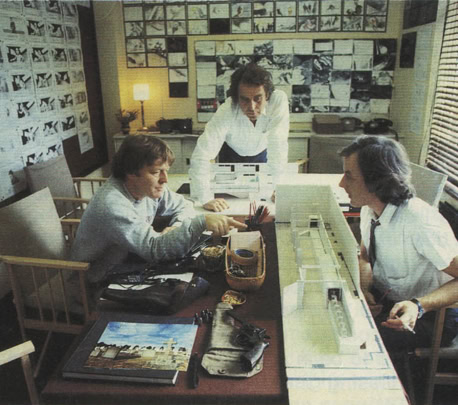
Director Gerald Scarfe, cartoonist Alan Parker and production designer Brian Morris at Pinewood Studios office. Photographies by David Appleby.
MAIN EVENT | Late July 1981 the production abandons the idea of giving the main role to Roger Waters
David Gilmour:
«He’s not an actor — he’s too self-conscious to be able to play the part properly.. That was only half the problem. “When he was going to play the part,!’ Gilmour said, “he wouldn’t write scenes that were difficult to act because he knew he couldn’t handle them.” Eventually Waters yielded to pressure from Parker and Gilmour, among others, not to portray Pink. He opened up and wrote stronger stuff in the script after that. If we had to find someone who was suitable for the part and liked our music as well, we might still be looking»
«Pink Floyd promotes ‘The Wall’», Valley News, 27 August 1982
MAIN EVENT | August 1981 Boomtown Rats-leader, Bob Geldof, is casted for the main role of the movie version of « The Wall »
Record Mirror, 19 September 1981.
Bob Geldof:
«I got a call from Alan Parker and I told him I wasn’t interested. But he kept at it and I was on tour that time and after finishing that, I went to Ibiza to record a new album which I wasn’t very happy with and I was tired and I did not want to go out on the road again. So Alan kept asking and said, ‘you should at least try it before brushing it off’ and I finally agreed and had to do a screen test and then went on to make the movie (which was so boring). I let my kids watch it and they said it was weird»
«Man of all seasons», November 2009, Star e-central Website
Bob Geldof:
« I have had all sorts of wigs and fittings and its all been really uncomfortable. This is my first film role (…) I think a lot of it sounds like the whole Syd Barrett thing, though they would probably deny it»
« Ad Lib », 18 September 1981, Evening Standard
MAIN EVENT | September 1981 Alan Parker begin the production. The shooting run from 7th September for the «House scene» and then move to Pinewood studios from the 9 September to 12 December 1981. On 7 September, the first scene shot was set in a retired admiral’s house (for Goodbye Blue Sky and When the Tigers broke Free songs).
Alan Parker:
«We began filming on September 7, 1981 at a retired admiral’s house in East Molesey. The recently deceased occupant hadn’t decorated for many years allowing us to swiftly turn back the clock to the 1950s. From the start I had asked everyone to be brave, and for the sequence of the teacher and his wife eating their gristle dinner the cinematographer, Peter Biziou, lit the interiors with an enormous ‘brute’ light at floor level. With the unusually harsh light, you could see the pores on their faces. And so a pattern was set for the rest of the filming »
«The Making of the Wall - an essay», Alanparker.com
Alan Parker:
« I remember the first and last time Roger came to the film set. I remember sitting in a tent thing and looking my hand and it was shaking »
David Gilmour:
« So I had to go to Roger and say to him 'Give him what it says in his contract... I'm sorry, man, but otherwise we'll have to have a meeting of the shareholders and directors - which is me, Nick and Roger - and we'll out-vote you.' There was nothing he could do and he's never forgiven me for that ».
«The Floyd’s Tour de Force …», The Guardian, 22 June 1988.
Alan Parker:
« In the end, Roger went on holiday for the whole time we were making the film which was a godsend »
« The making of Pink Floyd The Wall », Gerlad Scarfe
Roger Waters on the set, September 1981
MISCELLANOUS | The shooting for «Pink Floyd, The Wall» appears to be difficult from the beginning. The presence of the creator of « The Wall » create big tension with the director. The late threat to walk off by many times.
Alan Parker:
«To be honest I should never have made Pink Floyd The Wall – it was a bizarre accumulation of events that left me with the directorial responsibilities. It’s not that I’m ashamed or displeased with the result. On the contrary, I’m very proud of it. But the making of the film was too miserable an exercise for me to gain any pleasure from looking back at the process. The American director Joe Losey once said: «Beware of a cozy British film set, because often, in the creative process, ‘niceness’ can lead to disaster». The film of «The Wall» was not cozy and niceness was in short supply, but curiously we did some extremely good and original work. I first came to Pink Floyd’s album «The Wall» as a fan. I’d been a Floyd devotee since «A Saucerful Of Secrets» and over the years had played «Dark Side Of The Moon» so often it ended up scratched and unplayable in its vinyl manifestation. And as I listened to «The Wall» album it was clear that it had dramatic possibilities. The whole album had a narrative sense – although, in those days, what exactly the sense was, I can’t say that I, nor anyone else, really understood. I still had no intention of directing the film myself (…) But Roger was very persuasive and I spent the next two weeks returning each day, going through the script treatment that Roger had written»
«The Making of the Wall - an essay», Alanparker.com
Alan Parker:
«One of the most miserable experiences I’ve had working on a film, mostly because of Roger ... The problem wasn’t over creative differences, just a collision of egos. Waters was used to being in control of his world and I was used to being in control of mine»
Roger Waters:
« (It was) the most unnerving, neurotic period of my life (…) Parker is used to sitting at the top of his pyramid, and i’m used to sitting at the top of mine. We both pretty much used to getting our way »
« Behind Pink Floyd’s The Wall », Rolling Stone, 16 September 1982
Gerald Scarfe:
«The trouble is Roger and I had lived this together for about three years. So when it came to the film, Roger didn’t want to relinquish control. So, there was me and Roger on one side and Parker on the other - and that’s when the war started »
« Comfortably Numb - The inside story of Pink Floyd », Mark Blake
Bob Geldof:
«( The ambience) was a mine field which had been sown with exploding egos »
« Is that this ? », Bob Geldof, 1986
Photography by Nigel DICKSON
According to Gilmour, the trouble really started when the band commissioned Alan Parker to direct his successful feature film version of The Wall, and Parker allegedly threatened to walk off because of Waters' interference.
Gilmour:
«So I had to go to Roger and say to him 'Give him what it says in his contract... I'm sorry, man, but otherwise we'll have to have a meeting of the shareholders and directors - which is me, Nick and Roger - and we'll out-vote you.' There was nothing he could do and he's never forgiven me for that».
The Guardian, June 1988.
Gilmour:
« I had a lot to do with getting the music right for the film and trying to keep the peace between the warring factions at Pinewood Studios, with directors walking out and being begged to come back. That was my role, begging the director to come back »
« Over the Wall », MTV TV, 15 May 1988.
MISCELLANOUS | November 1981. The Chairman of Oriental division of EMI, Allan Boxer, announces «The Wall» was sold at 300,000 copies. A record for this country.
On the left: Display for music shop. On the right: the acetate of the album
RECORD RELEASE | 22 November 1981 Pink Floyd released the compilation album « A Collection Of Great Dance Songs » in the US. It reached No. 31 in the charts.
EMI decided to release a compilation album in order to capture the Christmas market following the huge success of « The Wall ». If the band is firstly reluctant to this project, the contractual obligation to release an album every two-year don’t offer the choice to reject it. Waters led the lead to the two others members since he works on the « Wall » movie project.
Hipgnosis come with the title « A Colleciton of Great Dance Songs » from a Nick Mason sentence during a brief with Columbia Records (A chairman said the Pink Floyd could be a « better output if they release any dancing material for their next album »). Hipgnosis worked on the idea of a tension between what Floyd's music is (slow, contemplative) and what the music market expects (some dancing tracks). Here come the image of two Argentinian tango’s dancers restrained by ropes.
Tests was made in London. The male dancer Peter Jessup was used for the photo session shot by Thorgerson, Cristopherson and Powell at Dungeness, on the South Coast.
Four English promos for the release of « A collection of great dance songs »
RECORD RELEASE | 23 November 1981 «A Collection Of Great Dance Songs» was released in the UK, and reached No. 37 in the charts.